Burn replaces the ONNX export step with one Rust codebase
Burn is a next generation tensor library and Deep Learning Framework that doesn't compromise on flexibility, efficiency and portability.
At a glance
- What is it?
- Burn is a Rust tensor library and deep learning framework that trains and serves from the same code, fusing tensor operations with a JIT compiler across CUDA, ROCm, Metal, Vulkan and WebGPU. Its most quotable claim, recompiling in under five seconds, arrives with no benchmark attached, and main has already moved to 0.23.0-pre.1 after the 0.22.0 and 0.22.1 releases.
- Who is it for?
- Burn fits a team that wants training and serving in one Rust codebase, especially for on-device or federated work where an ONNX export step is the wrong shape, and the CubeCL backends cover the accelerators most deployments target. Be careful if you need a stable API, because main has already moved to 0.23.0-pre.1 after the 0.22.0 and 0.22.1 releases, and the Flex CPU/no_std backend gives up kernel fusion and remote execution.
- Can I use it commercially?
- Yes. Apache-2.0 is a permissive licence: you can use, modify and sell software built on it, as long as you keep its copyright and licence notices.
- Is it still maintained?
- Yes. The repository last received commits 1 day ago.
- What is it written in?
- Mainly Rust, according to GitHub's language statistics.
Answers come from the project's GitHub data, last synced on November 13, 2026, and from our analysis. They are not legal advice.
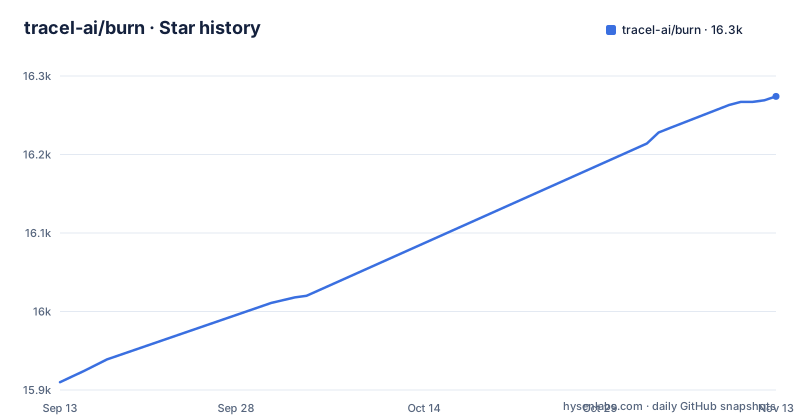
Star history
- tracel-ai/burn16,274 ★ · +364
| Repository | 2026-09-13 | 2026-11-13 |
|---|---|---|
| tracel-ai/burn | 15.9k | 16.3k |
364 Stars in the last 61 days, measured from the daily GitHub snapshot. Compare with other projects
Editorial analysis
One codebase instead of an ONNX export
The pitch starts from a failure anyone doing machine learning in two languages has hit. You train a model, then you need it to run somewhere else, so you export it to ONNX or hand it to vLLM, ONNX Runtime or TensorRT. That export step is described as often brittle and lossy, and the consequence is specific rather than general: complex architectures and advanced deployment use cases get ruled out, because they are exactly the ones that do not survive the crossing.
Burn's answer is to remove the crossing. Multi-platform tensor operations run through a single unified API, so the code that trains is the code that runs in production. The workloads named as beneficiaries are on-device personalization and federated learning, both cases where maintaining a second inference build is hard to justify, and the stated outcome is moving from prototype to deployment inside one codebase.
The price of that unification is committing to Rust for both halves. For a team already training in Python the question is not whether one codebase beats two. It is who maintains it, and whether the export you currently tolerate is cheaper than a Rust learning curve.
Dynamic graphs that a JIT compiler fuses
Two properties usually trade against each other in this space, and the argument here is that they need not. You keep the ergonomics of PyTorch, with dynamic shapes and dynamic graphs, and in exchange a JIT compiler processes streams of tensor operations and performs automatic kernel fusion. Nothing in the model code has to be rewritten into a static graph for the compiler to see it.
Fusion is where the substantive claim sits. A sequence of small operations on an accelerator pays launch and memory round-trip costs at every step, and fusing adjacent ones removes most of them. Getting that automatically, without writing a graph rewrite pass, is the part that changes the arithmetic of a forward pass.
What the README does not do is quantify any of it. It says you get dynamic graphs without the performance drop, and it points to `burn-bench` in the ecosystem table, described as a project to benchmark and compare backends and track performance over time. That is the place to measure rather than the place to read a number. The mechanism is documented. The result is somebody else's to produce.
The five-second claim arrives with no benchmark
The section aimed at researchers makes exactly one quantitative statement: designed around incremental compilation, modifying model code recompiles in under 5 seconds, even in release mode. The problem it attacks is stated first, that long Rust compilation times disrupted the edit-compile-run loop that draws researchers to Python.
Treat the figure as an assertion rather than a measurement, because the README states it in prose with no measurement beside it. No machine is named. No model size is named. No distinction is drawn between a warm dependency cache and a cold one. The sentence sits in prose rather than beside a table of results, and the ecosystems table points at burn-bench for measurement without printing anything from it.
This is the claim that decides whether Rust is workable for research at all, which makes its thinness more consequential than most missing numbers. If your models are large or your loop is measured in minutes, under five seconds may describe a case that resembles nothing you intend to run. The repository carries `benchmarks.toml` and a dedicated benchmarking project, so the measurement is available to make. Neither is a substitute for making it on your own code.
Fusion and remote execution stop at the backend boundary
Backend support is not a flat list, and the grouping matters more than the membership. The CubeCL backends, covering CUDA, ROCm, Metal, Vulkan, WebGPU and CPU, compose with autodiff, with fusion and with remote-execution decorators. The pure-Rust Flex CPU/`no_std` backend composes with autodiff only.
Read that as a capability gradient. Choosing the Flex CPU/`no_std` path for a constrained target buys you differentiation and nothing more: automatic kernel fusion and remote execution are not on it. That is a real reduction rather than a rounding error, and it lands hardest exactly where you can least afford it, on the smallest devices. The examples reflect that spread, carrying both `mnist-inference-web` and `remote-inference-web` beside more conventional training examples such as `mnist`, `simple-regression`, `wgan` and `modern-lstm`.
A Supported Backends section is pointed at for the full matrix, so anyone targeting a specific accelerator should confirm the combination there rather than infer it from the grouping described here.
burn-onnx and burn-store are the actual Python bridge
The Python ecosystem gets handled by two crates rather than by the core. `burn-onnx` imports ONNX models into Burn as native Rust code, so a model that already exists arrives as a Rust program instead of a serialized blob the framework has to interpret at runtime. `burn-store` saves, loads and imports weights, and its description names PyTorch and Safetensors in particular, which is the migration route in both directions: bring the numbers across, then rewrite the graph.
Around those sit the domain crates. `burn-vision` holds computer vision operators and building blocks, `burn-rl` holds reinforcement learning building blocks, and `burn-dataset` covers loading, transforms and ready-made sources. Curated pre-trained models and further examples live in a separate `models` repository.
What none of those descriptions quantify is fidelity. The README argues that exporting is lossy, then offers import tooling, so if one specific model has to come across, check how much of its graph burn-onnx supports before relying on it.
Every example is a workspace member except three
The Cargo workspace exposes the repository's testing strategy. Members are `crates/*`, `xtask`, every directory under `examples/`, and two test crates devoted to weight import:
members = [
    "crates/*",
    "crates/burn-store/pytorch-tests",
    "crates/burn-store/safetensors-tests",
    "examples/*",
    "xtask",
]

exclude = [
    "examples/notebook",
    "examples/dqn-agent",         # gym-rs
]
Two dedicated crates for PyTorch and Safetensors loading tell you that migration path is exercised rather than advertised. The exclusion list is equally informative. `examples/notebook` is held out, so the notebook example is not built by the workspace. `examples/dqn-agent` is held out with an inline comment naming gym-rs, meaning a reinforcement learning agent pinned to a crate the workspace will not take.
So the example tree is broader than the code that compiles on every commit, and knowing which two sit outside is the difference between reproducing a CI run and guessing at it.
A pre-release version and a stack you did not choose
Version is where a reader should slow down. The workspace declares `0.23.0-pre.1`, and the recent releases are v0.23.0-pre.1 on 2026-10-29, v0.22.1 on 2026-10-20 and v0.22.0 on 2026-10-06. The last push to main was 2026-11-02, so main is already on the next pre-release line. Pin the exact version and expect the API to shift within a minor release.
The licence is the easy part. Cargo.toml declares `MIT OR Apache-2.0`, and the repository root carries LICENSE-MIT, LICENSE-APACHE and NOTICES.md, so you pick either. The toolchain is edition 2024 on workspace resolver 3.
The adoption surface deserves more thought than the licence. Alongside the core sit CubeCL, burn-onnx, burn-vision, burn-rl, burn-dataset, burn-store, a models repository and burn-bench, all under one organisation. Then a community crate table naming polars, arrow-rs, image, hf-hub, tokenizers, rust-bert, ndarray and nalgebra, and those are explicitly not maintained by Tracel. You are joining a stack, and the parts you did not choose carry their own release cadences.
Editorial conclusion
Burn fits a team that wants training and serving in one Rust codebase, especially for on-device or federated work where an ONNX export step is the wrong shape, and the CubeCL backends cover the accelerators most deployments target. Be careful if you need a stable API, because main has already moved to 0.23.0-pre.1 after the 0.22.0 and 0.22.1 releases, and the Flex CPU/no_std backend gives up kernel fusion and remote execution. Before committing, measure the incremental recompile claim on your own hardware and your own model size, since the README states under five seconds without naming a machine, and check burn-onnx against the specific graph you need to import.
Frequently asked questions
What is Burn in Rust?
Burn is both a tensor library and a deep learning framework written in Rust, optimized for numerical computing, training and inference. It exists so the same code trains a model and runs it in production, rather than training in Python and exporting to ONNX or an inference engine such as vLLM, ONNX Runtime or TensorRT.
Which backends does Burn support?
The CubeCL backends cover CUDA, ROCm, Metal, Vulkan, WebGPU and CPU, and compose with autodiff, fusion and remote-execution decorators. The pure-Rust Flex CPU/no_std backend composes with autodiff only, so it loses automatic kernel fusion and remote execution.
What licence is Burn released under?
Cargo.toml declares the license as MIT OR Apache-2.0, and the repository root carries LICENSE-MIT, LICENSE-APACHE and NOTICES.md, so either can be chosen. The latest stable release is v0.22.1, and the workspace on main declares the pre-release version 0.23.0-pre.1.
How does Burn handle models that already exist in ONNX?
The burn-onnx project imports ONNX models into Burn as native Rust code, and burn-store saves, loads and imports weights including PyTorch and Safetensors.
What is CubeCL and do I need it?
CubeCL is the GPU compute language and compiler behind Burn's accelerated backends, letting you write kernels once in Rust and run them on CUDA, ROCm, Metal, Vulkan and WebGPU. It is usable on its own and is developed by the same organisation as Burn, while the pure-Rust Flex CPU/no_std backend takes autodiff only.
Official sources
Add this badge to your README
If you maintain this project, the badge below links readers to this analysis and shows its maintenance status from the daily GitHub snapshot. Paste the markdown into your README; add ?metric=license or ?metric=stars to the image URL for a different field.

[](https://hysenlabs.com/projects/tracel-ai-burn)Star history chart for your README
[](https://hysenlabs.com/projects/tracel-ai-burn)Was this useful?