Unkey's monorepo: three release tracks, a closed PR door, and a binary the README does not document
The Developer Platform for Modern APIs
At a glance
- What is it?
- Unkey bills itself as a developer platform for modern APIs and ships three separately versioned Go services from one module. The repository is worth reading for its build chain, its dependency footprint, and the limits of what it documents.
- Who is it for?
- Read Unkey when you are deciding whether to run your own API key and gateway layer in Go, since the build chain and pinned dependencies are all visible here. Do not expect the repository itself to tell you how to configure or operate the platform, because the README stops at a feature list and a docs link.
- Can I use it commercially?
- Check first. The repository uses a licence we do not classify automatically, so read its LICENSE file before any commercial use.
- Is it still maintained?
- Yes. The repository last received commits 7 days ago.
- What is it written in?
- Mainly Go, according to GitHub's language statistics.
Answers come from the project's GitHub data, last synced on November 8, 2026, and from our analysis. They are not legal advice.
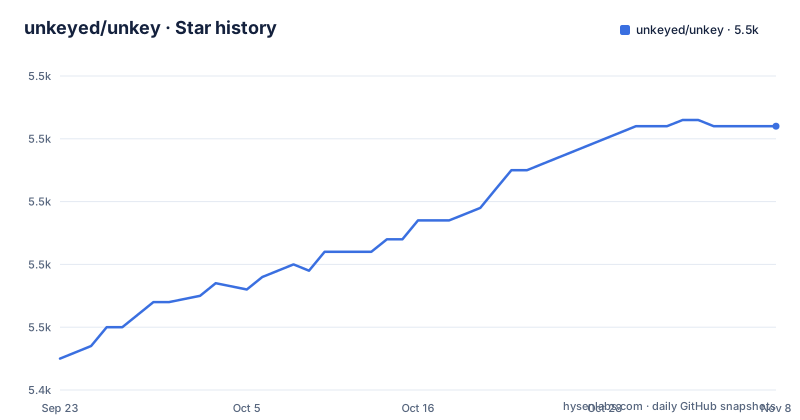
Star history
- unkeyed/unkey5,482 ★ · +37
| Repository | 2026-09-23 | 2026-11-08 |
|---|---|---|
| unkeyed/unkey | 5.4k | 5.5k |
37 Stars in the last 46 days, measured from the daily GitHub snapshot. Compare with other projects
Editorial analysis
Three versioned release tracks ship from one repository
Three tags in the release history name three different Go services: control-worker/v1.1.54, frontline/v1.0.34, and control-api/v1.1.33. Each carries its own version number, and all three were published on 2026-11-02. go.mod declares a single module, github.com/unkeyed/unkey, covering the whole tree, which means the tags cut separate slices out of one codebase rather than pointing at separate repositories. Directories split along service lines: svc/, internal/, pkg/, cmd/, and build/, with proto/ and gen/ holding protobuf definitions and generated output. Release and lint configuration sits at the top level next to the source, in .goreleaser.yaml, .goreleaser.service.yaml, .golangci.yaml, and the buf.yaml and buf.lock pair.
External pull requests are closed while issues stay open
The contribution policy is stated without hedging: Unkey is not accepting external pull requests at this time. The stated reason is that the team is focused on platform direction and stability, and that pull requests opened by people outside the team will not be reviewed or merged. Issues remain open for bug reports, feature requests, and documentation feedback, and the repository stays public and source-available, so you can read the code, fork it under the terms of the FSL-1.1-ALv2, and self-host. Any change to this policy is announced in the README itself. The practical effect is that the fork is the contribution path. A patch you need lands in your own copy of the code, and reaching upstream depends on a policy change you cannot trigger.
The container ships one static binary from a digest-pinned builder
Building runs on ubuntu:24.04 pinned by digest, with ca-certificates, curl, and git added and no compiler from the distribution. Go arrives through mise rather than apt, and the lock file decides which toolchain is used. Everything the image needs is compiled with CGO_ENABLED=0 and GOPATH=/go, so the build leaves a single executable at /out/unkey that the runtime stage copies in as /unkey. Nothing else survives into the final image, which is a distroless static base running as the nonroot user.
FROM gcr.io/distroless/static-debian13:nonroot@sha256:516757106de35205efb70b91ba03f6f1298424a0678c603255cf2852a7000087

COPY --from=builder /out/unkey /unkey
LABEL org.opencontainers.image.source=https://github.com/unkeyed/unkey
ENTRYPOINT ["/unkey"]
The build line that produces that binary is equally explicit about the toolchain, and it reads the mise lock rather than a version tag:
mise trust .mise/config.toml && mise install --locked --yes goThat means the image pins its Go release through .mise/config.toml and .mise/mise.lock, so a rebuild years from now resolves the same toolchain as today.
Code generation and linting are declared as Go tools
go.mod carries its own toolchain declarations instead of leaving the generator binaries to the shell. One block is commented Generating code and holds buf, oapi-codegen, the Restate protoc plugin, and sqlc. A second block is commented Linting and holds exhaustruct, go-reassign, ineffassign, errcheck, exhaustive, and the honnef.co unused checker. Because the versions live in the module file, a tool upgrade is an ordinary dependency bump, and a reproducible developer setup comes from the same lock that pins libraries. Three replace directives sit above them, and two carry comments naming the failure they work around: Yaml parsing errors for go-yit, and Sqlc engine errors for the tidb parser.
make install expects tilt, ctlptl, minikube, dprint, and ngrok
generate-sql rewrites the MySQL schema out of the Drizzle output
The unkey binary has no documented commands
The container sets ENTRYPOINT ["/unkey"] and stops there. The README documents no flag, subcommand, environment variable, port, or configuration file for that binary. Directories such as dev/, docs/, and tools/ exist, but the README does not describe them. So the build path is reproducible from the Dockerfile, but the runtime contract for the entrypoint is not something the README explains. The seven capabilities the README advertises, deploy, gateway, API keys, ratelimiting, permissions and RBAC, analytics, and audit logs, are named without any request shape, key format, or endpoint path attached to them.
Licensing is a file pointer, and the scope of security work lives in another file
Two governance questions are answered by reference rather than by text. On licensing, the README says only to find the license under the LICENSE file, and the repository license field reads NOASSERTION rather than a named grant, so the actual terms are whatever that file says. The pull request section names FSL-1.1-ALv2 as the basis for forking, which is the only license identifier stated in prose. On security, the README points to SECURITY.md for what is in scope, without summarizing it. The repository also carries AGENTS.md, CLAUDE.md, and the .agents/, .amp/, and .claude/ directories, which tells you the project expects agent tooling in the loop, and a user interview link at unkey.cal.com under Let's Talk, alongside the Discord link at the top of the README.
Editorial conclusion
Read Unkey when you are deciding whether to run your own API key and gateway layer in Go, since the build chain and pinned dependencies are all visible here. Do not expect the repository itself to tell you how to configure or operate the platform, because the README stops at a feature list and a docs link. Before committing, confirm the CLI surface and the pricing against the hosted docs, and decide whether a fork you maintain yourself fits your plan given that outside pull requests are not reviewed.
Frequently asked questions
What does "unkey" mean in the Unkey project?
The README never explains the word itself. It only presents the name Unkey with the tagline The Developer Platform for Modern APIs and describes what the platform does, not what the name means.
Who is Unkey built for?
The stated audience is teams shipping modern APIs. The README covers deploy, gateway routing, issuing and revoking API keys, ratelimiting, permissions and RBAC, usage and latency analytics, and audit logs across a workspace.
How much does Unkey cost?
No pricing appears in the README, and no plan names, tiers, or rate limits are listed there. The only cost relevant detail in this file is that the code can be forked under the terms of the FSL-1.1-ALv2 and self-hosted.
What is an alternative to Unkey?
The README names no alternative and no competing project. It links to unkey.com, documentation at unkey.com/docs, and a Discord, and offers self-hosting from the source as the only other path it describes.
Official sources
Add this badge to your README
If you maintain this project, the badge below links readers to this analysis and shows its maintenance status from the daily GitHub snapshot. Paste the markdown into your README; add ?metric=license or ?metric=stars to the image URL for a different field.

[](https://hysenlabs.com/projects/unkeyed-unkey)Star history chart for your README
[](https://hysenlabs.com/projects/unkeyed-unkey)Was this useful?