New-Grad-2027: a job list maintained as a Markdown table
2025 & 2026 New grad full-time roles in SWE, Quant, and PM.
At a glance
- What is it?
- No code, no releases, no build. Just a README table of entry-level roles, an issue form instead of a pull request, and one person deciding what makes the cut.
- Who is it for?
- What New-Grad-2027 demonstrates is that a GitHub repository can be infrastructure without containing a line of code. The entire product is one Markdown table, kept current by an issue form, reviewed by one person, and read by people in the weeks when a job board has already forgotten them.
- Can I use it commercially?
- Yes. MIT is a permissive licence: you can use, modify and sell software built on it, as long as you keep its copyright and licence notices.
- Is it still maintained?
- Yes. The repository last received commits 1 day ago.
- What is it written in?
- GitHub does not report a main language for this repository.
Answers come from the project's GitHub data, last synced on October 22, 2026, and from our analysis. They are not legal advice.
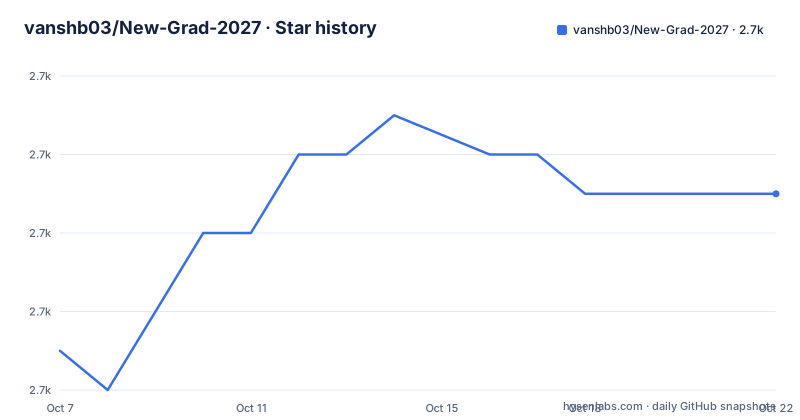
Star history
- vanshb03/New-Grad-20272,689 ★ · +4
| Repository | 2026-10-07 | 2026-10-22 |
|---|---|---|
| vanshb03/New-Grad-2027 | 2.7k | 2.7k |
4 Stars in the last 15 days, measured from the daily GitHub snapshot. Compare with other projects
Editorial analysis
Seven files, none of them code
Start with what the repository is not, because it sets up everything else. There is no source code, no build system, no tests, no package manifest, and no language declared in the repository settings. There are no tagged releases, which for a project of this size is the correct choice rather than an omission. What is there is a tree of seven entries: a `.github` directory, a `.gitignore`, a contribution guide, a licence, a second Markdown file for Canada, a folder for archived material, and the README itself.
That is worth stating plainly because the request the repository answers is not a technical one. Someone graduating in 2027 needs to know which companies are hiring entry-level engineers right now, which of those roles require work authorization, and which links are still open. Job boards are poor at that. They mix internships with full time, they rank by a paywall or an ad budget, and they fill with roles that closed weeks ago. A hand-curated table in a public file has none of those problems and one big drawback: it does not scale, and it does not update itself.
So the interesting engineering question is not what this repository does but how it stays current without any software in it. The answer is a workflow, and it is mostly visible in the README's own instructions. Contributions arrive as issues, not pull requests. There is a contribution guide to say what makes a submission valid, and the README asks for exactly that, pointing readers at the issue form rather than at a fork-and-branch flow. Whatever checks a reviewer needs to make happen on GitHub's issue UI instead of in a diff.
The `archived` folder and the separate Canada file are the two structural decisions that tell you this repository expects to outlive a single hiring cycle. Roles get archived when they close, the Canada list gets split out when it grows, and neither requires a line of code.
The name says 2027 and the links say something else
The repository is called New-Grad-2027, and it carries 2,676 stars and 68 forks. The header inside the README says New Grad Positions by V, and the sentence under it covers new graduates for 2026 and 2027. The GitHub description is older still, promising 2025 and 2026 roles in software engineering, quant, and product management. So three parts of the project describe three overlapping windows rather than one.
More interesting than the drift is the link lineage. Every contribution and issue URL in the README points at a different account than the repository's current owner. The issue form link and the Canadian list both resolve under a `cvrve` owner, and the README states it was inspired by the Pitt CSC and Simplify job list repositories. The tracked homepage is a personal domain rather than a project page. Read together, these point to a fork or continuation: a person took an existing community list, renamed it for a new graduating class, and is running it under their own account while the README still carries the previous owner's URLs.
That is not a criticism so much as an explanation of the maintenance risk. A fork inherits a community and a workflow but not an institutional commitment, and the README's stale links are exactly what that looks like in practice. It also explains the MIT licence, which is what you would expect when a community resource changes hands: permissive enough that the next person can pick it up and do the same thing.
There is one more small signal in the repository settings. The default branch is `dev`, not `main`. For a repository whose changes are a few table rows, that is a small thing, but it is a signal that this is a personal working setup rather than a template anyone is meant to fork cleanly.
What the table actually encodes
The list is a five-column Markdown table, and the column choices carry most of the design work. Company, Role, Location, an application link, and a date posted. What is absent is as informative as what is present. There is no salary column, no column for whether a role is hybrid or onsite, no column for the interview process, and no column for whether the role has already been reposted. For a new grad with no reference point, salary is the field you most want and the one hardest to keep accurate without a maintainer checking every application page by hand.
The link column is where the pragmatism shows. Instead of linking the company name, every row points at an application URL that carries a tracking parameter identifying the maintainer, and the visible label is a single shared image used for all rows rather than a company logo. That is a deliberate trade. Logos would look better and cost one image fetch per company to maintain; a uniform button costs nothing and keeps the rendered table light. The attribution parameter on the outbound links is the mechanism by which the maintainer can tell which companies are worth listing more of.
The last column is a bare month and day, with no year. Rows show dates like Aug 05 and Jul 31. The table is unambiguous when you arrive during the cycle it was written for and genuinely ambiguous a year later, which is a real limitation of the format and probably a deliberate response to the fact that this file gets rewritten each recruiting season rather than appended to.
The rows themselves show the shape of the market better than any summary would. Title conventions are a free taxonomy: some companies name the level in the title, as in Software Engineer I or Software Engineer 1, others put the graduating year in, as in New Grad 2027, and others use Associate. A handful of rows include a flag emoji in the role title itself to mark that the employer does not sponsor work authorization. The employers range from large technology companies through defence contractors and quant trading firms to universities hiring research computing staff, and the concentration of postings on a single date suggests these get added in batches as they are found rather than one at a time.
Three flags, one Discord, and a form instead of a pull request
The README defines three markers before the table begins. A barrier symbol means the role does not offer sponsorship. A flag symbol means the role requires United States citizenship. A padlock means the application is closed. That is the entire status vocabulary, and it is worth noticing what it covers and what it does not. It tells you whether you are legally eligible and whether the door is still open. It does not tell you the role is remote, does not tell you the working location's cost of living, and does not tell you how many openings there are.
For an international applicant those three markers are the entire value of the table. The United States is explicit that sponsorship is limited and that many entry-level roles are citizenship-gated, so a candidate who is not a citizen is not wasting an evening on applications that cannot work. Marking that inline rather than in a separate guide is the right call, because the filtering happens at the point of scanning the list.
The Discord link is the mechanism that makes the table feel alive. The README frames it as notifications when new roles open, and positions it as a way to connect with other candidates. That is the real distinction between this repository and a static list: the table is the archive and the Discord is the notification layer. A student who checks the repository weekly sees yesterday's postings. A student who joins the Discord sees them the day they are added.
The contribution flow completes the loop, and it is the piece that is unusual. New entries arrive by opening an issue with a template, the maintainer reviews them, and a row appears in the README. There is an invitation in the README to contribute through the issue form rather than a pull request, and the repository includes a contribution guide that presumably says what a good submission contains. For a repository whose content is data rather than code, routing changes through issues is defensible: it keeps the volume of half-finished forks down, and it gives the maintainer a single queue to work through instead of a stream of diffs.
What 2,676 stars are measuring
It is tempting to read the star count as a measure of the list's usefulness, and it probably is one, but it is worth being precise about what a star means here. Nobody is starring this to bookmark the file, because the file changes constantly and a bookmark of a changing URL is worth little. The stars are a signal that this is the list to check, which for a repository that is entirely a curation of other people's job postings is close to the most meaningful metric available.
The numbers around it are consistent with that reading. Sixty-eight forks is high for a repository with no code, and it says something specific: people are not forking it to contribute, they are forking it to run their own version. That is the natural response to a list scoped to one geography and one graduating class, and it explains the design choice to keep Canada in a separate file. Once the geographic boundary is drawn, the obvious exit is for somebody who needs a different boundary to make their own.
Activity is steady rather than automated. The repository was last pushed on 2026-08-21 and carries an MIT licence with four open issues, which for a project whose entire output is a table maintained by one person reads as healthy and expected. There is no release history because there is nothing to release. There is no declared programming language because there is nothing to declare.
The one thing a reader should not do is treat it as complete. A list maintained by one person, scoped to three geography categories, with entries added when somebody notices them, will be incomplete in a way that no amount of stars changes. The practical use is scanning it every few days alongside one or two similar lists, which is exactly the loop the Discord was built to make bearable.
Editorial conclusion
What New-Grad-2027 demonstrates is that a GitHub repository can be infrastructure without containing a line of code. The entire product is one Markdown table, kept current by an issue form, reviewed by one person, and read by people in the weeks when a job board has already forgotten them. The trade-offs follow from that shape. There is no API and no notification feed, so the Discord is the actual product surface and the repository is the archive. The geography is narrow by design, limited to the United States, Canada and remote roles. And because the whole thing rests on one maintainer with a personal domain attached, it is worth pairing with one or two other lists rather than treating it as complete. Two thousand six hundred seventy-six stars say a lot of people already made that decision.
Frequently asked questions
What does the New-Grad-2027 repository track?
It tracks entry-level software, tech, computer science, product management and quant roles aimed at 2026 and 2027 graduates. The list is scoped to the United States, Canada and remote positions, with Canadian roles kept in a separate file. Each entry records company, role title, location, a direct application link and a posting date.
How do I add a job posting to this list?
Open an issue using the repository's issue form rather than sending a pull request. The README directs contributors to that form and to the contribution guide. Because the content is data rather than code, changes are reviewed as submissions in a single queue, which is why no fork is needed to contribute one row.
What do the symbols next to the job listings mean?
Three markers are defined before the table: a barrier symbol means the employer does not offer work authorization sponsorship, a flag symbol means the role requires United States citizenship, and a padlock means the application is closed. They exist so an ineligible candidate can rule out rows while scanning.
Does this repository have any software in it?
No. There is no source code, no build system and no tagged release. The tree contains a README, a contribution guide, a separate Canada file, an archived folder and a .github directory. The whole value is curation and freshness of the table, plus the Discord that notifies people when rows are added.
Official sources
Add this badge to your README
If you maintain this project, the badge below links readers to this analysis and shows its maintenance status from the daily GitHub snapshot. Paste the markdown into your README; add ?metric=license or ?metric=stars to the image URL for a different field.

[](https://hysenlabs.com/projects/vanshb03-new-grad-2027)Star history chart for your README
[](https://hysenlabs.com/projects/vanshb03-new-grad-2027)Was this useful?