TripoSplat ships two library files, four weight-download paths, and no requirements file
TripoSplat converts a single 2D image into high-quality and variable number of 3D Gaussians, developed by TripoAI.
At a glance
- What is it?
- The inference half of TripoSplat is small enough to read in an afternoon, and the surrounding project is full of small choices that cost you an afternoon each: weights under a different organization name than the repository, torch left out of the install list, and no version marker anywhere in the tree.
- Who is it for?
- TripoSplat is worth reading if you want to know how a single-image to Gaussian-splat pipeline is put together, because the whole inference path is about 2,000 lines across two files and the dependencies are plain enough to swap. Three things to settle first.
- Can I use it commercially?
- Yes. MIT is a permissive licence: you can use, modify and sell software built on it, as long as you keep its copyright and licence notices.
- Is it still maintained?
- Yes. The repository last received commits 104 days ago.
- What is it written in?
- Mainly Python, according to GitHub's language statistics.
Answers come from the project's GitHub data, last synced on November 24, 2026, and from our analysis. They are not legal advice.
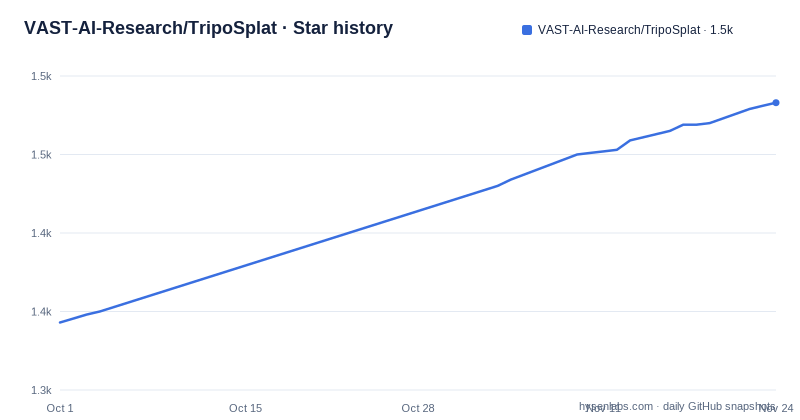
Star history
- VAST-AI-Research/TripoSplat1,483 ★ · +140
| Repository | 2026-10-01 | 2026-11-24 |
|---|---|---|
| VAST-AI-Research/TripoSplat | 1.3k | 1.5k |
140 Stars in the last 54 days, measured from the daily GitHub snapshot. Compare with other projects
Editorial analysis
Two library files, four Python files, and one number that only counts two
The size claim is specific: two files named `triposplat.py` and `model.py`, about 2,000 lines between them, described as easy to customize and integrate elsewhere. Read the tree and you will find four Python files. `run_example.py` and `run_gradio.py` sit at the top level next to the two library files, alongside a `static/` directory that the demo serves from.
So the two-file figure counts the importable library and leaves the two entry points out. That is a reasonable way to describe what you would vendor into your own pipeline, and it is worth knowing which half the number covers before you plan around it. The part you would import is genuinely small. The part that turns weights into a file on disk is two more scripts.
There is no `requirements.txt` in the tree and no `setup.py`, `pyproject.toml` or environment file. The dependency set is a single sentence of prose in the quickstart, which means nothing records it for you.
The weights sit under a different organization name than the repository
The repository lives under `VAST-AI-Research` on GitHub. Two of the four documented download paths point somewhere else entirely, at `VAST-AI` on Hugging Face. Two more point at `VAST-AI-Research` on ModelScope. The organizations do not match, and neither string is wrong on its own platform, so the two halves of the project are split across two different names.
hf download VAST-AI/TripoSplat --local-dir ckpts/The Python variants carry the same split in their arguments:
python -c "from huggingface_hub import snapshot_download; snapshot_download(repo_id='VAST-AI/TripoSplat', local_dir='ckpts/')"and the ModelScope pair names the other one:
modelscope download VAST-AI-Research/TripoSplat --local_dir ckpts/The quickstart block offering all four is cut off partway through the fourth command, so the last option is incomplete in the place you would copy from. The first three work as written. If you are scripting the download, use the first one and skip reading the rest of the list.
Torch is the dependency you install yourself, and the comment says so
The environment setup is four packages and a script invocation:
pip install numpy safetensors pillow tqdm
python run_example.py
Above that line sits a comment reading `# install torch and torchvision according to your environment`. So the two libraries the project actually depends on most are handled by a comment, and the four that get a command are the four that never conflict. `safetensors` implies the weights load through a format with a speed and safety story, and `tqdm` implies the run is long enough to want a progress bar.
Nothing pins any of the four. There is no lock file and no version list, so what you install is whatever the index serves at the time. For a project whose pitch is near-zero dependencies, that is the trade being made: fewer packages to resolve, more of the resolution left to you.
The Gradio demo takes the same shape:
pip install gradio
python run_gradio.py
which adds one package and one script, and inherits the same missing torch step.
No GitHub releases, so the weight directory is the only version marker
The repository has no GitHub releases. Version tracking therefore happens wherever the weights are, which means your `ckpts/` directory is the artifact that pins your run, not a tag you can check out.
There is no `ckpts/` directory in the tree either, which is the expected arrangement for weights and also the reason a fresh clone cannot run anything until the download step happens. The `.gitignore` is the only file that hints at the arrangement.
Three other places point outward rather than inward. A ComfyUI workflow template lives in the Comfy-Org repository rather than here. A Hugging Face Space exists under the same `VAST-AI` organization that hosts the weights. And a training repository sits under a different GitHub account entirely, at `runjie-yan/TripoSplat-Training`, which is where the training half of this work lives. This repository is inference only, and that sentence is the first one in the description.
The paper is on arXiv as 2605.16355, which the identifier scheme dates to May 2026.
Up to 262,144 Gaussians is a frame budget, not a quality dial
The second highlight names arbitrary Gaussian count up to 262,144, and frames it as a trade of visual quality against rendering cost according to your need. That framing is the useful part, because a count ceiling is not a setting you raise for a better result. Each Gaussian carries position, scale, rotation and color, and a viewer has to sort and draw all of them every frame.
262,144 is the top of the range rather than a default. The description calls the output a variable number of 3D Gaussians, which suggests the count comes out of the model for a given input rather than being a parameter you set. What the number buys you is headroom: a dense result on a subject where the geometry is genuinely complicated.
Two output extensions are named, `.ply` and `.splat`. The docs point at SparkJS and SuperSplat as viewers, both browser-based, which is the constraint that makes the count ceiling matter. A browser viewer holds a fixed frame budget on whatever hardware the visitor has, and 262,144 primitives is a lot to sort sixty times a second.
The two are described as interchangeable for visualization, so pick whichever your target tool reads.
The license covers the weights, which is rarer than it sounds
The license line is short and names two things: TripoSplat code and weight models are both released under the MIT License, with a link to the LICENSE file in the repository root.
Naming the weights explicitly is worth pausing on. Most inference-only repositories license the code and leave model weights to whatever separate terms the model host publishes, often with usage conditions attached. This one puts both under the same permissive terms, and the LICENSE file in the tree is a single file rather than a directory of per-component terms.
That is a cleaner position for anyone shipping a derivative, and it removes the question of which terms govern the several gigabytes you download into `ckpts/`. It does not remove the questions that come with the training repository, which is a separate project with its own terms and its own authors.
The citation block names six authors and gives the arXiv identifier twice, in the eprint and the URL fields. There is no conference or venue field, which is consistent with a paper that has a preprint number and no publication record yet.
What the project claims about coverage, and what it does not test
The first highlight says high-quality, versatile generation that handles a wide range of image styles. That is a claim about input variety rather than a measurable one, and the repository carries no benchmark table, no reference images and no evaluation script to back it.
The tree holds no test directory. Nothing in it compares output against a ground truth, and there is no way to tell from the repository whether a style that renders poorly is out of distribution or just needs a different Gaussian count.
The last push on the default branch is 2026-08-13, which is recent enough that maintenance is not in question, but there is no changelog file and no release history to check it against. The eight top-level entries are `.gitignore`, `LICENSE`, `README.md`, `model.py`, `run_example.py`, `run_gradio.py`, `static/` and `triposplat.py`. No configuration file, no model card inside the repository, no container definition and no platform notes beyond the claim that it runs anywhere.
Editorial conclusion
TripoSplat is worth reading if you want to know how a single-image to Gaussian-splat pipeline is put together, because the whole inference path is about 2,000 lines across two files and the dependencies are plain enough to swap. Three things to settle first. Fetch the weights from the Hugging Face organization the commands actually name, not the one that matches the repository URL, because they are different strings and the wrong one has no weights. Install a matching torch and torchvision yourself, since the install list omits both and the example imports will fail without them. And treat the Gaussian count as a memory and frame-time budget rather than a quality dial, because the useful number for your scene is whatever your viewer can hold at the frame rate you need. If you need to train rather than only run inference, this repository is the wrong one and the training repository is where that code lives.
Frequently asked questions
What is TripoSplat?
An inference-only pipeline that turns a single 2D image into a variable number of 3D Gaussians, developed by TripoAI and hosted by VAST AI Research. The importable part is two files totalling roughly 2,000 lines, and the training code lives in a separate repository.
Where do I download the TripoSplat model weights?
From Hugging Face, into a `ckpts/` directory. The commands name the `VAST-AI` organization on Hugging Face and the `VAST-AI-Research` organization on ModelScope, which is not the same string as the GitHub repository.
Does TripoSplat let you choose how many Gaussians it outputs?
It produces a variable number of them, up to 262,144, and the documentation frames that as a trade of visual quality against rendering cost rather than as a quality setting.
What does it take to run the TripoSplat example?
`pip install numpy safetensors pillow tqdm`, plus a torch and torchvision install you do yourself, and the weight files in `ckpts/`. The README does not document how to verify a download or how to pin a version of the weights.
Is there a ComfyUI workflow for TripoSplat?
Yes. An official template is published in the Comfy-Org workflow_templates repository under `templates/3d_triposplat_image_to_gaussian_splat.json`, not inside this repository.
Official sources
Add this badge to your README
If you maintain this project, the badge below links readers to this analysis and shows its maintenance status from the daily GitHub snapshot. Paste the markdown into your README; add ?metric=license or ?metric=stars to the image URL for a different field.

[](https://hysenlabs.com/projects/vast-ai-research-triposplat)Star history chart for your README
[](https://hysenlabs.com/projects/vast-ai-research-triposplat)Was this useful?