Visa's vulnerability harness runs twelve stages and ships nine, and its beta verifier is localhost only
Visa Vulnerability Agentic Harness
At a glance
- What is it?
- An Apache-2.0 harness from Visa for autonomous vulnerability discovery, remediation and validation with language models. The pipeline is explicit about its own limits: the default profile stops before remediation, exploit verification is beta and off by default, and no authorization check is documented.
- Who is it for?
- Run it only against code you own or have explicit permission to test, and treat every finding as an LLM generated triage candidate that needs human review, which is how the project frames its own output. With that stated, the scope picture is mixed and worth reading before a first run.
- Can I use it commercially?
- Check first. The repository uses a licence we do not classify automatically, so read its LICENSE file before any commercial use.
- Is it still maintained?
- Yes. The repository last received commits 2 days ago.
- What is it written in?
- Mainly Python, according to GitHub's language statistics.
Answers come from the project's GitHub data, last synced on November 22, 2026, and from our analysis. They are not legal advice.
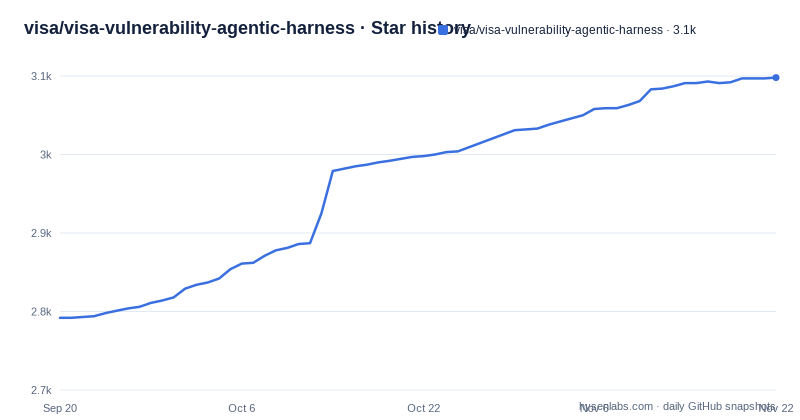
Star history
- visa/visa-vulnerability-agentic-harness3,098 ★ · +306
| Repository | 2026-09-20 | 2026-11-22 |
|---|---|---|
| visa/visa-vulnerability-agentic-harness | 2.8k | 3.1k |
306 Stars in the last 63 days, measured from the daily GitHub snapshot. Compare with other projects
Editorial analysis
Twelve stages, and the shipped profile runs the first nine
The pipeline is numbered S0 through S11 and grouped into four phases, and the number that ships by default is smaller than the number that exists.
An S0 static seed is followed by detection and reporting across S1 to S9, with remediation and validation across S10 and S11 as an optional fourth phase. Phase 1 is discovery and modeling at S1 to S3, mapping the attack surface and building a threat aware plan. Phase 2 is deep dive and verification at S4 to S6. Phase 3 is synthesis and reporting at S7 to S9, deduplicating, chaining and emitting structured findings in Markdown and SARIF. Phase 4 is remediation and validation at S10 and S11, proposing candidate fixes and adversarially validating them before adoption, and it is disabled in the shipped default profile, which stops after phase 3.
Three profiles ship. `default.yaml` and `full.yaml` derive the S0 seed from the model, while `taint.yaml` uses rules mode, which needs operator supplied source and sink YAML, so the taint path cannot start without a human deciding what the sources and sinks are.
The stated primary effectiveness metric is Mean Time to Adapt, the elapsed time from AI discovered exploitability to a validated fix in production, on the argument that the bottleneck in AI assisted vulnerability management is triage speed rather than discovery. One related caveat is stated plainly: unrecognised files can be added to catch all review chunks instead of being silently excluded, but the backstop is best effort, not a guarantee.
Exploit verification is beta, API only, localhost only and off by default
The 1.4 release added the ability to prove a finding is exploitable by sending real HTTP traffic at it, and it lists four constraints before describing anything else.
It is beta. It is API only. It is localhost only. And it is off unless `EV_API_COLLECTION` is set. Those four words together mean the feature cannot be pointed at a remote target as shipped, and that turning it on is a deliberate act rather than a default.
The design constraint that matters for trusting output is stated as well: it is additive and positive only, it never drops a finding, and the static verifier keeps the verdict. So the live traffic stage can add evidence to a candidate and cannot remove one, which means a false negative cannot be introduced by this stage even where it runs.
There is also a cost control. `--stop-after ev` validates a collection and a target with no model spend, which is the cheapest way to find out whether a collection is well formed and a target reachable before any of the language model stages start.
Two commands close the loop. `vvaharness ev-replay` re-runs a confirmed attack against a target after you have patched and redeployed, and reports whether it still lands, which turns the finding into a regression test derived from the attack itself. Nothing in what is published describes replay's own target restrictions, so treat that as something to confirm against the documentation rather than assume it inherits the localhost limit.
Exploit verification credentials come from the environment and nowhere else
The credential story for the verification stage is the most carefully bounded part of the design.
Its own auth credentials are read only from `EV_AUTH_*` environment variables, never from a profile and never from a command line flag. A collection may name the auth scheme, but never a value. So the sensitive half cannot be captured in a checked in YAML profile or leaked into a shell history or a process listing.
Then the same passage lists what can still reach the target on the wire, and it is a list of three. A token saved inside the collection's own requests. The client key passphrase `EV_TARGET_CLIENT_KEY_PASSPHRASE`. And any hardcoded credential the attacker agent finds in the repository and replays.
That third item is the one to sit with. The harness includes an agent whose job is to find weaknesses in code, and a hardcoded credential is one of them, so a scan of your own repository can discover a secret in it and then use it against your own target. That is the intended behaviour rather than a flaw, but it means the blast radius of running a scan is not limited to the target's listening ports: it includes whatever the code in the repository is able to authenticate with, and it means a credential committed by accident gets exercised rather than merely reported.
The credential sections in the example environment file are three, and the first key in each is left blank as a fill in slot, with a blank key treated as unset.
An uncommented line with a trailing comment becomes the value
The example environment file carries a parsing warning that is more specific than most configuration documentation manages, and it is the first thing to read before you fill anything in.
The first key in each of the three credential sections is left blank as a fill in slot, and a blank key is treated as unset. Every other optional variable is commented out rather than left blank, and the file says it must stay that way, for a specific reason: a trailing `#` comment is stripped only from a line that has a value, so this hands the parser the comment text as the value.
KEY= # noteIn other words, uncommenting an optional line and leaving the explanatory comment at the end does not disable the comment, it turns the comment into the credential. The failure is silent and it lands in the one place you would rather not have a stray string, which is an authentication header.
Three further details about where configuration comes from. It is auto-loaded from exactly the working directory or the home directory, so no `source` command is needed, and shell exported variables win over the file. A `.env` inside the scan target is ignored by default, which is a deliberate safety default given that the target is code you may not control. And the example file itself is not installed by `pip` or `pipx`, so a fresh install has no template and you have to fetch it from the source repository, with a separate `.env.exploit.example` alongside it for the verification stage.
Dependency caps are written as design notes explaining what breaks
The dependency list carries comments that explain why an upper bound exists, which is more information than the bound itself.
The `anthropic` pin is capped below 1.0, and the comment above it gives the reason: anthropic 1.0 removed temperature, top_p and top_k from the Messages methods, so passing one becomes a client side TypeError that the 400 handler in the SDK backend cannot catch, because the request never reaches the server. `langchain-anthropic` used to cap this transitively; version 1.7.0 of it relaxed its own bound to allow the 2.x major, so a fresh dependency resolve can now select the breaking major. And the comment ends with the release condition: lift the cap only together with a backend change that stops sending temperature as a top level keyword argument.
That is three separate pieces of information: the failure mode, the reason the protection lapsed without anyone touching this repository, and the condition for removing the protection. A pin with only a version number tells you none of them.
A second comment covers `httpx2`, pinned because the OpenAI backend imports it directly and openai 3 and later is backed by it, which makes it a direct dependency in practice rather than a transitive one. The rest of the pins are ordinary upper and lower bounds: pydantic, pydantic settings, PyYAML, openai, httpx, urllib3, python dotenv, typing extensions and the Claude agent SDK. The project metadata declares `requires-python` of 3.11 or newer, and the build backend is setuptools constrained to the 84 series below 85.
So the packaging is a modern pyproject only project: no setup.py, and the version lives beside the dependency list.
Multi model by design, and four routes decide where your source code goes
Every model driven role, S0 through S11, can be pointed at its own model and provider, and the three options are named.
Anthropic Claude on the native route. An OpenAI compatible route, covering OpenAI models and any OpenAI compatible gateway. And an open weight route served over Chat Completions compatible endpoints. No single provider is a hard dependency, detection and remediation and validation draw on the same set, and the per role matrix lives in a separate document.
The same set of choices reappears in the data egress warning, which is what makes this worth reading closely. Any role routed through `via: cli`, `via: sdk`, `via: openai` or `via: deepagents` sends prompt data to that model provider endpoint, whether that is Anthropic, OpenAI or your own gateway. The instruction is to use only approved endpoints and scan targets you are authorized to process.
So portability and exposure are the same decision. A gateway that keeps traffic inside your own network removes the third party from the path, and the role matrix is therefore also the list of places your source code can end up, since the prompts are built from the code under analysis. The default profile is described as local S0 followed by every model role on the deepagents route against Anthropic, with one credential covering all of it, and missing post scan credentials skipping S10 and S11 with a warning rather than failing.
Nothing in what is published records prompts, retention or provider side training settings, because those are properties of the endpoint you configure rather than of the harness.
Issues are open, code contributions are not, and the licence field disagrees with the files
The contribution policy is stated in one sentence in the README and it is not the usual one.
GitHub Issues are open for bug, documentation, setup and feature request reports, and the same paragraph says the repository is not currently accepting external code contributions, with details in `CONTRIBUTING.md`. So the harness is published for use rather than for extension, and the difference between the two channels is deliberate.
The rest of the top level matches that posture. Alongside the usual `CHANGELOG.md`, `LICENSE`, `NOTICE` and `THIRD_PARTY_LICENSES.md` sit `GOVERNANCE.md`, `CODE_OF_CONDUCT.md`, `SECURITY.md` and `SUPPORT.md`, plus two agent instruction files, `AGENTS.md` and `CLAUDE.md`, which is a tree organised around governance rather than around a single contributing guide. There are also `docs/`, `inputs/`, `scripts/`, `tests/` and the `vvaharness/` package itself.
The licence is where the metadata and the files disagree, and the honest thing is to say so rather than pick a side. The repository's licence metadata field reports no recognised licence. The README's own header, which is an Apache License 2.0 notice from 2026 Visa, Inc. wrapped inside an HTML comment, says Apache-2.0, and `pyproject.toml` declares `license = "Apache-2.0"` with a LICENSE file at the root. Three artefacts say Apache-2.0 and the metadata field says nothing recognisable. If the licence status of what you are about to run matters to you, that inconsistency is the thing to raise with the project rather than resolve yourself.
Editorial conclusion
Run it only against code you own or have explicit permission to test, and treat every finding as an LLM generated triage candidate that needs human review, which is how the project frames its own output. With that stated, the scope picture is mixed and worth reading before a first run. On the safe side, the shipped profile stops after phase 3, so remediation and validation are opt in rather than automatic; the rules mode profile refuses to run without operator supplied source and sink definitions; a .env inside the scan target is ignored by default; and exploit verification credentials are read only from environment variables, never from a profile or a flag. On the open side, there is no documented per target authorization check anywhere in what is published, so the authorized use notice is an instruction to the operator rather than a mechanism; exploit verification is beta, API only, localhost only and off unless you set EV_API_COLLECTION; and every role routed through cli, sdk, openai or deepagents sends prompt data built from your source to that provider endpoint. Before pointing it at anything, decide which model route your code is allowed to travel through, confirm the collection and target are ones you are cleared to test, and read the coverage backstop note, since unrecognised files go into catch all chunks on a best effort basis.
Frequently asked questions
What is the Visa Vulnerability Agentic Harness?
Visa's open-source harness for autonomous vulnerability discovery, remediation and validation using large language models, built on learnings from Project Glasswing. Its pipeline runs from an S0 static seed through detection and reporting at S1 to S9, with remediation and validation at S10 and S11 optional.
What does exploit verification in VVAH do, and what are its limits?
It sends real HTTP traffic at a candidate finding to establish whether it is genuinely exploitable, so the finding arrives with evidence attached. It is beta, API only, localhost only, and off unless EV_API_COLLECTION is set, and it is additive and positive only: it never drops a finding and the static verifier keeps the verdict.
Does VVAH accept outside code contributions?
No. The repository states that it is not currently accepting external code contributions, with the details in CONTRIBUTING.md. GitHub Issues stay open for bug, documentation, setup and feature request reports.
Which model providers can VVAH use?
Every model driven role from S0 to S11 can point at its own model and provider: Anthropic Claude on the native route, any OpenAI compatible gateway, or open weight models over Chat Completions compatible endpoints. No single provider is a hard dependency, and detection and remediation draw on the same set.
What licence does VVAH use?
The README header and pyproject.toml both state Apache-2.0, and a LICENSE file sits at the root beside NOTICE and THIRD_PARTY_LICENSES.md. The repository's own licence metadata field reports no recognised licence, so the metadata and the files disagree and the inconsistency is worth raising with the project.
Where does VVAH read credentials from?
A .env file auto-loaded from exactly the working directory or the home directory, with shell exported variables taking precedence, and a .env inside the scan target ignored by default. Exploit verification credentials are read only from EV_AUTH_* environment variables, never from a profile or a command line flag.
Official sources
Add this badge to your README
If you maintain this project, the badge below links readers to this analysis and shows its maintenance status from the daily GitHub snapshot. Paste the markdown into your README; add ?metric=license or ?metric=stars to the image URL for a different field.

[](https://hysenlabs.com/projects/visa-visa-vulnerability-agentic-harness)Star history chart for your README
[](https://hysenlabs.com/projects/visa-visa-vulnerability-agentic-harness)Was this useful?