Vonage Node SDK: one published package hiding 29 workspaces
Vonage API client for Node.js. API support for SMS, Voice, Text-to-Speech, Numbers, Verify (2FA) and more.
At a glance
- What is it?
- The Node client for Vonage APIs is a single npm name backed by a 29-workspace monorepo, and the front page is a short cover over a support table with two holes in it.
- Who is it for?
- Adopt @vonage/server-sdk when you are wiring SMS, Verify or Voice from Node and want a client the vendor still tags. Pass on it if you need Dispatch or External Accounts, since no client ships for those, or if your code still calls vonage.conversion, which 2.x has no replacement for.
- Can I use it commercially?
- Yes. Apache-2.0 is a permissive licence: you can use, modify and sell software built on it, as long as you keep its copyright and licence notices.
- Is it still maintained?
- Yes. The repository last received commits 4 days ago.
- What is it written in?
- Mainly TypeScript, according to GitHub's language statistics.
Answers come from the project's GitHub data, last synced on November 15, 2026, and from our analysis. They are not legal advice.
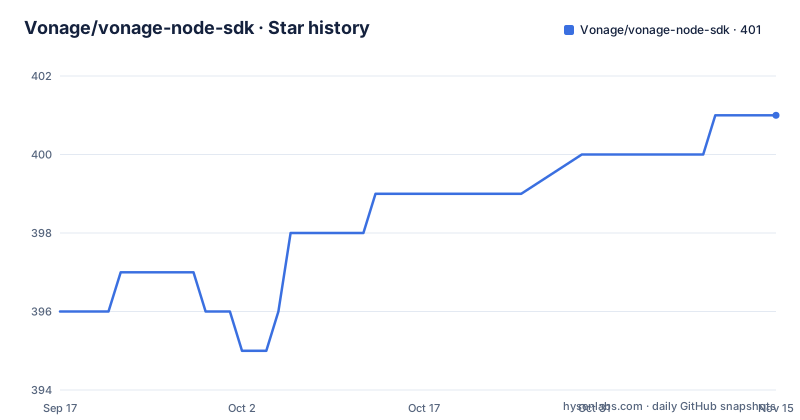
Star history
- Vonage/vonage-node-sdk401 ★ · +5
| Repository | 2026-09-17 | 2026-11-15 |
|---|---|---|
| Vonage/vonage-node-sdk | 396 | 401 |
5 Stars in the last 59 days, measured from the daily GitHub snapshot. Compare with other projects
Editorial analysis
One published package in front of 29 workspaces
What lands in node_modules is not the repository root. That package.json is named @vonage/server-sdk-monorepo and carries "private": true, so the artifact npm gives you comes from the packages/server-sdk workspace, listed last among the 29 entries under "workspaces". The array runs from packages/jwt and packages/auth through packages/network-sim-swap and packages/identity-insights to packages/conversations and packages/server-sdk, which is why one install command sits in front of a directory tree rather than a single module.
Two fields in that manifest deserve a second look. "type": "module" is set at the root, yet the constructor sample reaches for require('@vonage/server-sdk'); nothing on the page says which module system the published entry point gives you. And the version field reads 3.20.1 while the release line has already produced v3.30.0 on 1 September 2026, following v3.29.0 on 29 July and 3.28.0 on 29 June, so the root version number tells you little about what npm resolved.
The keywords array describes the real centre of gravity: sms, voice, vonage, verify, 2fa, phone numbers, identity insights.
Two option bags, and the option bag you lost
A Vonage client is two arguments wide. credentials is any option from @vonage/auth and options is any option from @vonage/server-client, so the SDK keeps neither accepted shape in its own README; both live in packages/auth/README.md and packages/server-client/README.md, reached through the #options anchors in the constructor paragraph.
const { Vonage } = require('@vonage/server-sdk');

const vonage = new Vonage(credentials, options);
The V2 migration table shows what that indirection cost. vonage.credentials and vonage.options are both marked Updated with their options pointing at Server Client, vonage.options.userAgent is marked Moved for the same reason, and vonage.options.httpClient is marked Removed outright. Code that injected its own HTTP client in 2.x to proxy or retry calls has nothing left to point at in 3.x, and the table gives no replacement name.
None of the credential field names appear on this page. Anyone porting from 2.x has to read the auth package's own option list before the constructor will type-check.
Every call resolves, none of them take a callback
Calls hand back promises, and the awaited form takes a single object argument:
const resp = await vonage.sms.send({
    to: '15552220000',
    from: '15559992222',
    text: 'This is a test',
});
Both numbers sit in the reserved test range and the body is the literal string This is a test, so the sample shows the argument shape rather than a message you would send to a subscriber. The name resp is the only hint about what a settled call returns: no response schema, no error object and no status code appear on this README page, and no callback form is documented for the 2.x style of call either.
That awaited style does not vary by product. Accounts, Applications, Audit, Messages, Numbers, Sub Accounts, Verify, Verify v2, Video and Voice each sit in their own workspace with the same convention, so a promise is the interface you program against everywhere the SDK has a client at all.
Twenty-three rows, two of them empty
The support table is the most useful thing here, and it has twenty-three rows. Dispatch API and External Accounts API are the only entries marked not supported, and both are Beta at Vonage, which reads as timing rather than refusal. Everything else carries a check: Audit, Media, Reports and Sub Accounts are Beta but supported, Redact API is Developer Preview and supported, and four rows, Meetings API, Number Insight V2, Number Insights and Number Management, are marked Deprecated upstream while still supported here.
That deprecated group is the odd corner. Number Insight V2 and Number Insights hold separate workspaces, packages/number-insight-v2 and packages/number-insights, so two generations of one product were kept apart rather than folded together, and both remain callable. A client that keeps dead surfaces callable is carrying code the vendor has stopped extending.
Both self-descriptions also overreach. The repository description and the manifest description field promise API support for SMS, Voice Calls, Text-to-Speech, Numbers and Verify, but the support table has no Text-to-Speech row, and the reference list gives Text-to-Speech no package page either.
vonage.conversion has nowhere to move to
Every V2 namespace resolves to a different package except one. vonage.conversation, vonage.app and vonage.files each get a new import target in Conversations, Applications and Server Client; vonage.message moves to SMS, vonage.generateJwt to JWT, vonage.calls to Voice, and vonage.generateSignature to SMS and Voice together. Only vonage.conversion is marked REMOVED, with no destination in the note column and no replacement named anywhere on the page.
The message to SMS move is the one that narrows. In 2.x a single message namespace covered outbound traffic; in 3.x the SMS package carries it, which means code that reached for vonage.message has to decide whether it wanted SMS in the first place.
The table also redirects helpers rather than products, so a signature you generated for one channel can now sit under another product's package name. Per-package migration guides hold the option renames; this page only names the destination.
Two npm scripts stand in for the whole test story
Working on the SDK itself comes down to two commands:
npm run testnpm run test-watchEverything around those lines lives in repository files rather than in prose. jest.config.ts and tsconfig.jest.json configure the runner, testHelpers/ is a top-level directory for shared fixtures, .husky/ holds git hooks, and eslint.config.js with .prettierrc cover linting and formatting. Documentation is configured twice, in typedoc.json and typedoc.base.json. The build is split across tsconfig.build.cjs.base.json, tsconfig.build.esm.base.json, tsconfig.build.types.base.json and tsconfig.build.shared.json, which is how one package set ships CommonJS, ESM and type declarations side by side.
One script deserves a closer read. postbuild runs npm run check:pkg --workspaces, so every workspace package is checked after a build instead of only the root being checked. With 29 workspaces feeding one published name, that sweep is what catches a package that compiled but should not have shipped.
Where the page stops and where the rest lives
Full API documentation is not in this repository. The README points at developer.vonage.com for that and at the Vonage Node Quickstarts repo, Vonage/vonage-node-code-snippets, for runnable examples. Per-product detail sits in the packages directories, and the References section links a page for Accounts, Applications, Audit, Auth, JWT, Messages, Number Insight V2, Number Insights, Numbers, Pricing, Server Client, Server SDK, SMS, Sub Accounts, Verify, Verify V2, Vetch, Video and Voice.
Vetch is the one entry that is not a product. It has a workspace of its own, packages/vetch, and its own reference page, which is a hint that the HTTP layer the other packages sit on is documented separately from the products built on it.
The link list is also where the page runs out. What is visible stops partway through the Voice entry, leaving the closing link definitions missing, and the list is short of the support table either way: Media, Reports, Redact, Users, Alerts and Conversations all carry check marks above yet have no reference link here.
The repository root also carries MAINTENANCE.md, RELEASES.md, CHANGELOG.md, EXAMPLES.md and CONTRIBUTING.md, and package.json names Kelly Andrews, Chuck Reeves and Chris Tankersley as contributors. The repository is not archived, and the last push to the default branch, main, landed on 18 September 2026, seventeen days after the v3.30.0 tag dated 1 September 2026.
Editorial conclusion
Adopt @vonage/server-sdk when you are wiring SMS, Verify or Voice from Node and want a client the vendor still tags. Pass on it if you need Dispatch or External Accounts, since no client ships for those, or if your code still calls vonage.conversion, which 2.x has no replacement for. Before pinning a version, resolve the installed package instead of reading the monorepo manifest, which still says 3.20.1 while published tags sit at v3.30.0.
Frequently asked questions
Does Vonage have an open API?
The Node SDK's support table covers 23 Vonage APIs, including SMS, Voice, Verify, Verify v2, Messages, Video, Numbers and Accounts. Dispatch API and External Accounts API are the only two rows marked not supported, and both are Beta at Vonage.
Is Vonage open source?
This client is released under Apache-2.0, with LICENSE.txt at the repository root and the published package named @vonage/server-sdk. The root manifest itself is private, so the repository root is not what npm installs.
Is Nexmo vonage?
Every name used on this project's own pages is Vonage: the repository is Vonage/vonage-node-sdk, the published npm package is @vonage/server-sdk, and the root manifest is @vonage/server-sdk-monorepo. Nothing on those pages documents an earlier corporate name.
Official sources
Add this badge to your README
If you maintain this project, the badge below links readers to this analysis and shows its maintenance status from the daily GitHub snapshot. Paste the markdown into your README; add ?metric=license or ?metric=stars to the image URL for a different field.

[](https://hysenlabs.com/projects/vonage-vonage-node-sdk)Star history chart for your README
[](https://hysenlabs.com/projects/vonage-vonage-node-sdk)Was this useful?