walkccc/LeetCode multi-language solution reference
💡 LeetCode in C++23/Java/Python/MySQL/TypeScript (respect coding conventions)
At a glance
- What is it?
- walkccc/LeetCode collects LeetCode solutions in C++23, Java, Python, TypeScript, and MySQL with language-specific formatting conventions. It is a reference repository for readers and fork users, not an installable package or automated submission client.
- Who is it for?
- Adopt walkccc/LeetCode if you need a consistently formatted reference across C++23, Java, Python, TypeScript, or MySQL and are willing to maintain a fork. Do not adopt it as an installable library, a hosted judge, or a community contribution platform.
- Can I use it commercially?
- Yes. MIT is a permissive licence: you can use, modify and sell software built on it, as long as you keep its copyright and licence notices.
- Is it still maintained?
- Yes. The repository last received commits 73 days ago.
- What is it written in?
- Mainly C++, according to GitHub's language statistics.
Answers come from the project's GitHub data, last synced on November 7, 2026, and from our analysis. They are not legal advice.
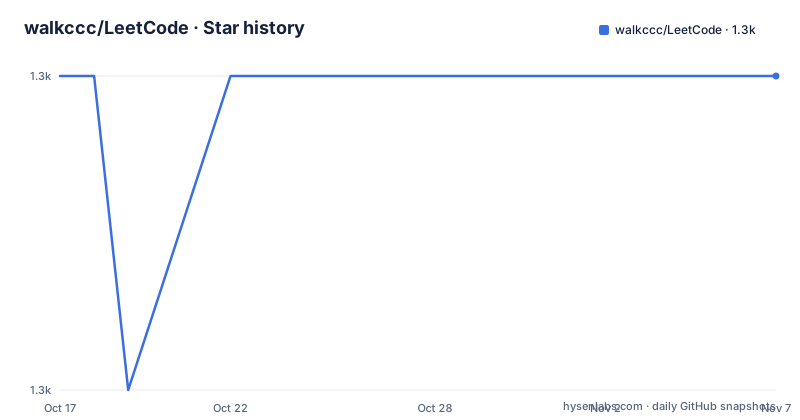
Star history
- walkccc/LeetCode1,342 ★ · +0
| Repository | 2026-10-17 | 2026-11-07 |
|---|---|---|
| walkccc/LeetCode | 1.3k | 1.3k |
0 Stars in the last 21 days, measured from the daily GitHub snapshot. Compare with other projects
Editorial analysis
What walkccc/LeetCode contains
walkccc/LeetCode addresses a practical problem in algorithm study: solutions written for the same LeetCode problem can diverge in naming, formatting, and presentation. The repository collects solutions in C++23, Java, Python, TypeScript, and MySQL under a common style policy. The README states that the goal is readable, consistent code across topics while incorporating newer language standards.
The collection is intended for readers who want reference implementations across several languages. Someone reviewing data structures can consult C++ or Java, while a reader working in Python, TypeScript, or SQL can examine another implementation of the same problem. The README badges classify entries as easy, medium, or hard LeetCode problems. These labels describe the source problems, not the completeness of the accompanying material.
This is a solution repository rather than an application. The README does not document a command-line interface, local web server, package installation, or automated LeetCode submission mechanism. Its practical value therefore depends on reading source code and comparing implementations. The repository also publishes a built page at `https://walkccc.me/LeetCode/`, which offers a second path for browsing the solutions.
Repository layout and access paths
The repository root shows a compact structure. The `solutions/` directory is the main source area. The root also contains `.clang-format`, `.prettierrc`, `STYLEGUIDE.md`, `README.md`, `LICENSE`, and `.github/`. This separates solution code from shared documentation and language-specific formatting configuration.
The README gives two documented ways to reach the content. Readers can browse the repository files, or they can open the built page linked under Getting Started. The hosted page is described only as `LeetCode Solutions`; the README does not explain how it is generated, deployed, or rebuilt locally. Consequently, the site is useful for browsing, but the repository does not present it as a local development feature.
The named configuration files indicate that formatting is handled by language. `.clang-format` applies to C++ and Java. Python uses `autopep8`, with `--indent-size=2` specified for better viewing on mobile devices. TypeScript uses Prettier through `.prettierrc`. MySQL has no listed formatter, configuration, or style guide. A fork user should preserve those differences rather than assume that one command formats the entire repository.
Formatting conventions in five languages
The formatting table is the clearest contribution constraint in the repository. C++ uses ClangFormat and the Google C++ Style Guide, with `.clang-format` as the configuration file. Java also uses ClangFormat, but follows the Google Java Style Guide and shares the repository's `.clang-format` file.
Python has a different toolchain. The documented formatter is `autopep8`, and the README specifically recommends passing `--indent-size=2` for a better viewing experience on mobile devices. TypeScript uses Prettier and the Google TypeScript Style Guide, with `.prettierrc` as its configuration. MySQL is listed as `N/A` for formatter, style guide, and configuration, which means the repository does not define a parallel formatting policy for SQL.
The repository also links to a dedicated style guide page and includes `STYLEGUIDE.md` in the root. The README does not reproduce the guide's rules, so it would be unsafe to claim particular naming or spacing rules beyond the tools and standards it names. The documented setup is still useful: it tells a fork maintainer which formatter and reference guide correspond to each language.
Installing and using the solutions
walkccc/LeetCode does not document an installation procedure because the README presents it as source material rather than an executable package. It provides no documented `npm install`, `pip install`, Maven, Gradle, or other dependency command. A reader can start by opening the built solutions page or by browsing the `solutions/` directory.
The first documented access step is the hosted page:
https://walkccc.me/LeetCode/Opening that URL should present the built LeetCode Solutions page. For source-oriented use, the repository itself contains the `solutions/` directory and the formatting configuration files. The README does not provide a clone command, so no clone command is reproduced here.
A practical first use is to select a problem and language, read the corresponding solution, then apply the formatter associated with that language. The repository does not document a test command, a local execution command, or a way to submit a solution to LeetCode. The README also does not say whether each solution includes an explanation, complexity analysis, or test cases, so those details should be checked in the individual file rather than assumed.
Contribution boundaries and maintenance cost
The repository is explicitly described as a personal project that does not accept pull requests in order to maintain consistency in coding style and solutions. That is a material limitation for anyone hoping to contribute through the normal GitHub workflow. The README invites users to fork the repository and modify it as needed, which shifts consistency checks and upkeep to each fork.
The repository is not archived, and the last push was on 2026-08-27. There are no GitHub releases, so the README provides no release history or versioned migration path. Maintenance is therefore expressed through repository changes rather than a documented release process. A fork that adds solutions must decide for itself whether to follow the existing formatters and style guide.
The repository is licensed under the MIT License, with copyright attributed to P.-Y. Chen and a copyright range of 2019-2026. That identifies the stated licensing basis. It does not answer practical questions about compatibility with a particular downstream use, or whether particular LeetCode submissions have separate terms, so consumers should review the license text and relevant platform terms themselves.
Where the repository is the wrong tool
walkccc/LeetCode is the wrong choice when the goal is automatic LeetCode submission, local problem execution, or a maintained package that plugs into an IDE. None of those capabilities is documented in the README. It also does not accept pull requests, so a team that wants an upstream contribution path or centralized review workflow will need a different arrangement.
The collection may also be insufficient for a learner who requires a complete curriculum. The README establishes a repository of solutions and a progress badge, but it does not describe a prescribed learning sequence, written explanations, automated correctness checks, or a local development environment. A hard problem may be present in the repository without enough supporting material for every reader's needs. The individual solution files are the relevant place to determine whether explanation and complexity analysis are included.
Compared with a general algorithm course or an interactive coding platform, this project offers a narrower thing: source code organized by language and style. Compared with an automated LeetCode client, it offers no documented submission integration. Its value lies in readable reference code, not workflow automation.
A practical adoption decision
For an individual learner, the repository can serve as a language-specific reference when browsing code is enough. The built site may reduce the friction of navigating a large collection, while the formatting files make it possible to inspect or normalize fork contents. The absence of pull-request acceptance is not a problem for private study, but it matters for collaboration.
For a team, the main trade-off is control versus coordination. Forking gives the team freedom to change solutions and structure, but it also removes the upstream contribution path documented by the README. The team would need to define its own review and formatting process. The repository's MIT license provides the stated permission framework, but it does not supply governance or a release schedule.
The first check should be concrete: open the target problem in the built site and inspect the corresponding source file. Confirm that the code, explanation, complexity discussion, and language are suitable for the intended use. If that check passes, the repository is a straightforward reference collection. If an automated judge, installable CLI, or contribution workflow is required, it does not match the documented project scope.
Editorial conclusion
Adopt walkccc/LeetCode if you need a consistently formatted reference across C++23, Java, Python, TypeScript, or MySQL and are willing to maintain a fork. Do not adopt it as an installable library, a hosted judge, or a community contribution platform. Verify first whether the repository or built site contains the exact problem and explanation style your learning workflow requires, because the README does not document automated tests, submission commands, or a local build process.
Frequently asked questions
Does walkccc/LeetCode support C++, Java, Python, TypeScript, and MySQL?
Yes. The README describes solutions in C++23, Java, Python, TypeScript, and MySQL.
Can I install walkccc/LeetCode as a package?
The README does not document an installation command or package distribution. It directs readers to the built solutions page and presents the repository as a source collection.
Can I contribute solutions through pull requests to walkccc/LeetCode?
No. The README says the repository is personal and does not accept pull requests, while allowing users to fork it and modify it.
Official sources
Add this badge to your README
If you maintain this project, the badge below links readers to this analysis and shows its maintenance status from the daily GitHub snapshot. Paste the markdown into your README; add ?metric=license or ?metric=stars to the image URL for a different field.

[](https://hysenlabs.com/projects/walkccc-leetcode)Star history chart for your README
[](https://hysenlabs.com/projects/walkccc-leetcode)Was this useful?