ARIS is Markdown skills and a reviewer bridge it had to rebuild
ARIS (Auto-Research-In-Sleep), Lightweight Markdown-only skills for autonomous ML research: cross-model review loops, idea discovery, and experiment automation. No framework, no lock-in, works with Claude Code, Codex, OpenClaw, or any LLM agent.
At a glance
- What is it?
- ARIS packages an autonomous machine-learning research workflow as Markdown skill files that install into whichever coding agent you already use, with an executor model doing the work and an independent model reviewing it. The interesting engineering is not the skills but the seams: a reviewer bridge that had to be rewritten when codex-cli removed its MCP server, an environment file that names search, model, review and Feishu services, and a manual review path that costs nothing.
- Who is it for?
- ARIS fits a researcher or engineer who wants a repeatable loop for idea generation, experiment automation and adversarial review without committing to a platform, and who is willing to accept that the workflow is a set of Markdown conventions rather than a scheduler with guarantees.
- Can I use it commercially?
- Yes. MIT is a permissive licence: you can use, modify and sell software built on it, as long as you keep its copyright and licence notices.
- Is it still maintained?
- Yes. The repository last received commits 3 days ago.
- What is it written in?
- Mainly Python, according to GitHub's language statistics.
Answers come from the project's GitHub data, last synced on November 13, 2026, and from our analysis. They are not legal advice.
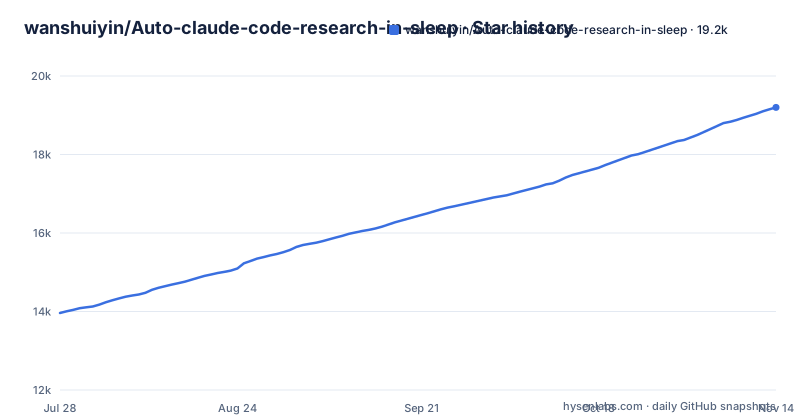
Star history
- wanshuiyin/Auto-claude-code-research-in-sleep19,152 ★ · +5,189
| Repository | 2026-07-28 | 2026-11-13 |
|---|---|---|
| wanshuiyin/Auto-claude-code-research-in-sleep | 14k | 19.2k |
5,189 Stars in the last 108 days, measured from the daily GitHub snapshot. Compare with other projects
Editorial analysis
A methodology in Markdown files, deliberately not a platform
The first line of positioning is the one to quote when someone asks what this is: ARIS is a methodology, not a platform, and what matters is the research workflow, which you take wherever you go. That is not marketing, it is a description of the packaging. What ships is a set of Markdown-only skills for autonomous machine-learning research covering cross-model review loops, idea discovery and experiment automation, with no framework and no lock-in. The portability claim is tested by the number of hosts it documents: Claude Code, Codex CLI, Cursor, Trae, Antigravity, GitHub Copilot CLI, OpenClaw and a DeepSeek harness, most with their own adaptation document or skill set. The repository makes the same point structurally with two plugin directories at the root, one for the Claude plugin format and one for the Codex plugin format, so the same content is packaged twice for two different hosts.
The executor drives, and a second model reviews
The loop is deliberately two-headed: the executor drives the work while an independent model reviews it, with the Codex MCP server used by default for that review. The environment example file shows how much choice that leaves you. There are two reviewer backends configured as separate services, one wrapping a Gemini binary with an API backend, a ten-minute timeout and its own debug log, and one wrapping the Claude binary with a configurable tool list, also ten minutes. Then there is the third path, a manual reviewer labelled human in the loop with zero API cost, whose timeout is a full day rather than ten minutes, which opens a browser automatically and writes queued items to a pending review directory inside the project. For teams without a budget for reviewer calls, that path is the reason this configuration file is worth reading before anything else.
codex-cli 0.154 removed the entry point, and the bridge was rewritten
The most valuable thing in this repository is a failure report. A notice at the top of the readme states that codex-cli 0.154.0 removed a subcommand that every ARIS reviewer call used, and that upgrading would have killed every Codex review. The response is stated in the same paragraph: the reviewer is now ARIS's own bridge over a different Codex invocation, living in a bridge directory in the repository, with the same tools and the same results, and the skills, the ultra mode and per-thread resume all intact. One re-registration is all it takes. The release notes add detail that makes the fix sound rather than cosmetic: there is no server entry to configure any more, old entries migrate in memory, and thread records interoperate with the project's Python bridge. The honest read is that the workflow now depends on a CLI subprocess rather than a server it used to talk to.
The release notes are the documentation, and one number disagrees with itself
Because there is no platform, the changelog in the readme is where the behaviour of the tool actually lives. The cadence is fast and the entries are specific: the current release makes a reasoning-effort setting work on one provider channel and fixes tool calls that fail when a relay sends an empty placeholder object, and uses the operating system proxy on Windows and macOS without you exporting a proxy variable yourself. The previous release stopped the REPL from leaving an empty session file behind and made the resume listing show only sessions with messages. An earlier one made a model alias and the model command point at a new model while the default executor stayed where it was, and another added a model refresh. One inconsistency is worth noticing: the compatibility notice says all 82 skills are unchanged, while a later entry says the bundle moves to 83 bundled skills on a different model.
Five services and one bridge in the environment file
The example environment file is the honest inventory of what the workflow touches, and it is worth reading line by line because each block is a separate dependency. There are four search services: Exa, Keenable (keyless by default), Firecrawl and Semantic Scholar. There are three model providers: one chat provider with its own base URL, model name and a fallback model, one MiniMax configuration with its own base URL and model, and the Gemini reviewer. There is a fourth, a Claude reviewer configured with a binary path, a tools list and a timeout. And there is a bridge of a different kind entirely, a Feishu integration with an application identifier, a secret, a user identifier and a port. Nothing here is a database or a queue, which is consistent with the claim that this is a methodology; the manual reviewer queues items in `.aris/pending_review`.
Setup comes in pairs, in two languages
The repository is organised around the idea that the same method has to be re-expressed for each host, and the file list shows the duplication that implies. There is a readme in English and a Chinese one, a setup guide in both languages, a contributing guide in both, and a separate agent guide for the machine rather than the human. The docs directory holds one adaptation document per host, covering Cursor, Trae, Antigravity, the GitHub Copilot CLI, OpenClaw and a hosted-model guide, plus a directory of Codex-specific skills. Around that sit the parts a workflow needs: a commands directory, templates, tools, a test directory, a community papers folder, and a paper hosted on a paper repository with an identifier, alongside introduction slides in two formats. Two separate plugin directories at the root mean the same content is installable as a plugin for two different tools.
Sessions are replayable, and approval is a designed state
If a loop runs while you are away, the first question is what happened, and the release notes answer it with two commands. One replays everything that happened after your last input, folded the way the live display is folded, with a full variant that prints the complete output rather than the folded version. The other lists your sessions by index and shows where you stopped. Output folding arrived as its own release, which tells you the same thing from the other direction: long unattended runs produce long output, and the tool treats that as a first-class problem. Approval is the other designed state. A pending review directory holds items waiting for a human, and a small macOS widget in its own directory lights up when a session is blocked waiting for your approval, which is the difference between a loop you supervise and one you notice has stalled.
Editorial conclusion
ARIS fits a researcher or engineer who wants a repeatable loop for idea generation, experiment automation and adversarial review without committing to a platform, and who is willing to accept that the workflow is a set of Markdown conventions rather than a scheduler with guarantees. It does not fit a team that needs reproducible billing per experiment or unattended operation without supervision, because human approval is a designed part of the flow and a pending review directory exists for it. Before you install, read the compatibility note about codex-cli 0.154, because that release removed the entry point every reviewer call used and the fix means re-registering the bridge. The licence is MIT, the newest release is v0.4.28 from 2026-09-28, and the default branch was last pushed on 2026-11-02.
Frequently asked questions
Can the Claude code be used for research?
That is what this repository's skills are for. ARIS provides Markdown-only skills for autonomous machine-learning research covering cross-model review loops, idea discovery and experiment automation, and they install into Claude Code, Codex CLI, Cursor, Trae, Antigravity, GitHub Copilot CLI, OpenClaw and a DeepSeek harness. The same method also ships as a standalone command line tool and as plugins.
Does the Claude code work in sleep mode?
There is no sleep mode as a setting; the name describes the intended workflow, where the research loop runs unattended while one model drives and an independent model reviews the work. The command line release adds commands for replaying everything after your last input and for listing past sessions by index so you can see where an unattended run stopped.
Why does AI tell you to go to sleep?
That is where the name comes from: the project describes itself as auto-research-in-sleep, a workflow intended to keep researching while you are away, with an executor model doing the work and a separate model reviewing it. It states explicitly that it is a methodology rather than a platform, so what continues during the night is the loop, not a service you have to operate.
What does auto mode in the Claude code mean?
The repository does not define an auto mode in the host tool. What it defines is the split between an executor and a reviewer, plus the environment configuration that drives it: reviewer backends for Gemini and for Claude with ten-minute timeouts, a manual reviewer that costs nothing and waits a day, a configurable reasoning-effort setting for one provider channel, and model aliases that were repointed in a recent release while the default executor stayed unchanged.
Official sources
Add this badge to your README
If you maintain this project, the badge below links readers to this analysis and shows its maintenance status from the daily GitHub snapshot. Paste the markdown into your README; add ?metric=license or ?metric=stars to the image URL for a different field.

[](https://hysenlabs.com/projects/wanshuiyin-auto-claude-code-research-in-sleep)Star history chart for your README
[](https://hysenlabs.com/projects/wanshuiyin-auto-claude-code-research-in-sleep)Was this useful?