wemake-python-styleguide's comparison table says it finds bugs, its scope list says it does not
The strictest and most opinionated python linter ever!
At a glance
- What is it?
- A flake8 plugin providing the WPS violation codes, MIT licensed, requiring Python 3.10 and flake8 7.3, and delegating formatting and style to ruff. The interesting parts are the self dogfooding lint chain, an action image that pins the linter version, and two generated text files for language models.
- Who is it for?
- wemake-python-styleguide fits a team that has already handed formatting to ruff and wants a second opinion on complexity and correctness that a formatter cannot give, since the gap it occupies is precisely the one ruff leaves open. Three things to settle first.
- Can I use it commercially?
- Yes. MIT is a permissive licence: you can use, modify and sell software built on it, as long as you keep its copyright and licence notices.
- Is it still maintained?
- Yes. The repository last received commits 1 day ago.
- What is it written in?
- Mainly Python, according to GitHub's language statistics.
Answers come from the project's GitHub data, last synced on November 24, 2026, and from our analysis. They are not legal advice.
Star history
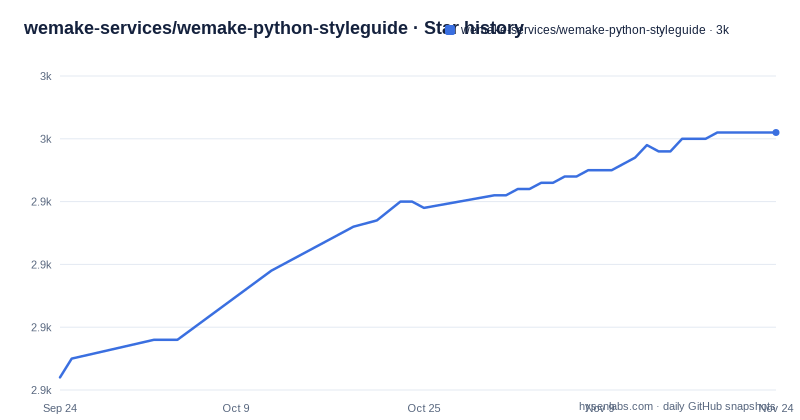
- wemake-services/wemake-python-styleguide2,951 ★ · +39
| Repository | 2026-09-24 | 2026-11-24 |
|---|---|---|
| wemake-services/wemake-python-styleguide | 2.9k | 3k |
39 Stars in the last 61 days, measured from the daily GitHub snapshot. Compare with other projects
Editorial analysis
Two tools in sequence: ruff checks and formats, flake8 runs the WPS codes
Installation is one line, and running it is another:
pip install wemake-python-styleguideflake8 your_module.py --select=WPSThe `--select=WPS` is the whole integration. The plugin registers itself under the WPS prefix from a single entry in pyproject.toml, where the flake8 extension points at `wemake_python_styleguide.checker:Checker`, so the codes are namespaced to this project and coexist with whatever else flake8 is loading. The README insists the tool is still just ordinary flake8 and will not change an existing workflow.
The recommended pairing is two commands run in sequence:
ruff check && ruff format
flake8 . --select=WPS
That is two tools in CI and two configuration files. The README claims full compatibility with all rules and format conventions from ruff, which is a strong statement for a plugin that deliberately does not format. It also links the example ruff configuration to a specific line of the project's pyproject.toml, at line 103, so that pointer will move every time the file is edited above that point.
The comparison table and the scope list give opposite answers on bug finding
The README carries a table comparing six tools across six questions, and for wemake-python-styleguide the rows read: does not format code, does not find style issues, finds bugs, finds complex code, has a lot of strict rules, has a lot of plugins. Two of those answers are surprising for a project whose name contains the word styleguide, and both are consistent: formatting and style are delegated to ruff, so the plugin declines them.
The third row is the problem. Marking it as finding bugs sits directly against the section titled what we are not, which lists among its refusals checking for all kinds of logical bugs, with the instruction to write tests instead.
So the table and the scope list cannot both be read as contracts. The scope list is the one with commitments behind it, since the project ships an error code index in its documentation and a linter whose entire product is a fixed set of rules. The table reads as positioning against six named competitors, where marking yourself as the only one that finds bugs and complex code is the point of the exercise. Anyone deciding what will be caught should read the violation index rather than the table.
The refusal list starts at zero, and one of its refusals is mypy
The scope section is numbered from zero rather than one, with four entries. Number zero declines to assume or check types, with the instruction to use mypy alongside. One declines to format code or produce stylistic errors, pointing at ruff format. Two declines to check for all kinds of logical bugs, pointing at tests. Three declines to appeal to everyone, while noting that any rule can be switched off.
Entry zero is the one with the most interesting consequence. The project tells users not to combine its linter with mypy, and then runs mypy on itself: the development dependencies include `mypy = "^2.3"`, the Makefile has a `type-check` target that runs mypy over the package and the scripts directory, and the type checking runs in the aggregate `test` target. The same repository sets the tool it tells you not to combine with, on itself.
The numbering is cosmetic. Starting at zero makes the four refusals line up with the four objectives listed above them, which run one to three, but it is also a small sign that the list is edited rather than generated.
The AI surface is a skill, an MCP server, a plugin manifest and two generated files
The README puts AI tooling first, under a heading of its own, and enumerates four surfaces. There is a skill, linked to a SKILL.md inside the repository at `.agents/skills/wps/SKILL.md`, whose purpose is to run better Python code that passes the linter. There is a `wps` MCP server, described as helping explain violations and giving context on how to fix them, which is why the `mcp` package with its cli extra is an optional dependency behind a `mcp` extra. There is Context7, with a `context7.json` file at the root of the repository. And there are two plain text files, `llms.txt` and `llms-full.txt`, served from the documentation site.
Those two files are generated rather than written. The documentation dependency group includes `sphinx-llms-txt = "^0.7"`, which is the Sphinx extension that produces them, so they stay in step with the docs build.
pyproject also declares a console script named `wps` pointing at `wemake_python_styleguide.cli.cli_app:main`, which is a third entry point alongside flake8 and the MCP server. The Running section of the README shows only the flake8 invocation. The `.claude-plugin/` directory at the root is the plugin manifest side of the same effort, and release 1.8.0 is titled with the phrase the Slop Slayer.
Two pre-commit files, and a lint chain that runs flake8 on itself
The repository ships two pre-commit files, `.pre-commit-config.yaml` and `.pre-commit-hooks.yaml`. The first is the usual one, the project's own configuration. The second is the file that publishes this project as a hook for other repositories to consume, which is why there are two of them rather than a mistake.
The Makefile is where the self dogfooding is visible. Its `lint` target is five commands, not one: ruff check with a non zero exit on fix, ruff format in check mode with a diff, `flake8 .`, `lint-imports`, and `python3 scripts/check_generic_visit.py wemake_python_styleguide/visitors/ast`. The fourth comes from `.importlinter` at the root, with import-linter in the development dependencies, so the package's own import boundaries are a test. The fifth is a custom script that inspects the AST visitor directory.
The `test` target aggregates four of those targets, `lint`, `type-check`, `unit` and `package`, and the last of those is `pip check`. So the definition of green here is lint, types, unit tests and a dependency consistency check, in that order.
The action image pins the linter version and pipes reviewdog from a master URL
The Dockerfile opens with a warning banner in comments: this is the GitHub Action image, it is not intended for local development, and it can still be used as a raw image for your own containers. The base is `python:3.14.7-alpine`, a specific patch of a new Python.
Two versions are frozen as environment variables. `WPS_VERSION` is set to `1.8.1`, and the install step is a pip install pinned to exactly that value, so the image cannot pick up a new plugin release by accident. `REVIEWDOG_VERSION` is set to `v0.21.2` for the optional pull request commenting.
The reviewdog installer is where the pinning stops. It is fetched with wget from a raw URL on the reviewdog repository's master branch and piped into `sh`, with the version passed as an argument. The version being an argument means the installer script itself is not versioned, so what runs is whatever master held at image build time. Two files are copied in from the repository, `scripts/action-config.cfg` for the action's configuration and `scripts/entrypoint.sh` as the entrypoint, and the same image is published to Docker Hub under the wemakeservices organisation.
The version pin has a consequence for anyone using the action: the image tracks 1.8.1 while the plugin on PyPI moves independently of it.
Randomized test order, generated strategies, and snapshot assertions
The development dependencies describe how this project tests itself. `pytest = "^9.1"` with `pytest-xdist` for distribution and `pytest-cov` with covdefaults for coverage. `pytest-randomly` between 4.1 and 6.0 randomises the order of the suite on every run, which is the cheapest way to find tests that depend on each other. `hypothesis` is paired with `hypothismith`, a tool that generates Hypothesis strategies from type hints, so property tests can be written against signatures rather than by hand. `syrupy` provides snapshot assertions, and `nbqa` runs the documentation notebooks as tests.
`astpath` sits in the same group, an AST wrapper that makes traversal code shorter, and `types-flake8` provides the typing stubs flake8 itself lacks.
The Python floor is `^3.10` and flake8 is `^7.3`, with the package classified as Production/Stable and Typed. The build backend is poetry-core with a declared poetry requirement of 2.4 or newer, and a lock file is committed. The last push to master was on 2026-10-02, which is after the 1.8.1 release on 2026-09-12, so the branch is ahead of the tag the action image installs.
Editorial conclusion
wemake-python-styleguide fits a team that has already handed formatting to ruff and wants a second opinion on complexity and correctness that a formatter cannot give, since the gap it occupies is precisely the one ruff leaves open. Three things to settle first. It refuses type checking by design, so if you want that opinion you run mypy separately, as the project does on itself. The comparison table in the README is not a reliable summary of scope: it marks the plugin as finding bugs while the scope list explicitly declines that job. And the published GitHub Action image pins the linter to a fixed version in an environment variable, so the action you inherit from a workflow file can be older than the plugin you have installed locally.
Frequently asked questions
What is wemake-python-styleguide?
A flake8 plugin that adds the WPS violation codes, MIT licensed, currently version 1.8.1. It requires Python 3.10 or newer and flake8 7.3 or newer, and it deliberately leaves formatting and style checks to ruff.
How do I run wemake-python-styleguide on a file?
Install it with `pip install wemake-python-styleguide`, create a setup.cfg for configuration, then run `flake8 your_module.py --select=WPS`. The README's recommended pairing runs `ruff check && ruff format` first and `flake8 . --select=WPS` second.
Does wemake-python-styleguide replace ruff?
The README calls it fully compatible with all rules and format conventions from ruff, and describes itself as the only plugin you need as a ruff companion. Its own scope list says it will not format code or produce stylistic errors, and points at ruff format for that.
What is the wps command in wemake-python-styleguide?
pyproject.toml declares a console script named `wps` that points at `wemake_python_styleguide.cli.cli_app:main`. The project also ships a `wps` MCP server for explaining violations and a `/wps` agent skill, although the README's running examples use flake8 directly.
Official sources
Add this badge to your README
If you maintain this project, the badge below links readers to this analysis and shows its maintenance status from the daily GitHub snapshot. Paste the markdown into your README; add ?metric=license or ?metric=stars to the image URL for a different field.

[](https://hysenlabs.com/projects/wemake-services-wemake-python-styleguide)Star history chart for your README
[](https://hysenlabs.com/projects/wemake-services-wemake-python-styleguide)Was this useful?