AlphaTree: most of the model index links to a different repository, and the prose disagrees with its own table
AI roadmap covering Machine Learning, Deep Learning, GANs, GNNs, NLP and big data, with extensive source code (Python, PyTorch) to help you master the fundamentals, pass interviews, and grow from beginner to qualified engineer; deep learning papers include official TensorFlow/Caffe source, with applications in recommendation algorithms and knowledge graphs.
At a glance
- What is it?
- A Chinese-language roadmap of deep learning notes organised by topic, with one markdown page per model and a comparison table tracing image classification from LeNet to ResNet. The repository has real internal inconsistencies worth knowing about: two repository names mixed in one index, a stated error rate that contradicts the table beside it, and a licence declared in prose that the metadata does not record.
- Who is it for?
- AlphaTree is worth browsing if you read Chinese and want the shape of the image classification literature in one place, since the per-model pages and the comparison table give you a map that most single-model write-ups do not. Three things to know before you rely on it.
- Can I use it commercially?
- The repository metadata does not identify a licence. Check the project’s published terms and any component-specific licences before reuse.
- Is it still maintained?
- Yes. The repository last received commits 43 days ago.
- What is it written in?
- GitHub does not report a main language for this repository.
Answers come from the project's GitHub data, last synced on November 24, 2026, and from our analysis. They are not legal advice.
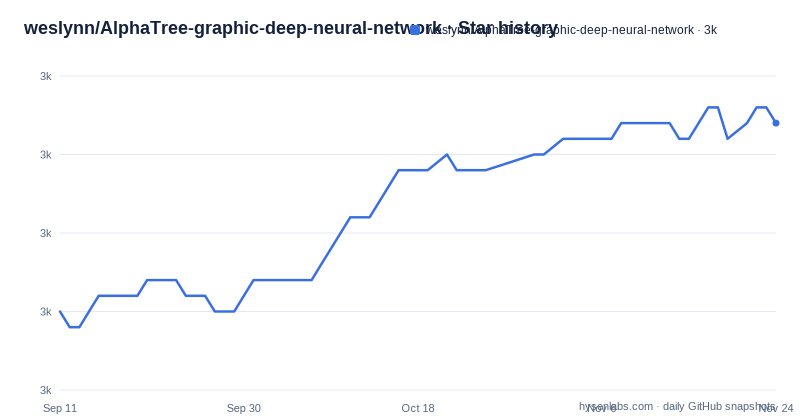
Star history
- weslynn/AlphaTree-graphic-deep-neural-network3,027 ★ · +12
| Repository | 2026-09-11 | 2026-11-24 |
|---|---|---|
| weslynn/AlphaTree-graphic-deep-neural-network | 3k | 3k |
12 Stars in the last 74 days, measured from the daily GitHub snapshot. Compare with other projects
Editorial analysis
Most of the model index points at a differently named repository
The index near the end of the file is a grid of links, one per model, and the links do not all resolve to the repository you are reading. The first two entries, for LeNet and for AlexNet, use the full name of this repository in their path. Every entry after them, including GoogLeNet, Inception V3, VGG, ResNet and ResNeXt, Inception-ResNet-V2, DenseNet and DPN, uses a shorter name with the AlphaTree prefix removed. Meanwhile the overview link just above the index, labelled as the new home of the page that used to show every model, uses the full name again. So one list mixes two repository identities, and the mismatch is in the majority of entries rather than a single stray link. That is the signature of a repository that was renamed and whose index was only partly updated, and it means a reader who clicks through from the index may end up somewhere they did not expect.
The prose and the table give different error rates for AlexNet
The history section describes AlexNet as taking first place in the 2012 classification competition with a top-5 error rate of 15.3 percent, and adds that this was about ten percentage points better than the previous year's winner. Four paragraphs later, a comparison table gives the same model's top-5 error as 16.4 percent. Nothing in the file reconciles the two figures, and they are close enough that one of them is a typo rather than a different measurement being described. The same table is otherwise internally consistent and quite specific: it gives layer counts, convolution counts, convolution kernel sizes, fully connected layer counts and sizes, and marks which models used data augmentation, dropout, local response normalisation and batch normalisation. So the table is worth using, with the caveat that the number most readers will quote from it is the one the prose contradicts.
The terms are declared in the readme and absent from the metadata
A copyright line near the top of the file states the work is shared under a Creative Commons attribution, non-commercial, share-alike licence, and it spells out what those terms mean in plain language. The licence recorded for the repository is unknown, which in practice means the field is empty rather than set to a different licence. So the terms exist only as prose in a Chinese-language readme, and no tooling reading the repository's licence field will find them. The non-commercial term is the part with teeth for reuse: the diagrams and per-model notes are exactly the sort of thing a reader might want in a slide deck or an internal document, and the licence as written forbids that. Check the terms against whatever you intend to do before lifting a figure.
A price table labelled early 2025 sits in a repository pushed in 2026
One section is not about neural networks at all. It is a comparison of AI video generation products, introduced as the pricing of commonly used video products as of early 2025. Nine products are listed with four numbers each: a monthly membership price in yuan, how many credits that membership includes, credits consumed per second of output, and the resulting price per second. Several membership prices are marked as approximate because they are derived from the credit figure rather than quoted directly. The products mix Chinese and Western services, and the list is a snapshot of one moment: it names a specific generation of two products, includes a resolution qualifier on one, and computes per-second prices from a credit rate that a vendor can change without notice. The last push to the repository is dated 2026-05-11, so the table is well over a year older than the file it lives in.
The navigation site was removed and replaced by a protected document
The readme explains the state of its own navigation, in a tone that is unusually candid for a project file. It says the navigation website is no longer maintained and that the developer took it down, replacing it with a shared cloud document that was built for personal use and is now being shared with readers. The link to that document is followed by its access password, printed in the file itself. So the project's front door is a password-protected personal document whose credential is published alongside it, which means the password protects almost nothing except the URL being unlisted. For a reader, the practical effect is that the structured navigation the project once had is now a flat list of links inside the readme, and the map has to be rebuilt from the section headings.
A desktop metadata file is committed, and two image folders sit side by side
The repository's top level is a directory per topic, four of them named in both Chinese and English for deep networks, adversarial networks, graph networks and natural language processing, plus five more directories for a database, a map, model images, papers, images and stories. The title of the readme names deep networks, adversarial networks, natural language processing and big data, so the graph network directory is present in the tree without appearing in the title. Two entries in that list deserve comment. A macOS desktop metadata file is committed at the root, which is a file Finder creates and that almost nobody wants in version control. And there are two separate image directories, one named for model pictures and one for images, with no stated rule for which belongs where, so a contributor adding a diagram has to guess.
The history section traces two lines of architecture research
The narrative walks forward from a convolutional network proposed in 1998 that reached commercial standard on handwritten digits, through a quiet period attributed to limited hardware, limited data and the difficulty of tuning, to the 2012 network that restarted the field. From there it splits into two threads, which it names as depth and complexity: one line adding modules, from the original inception-style network through several later versions and a residual variant, and one line making simple structures deeper, from a very deep plain network through a residual network to densely connected and dual-path variants. A third thread is application-driven and goes the other way, making models smaller. The file also reports competition results, including a 2016 entry that won with an ensemble of four architectures and a 2017 entry that won the final year of that competition.
Editorial conclusion
AlphaTree is worth browsing if you read Chinese and want the shape of the image classification literature in one place, since the per-model pages and the comparison table give you a map that most single-model write-ups do not. Three things to know before you rely on it. The index is not a reliable set of links, because most entries point at a differently named repository, so verify a path before you rely on it. The comparison table contradicts the prose next to it on one headline number, so treat either figure as approximate. And the terms are a non-commercial share-alike stated only in the readme text, which matters if you had planned to reuse the diagrams in something commercial.
Frequently asked questions
What is AlphaTree-graphic-deep-neural-network?
A Chinese-language roadmap collection for machine learning and deep learning, organised into topic directories for deep networks, adversarial networks, graph networks and natural language processing, with one markdown page per model that pairs an explanation with code and a diagram. The readme describes it as a plan to help practitioners move from beginner to working engineer.
Which models does the AlphaTree index cover?
LeNet, AlexNet, GoogLeNet, Inception V3, VGG, ResNet and ResNeXt, Inception-ResNet-V2, DenseNet and DPN each have an index entry, and the prose additionally discusses a neural architecture search result trained on five hundred GPUs and a mobile-oriented series including SqueezeNet, MobileNet, Xception and shuffleNet.
Why do some AlphaTree model links not resolve?
The index mixes two repository names. Its first two entries use this repository's full name while the rest use a shorter name with the AlphaTree prefix removed, and the overview link above the index uses the full name again, which is the pattern left behind by a rename.
What license is AlphaTree released under?
The readme carries a copyright line stating a Creative Commons attribution, non-commercial, share-alike licence and spells the terms out in Chinese. The licence recorded for the repository is unknown, so the terms exist only in the readme text, and the non-commercial term restricts reuse of the diagrams.
What is the AI video price table in the AlphaTree readme?
A snapshot from early 2025 comparing nine video generation products by monthly membership price in yuan, credits included, credits consumed per second, and the derived price per second. Several membership figures are marked approximate because they are computed from the credit allowance.
How do I find models in this AlphaTree repository?
The readme states that the navigation website was taken down by the developer and replaced by a shared cloud document, whose access password is printed in the file. The remaining navigation is the section headings of the readme itself, plus a grid of per-model links near the end.
Official sources
Add this badge to your README
If you maintain this project, the badge below links readers to this analysis and shows its maintenance status from the daily GitHub snapshot. Paste the markdown into your README; add ?metric=license or ?metric=stars to the image URL for a different field.

[](https://hysenlabs.com/projects/weslynn-alphatree-graphic-deep-neural-network)Star history chart for your README
[](https://hysenlabs.com/projects/weslynn-alphatree-graphic-deep-neural-network)Was this useful?