my-site: a Spring Boot personal site whose readme is also its changelog, ending in 2021
A personal website built with Spring Boot 2.0, combining a homepage, personal blog and portfolio of works.
At a glance
- What is it?
- This is a personal website project built with a Spring Boot application, a database layer, a template engine, and container packaging, bundling a homepage, a blog and a works section. What it is not is maintained documentation: the first line of the readme links to a different repository, the licence badge points at another project's licence file, the only quick-start item is a link, and the hand-written log ends four years before the last commit.
- Who is it for?
- Read it as a tutorial project rather than a product, which is how its own readme describes it, with a deployment page and a study group attached. Three things to check before you build on it.
- Can I use it commercially?
- Yes. Apache-2.0 is a permissive licence: you can use, modify and sell software built on it, as long as you keep its copyright and licence notices.
- Is it still maintained?
- Yes. The repository last received commits 13 days ago.
- What is it written in?
- Mainly Java, according to GitHub's language statistics.
Answers come from the project's GitHub data, last synced on November 15, 2026, and from our analysis. They are not legal advice.
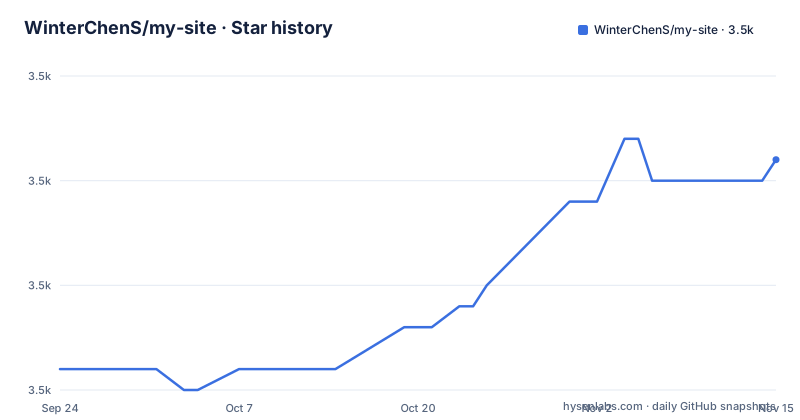
Star history
- WinterChenS/my-site3,506 ★ · +10
| Repository | 2026-09-24 | 2026-11-15 |
|---|---|---|
| WinterChenS/my-site | 3.5k | 3.5k |
10 Stars in the last 52 days, measured from the daily GitHub snapshot. Compare with other projects
Editorial analysis
The first line of the readme points at a different repository
The most prominent link in this readme is not about this repository.
The first heading under the title is a link labelled as clicking to view, and it resolves to another repository owned by the same account, holding a version of this site described as having a separated front end and back end.
So the opening thing a reader sees is a pointer to the successor of the thing they just opened. That is a defensible choice for a project whose architecture has been split, and it is also the first of several links in the document that leave the repository.
The readme is also not the only readme. Two translated versions are linked at the top, one in English and one in Japanese, and both live in a subdirectory rather than at the root. What sits at the root is a third version, in Chinese, which is the one this article is based on.
Three documents for one small project is not a problem. Having the root document begin by redirecting you elsewhere is.
The licence badge points at somebody else's licence file
Two links in the document's header row are worth reading for what they point at rather than what they say.
One is a licence badge, and its target is a file in a repository with a different name and a different owner, on a file path that ends in a licence filename.
This repository does have its own licence file in its root, and its metadata records an Apache 2.0 licence. The badge simply links somewhere else.
The other link in the same row is a build status badge, and that one is correct: it points at a workflow file inside this repository.
So the row contains one working status indicator and one licence indicator that is not about this project. That is the sort of thing that survives a copy of a readme from one repository to another, and it matters here because the readme is otherwise the only documentation, and a licence claim is the one thing in it that a reader should be able to check.
Check the file in the root instead.
The changelog is the readme, and it ends in 2021
There is no changelog file in this repository. The log is a list of dated lines inside the readme itself, under a heading of its own.
It has eleven entries and reads almost entirely as a development diary. The first is the first release, on the third of May 2018. The second is a week later. The third adds comments and improves article type selection. The rest of that month covers theme changes, header styling, article editing fixes, comment counts, typography, and a random header image for posts that have none.
Then the pace drops. One entry in July 2018, one in May 2018 that adds caching, and then nothing until August 2021, where the entry fixes leftover caching behaviour and a missing click count on works entries.
That is the end. The last log line is from August 2021, and the most recent commit to the repository is from September 2026.
Meanwhile the same readme, three sections earlier, describes its documentation as thorough and continuously updated. The log is the evidence, and the log says the feature work stopped five years ago.
One caching change in May 2018 produced bugs until 2021
Read the eleven log lines as a sequence rather than a list and one story emerges.
Caching is added in May 2018. In July 2018 there is a fix for article updates and deletions not taking effect, attributed to caching. In August 2021 there is a fix for remaining caching behaviour, plus a fix for works entries showing no click count.
So the single feature that was supposed to make the site faster is the subject of bug fixes in the month after it landed, a further three years later, and a second cleanup five years after that. Nothing in the log says the layer was removed or reworked, and nothing says it was fixed properly either.
That is the honest state of this project as far as its own documentation goes, and it is worth reporting as such rather than describing a site with a cache.
The rest of the diary is ordinary maintenance: a mobile layout offset in the list views, comment counts that did not accumulate, and a theme change. Those entries suggest a small project with one author iterating on a finished site rather than a product receiving bug reports.
The quick start is one link, and the preview is five labels
There is a section headed as a quick start, and it contains one item, already marked done, and that item is a link.
The link goes to a wiki page about how to deploy the site. So the deployment instructions are not in the repository, not in the readme, and not summarised anywhere in it. They are on a wiki, one click away, and the readme's own contribution to the process is to point at them.
The preview section is the mirror image. Five labels are listed in order, for the home page, the about page, the blog home, the login page, and the admin home. Each label is followed by nothing, because the screenshots are not in the file.
Those five labels are still the most complete feature list the repository contains, and they describe what this project is better than anything else in it does: a static personal site with a blog that has comments and click counts, a photography or works section, an authentication page, and an admin area behind it.
What the readme adds on top is a study group, offered with a group number and a one word answer to a join question, and an invitation for readers who deploy it successfully to post their address in the issue tracker.
A container project with no container file, and a root directory named file
The readme's opening description of the stack is a list of four technologies, and the root listing matches them less closely than you would expect.
The project is described as built with containers, a Spring Boot application, a database layer, and a template engine. The repository is a Maven project with a manifest at the root, which matches the framework but is not mentioned anywhere in the description.
There is no container file and no compose file in the root. What there is instead is a single shell script named for building the container image. So the documented technology is present, the documentation for it is one script, and the expected artefact is missing.
The second oddity is a directory in the root whose name is simply the singular of file. In a Maven project, static resources and uploads conventionally live under the main resources directory inside the source tree, so a root directory with that name is either the storage location the application writes to or a copy of the source resources placed outside the build.
Neither is explained. The repository root therefore contains two things a reader would have to open to understand, in a project whose only documentation is a wiki page and a diary.
A 2018 stack, a 2020 tutorial link, and a 2026 commit
The version story is legible from three places and they do not line up.
The readme's own description names a second major version of the Spring framework, which places the project in 2018. The companion tutorial it promotes for the rest of that ecosystem is a study of a specific release train of Spring Cloud, which places it a couple of years later.
The most recent commit is from September 2026, and there are no releases at all, so there is no version to compare against. Whatever changed in the last five years of commits, it did not come with a tag.
The caching entry names a Java caching library by name and by year, and the diary's last entry is from 2021, so the dependency set described in the readme is roughly a decade old in framework terms.
For a project whose stated purpose includes being a hands-on exercise with those technologies, that is not a criticism so much as a description of what a five-year-old tutorial codebase looks like after somebody keeps committing to it. What it is not is a current reference for either framework.
Editorial conclusion
Read it as a tutorial project rather than a product, which is how its own readme describes it, with a deployment page and a study group attached. Three things to check before you build on it. The stack is a 2018 generation of the framework and the last commit is from September 2026, so nobody has been upgrading the dependencies. The log in the readme is the only changelog and it stops in 2021. And the header links resolve to other repositories, so check the licence file in the root rather than the badge before you reuse anything.
Frequently asked questions
What is my site used for?
This repository is a personal website generator written as a Spring Boot application with a database layer, a template engine, and container packaging. It bundles a homepage, a blog with comments and click counts, a photography or works section, a login page, and an admin area, and its own readme describes it as both a starting point for a personal site and a hands-on exercise.
How do I login to my site?
Nothing in this repository documents a login procedure. The readme lists a login page and an admin page in its preview section and then sends readers to a wiki page about deployment, which is the only item its quick start contains.
Where can I find my site?
No address for a deployed instance appears in the readme itself. It asks readers who deploy it successfully to post their address in the project's issue tracker, and it links a separate repository holding a version of the site with a separated front end and back end.
Is my site legit?
Nothing here addresses that question. What the repository is: an Apache 2.0 licensed personal site project, last committed to in September 2026, whose only changelog is a hand-written diary inside the readme whose final entry is from August 2021.
how to add my site on google
Not a question this repository answers; it documents a site generator rather than search engine registration. What it does describe is deployment through a wiki page, a single shell script for building the container image, and a study group for discussion.
Official sources
Add this badge to your README
If you maintain this project, the badge below links readers to this analysis and shows its maintenance status from the daily GitHub snapshot. Paste the markdown into your README; add ?metric=license or ?metric=stars to the image URL for a different field.

[](https://hysenlabs.com/projects/winterchens-my-site)Star history chart for your README
[](https://hysenlabs.com/projects/winterchens-my-site)Was this useful?