wuhan2020 is a data repository that asks you not to commit data into it
GitHub describes it as An information collection platform for COVID-19 (novel coronavirus) prevention and control. The metadata lists the MIT license. This article stays within the project description and details documented in the GitHub repository README.
At a glance
- What is it?
- The data master repository for a volunteer COVID-19 information platform: seven spreadsheet categories, ten issue label types, five sibling code repositories, four Slack channels, and a last commit dated 2020-10-30.
- Who is it for?
- This repository is worth reading as a worked example of how a volunteer data project separates ingestion from publication, and it should not be treated as software anyone can run. The implementation lives in five other repositories, editing rights to the source spreadsheets are granted by invitation rather than by account, and the last commit is dated 2020-10-30 with no tagged release to anchor it.
- Can I use it commercially?
- Yes. MIT is a permissive licence: you can use, modify and sell software built on it, as long as you keep its copyright and licence notices.
- Is it still maintained?
- Probably not. The repository last received commits 72 months ago, on October 30, 2020.
- What is it written in?
- GitHub does not report a main language for this repository.
Answers come from the project's GitHub data, last synced on October 23, 2026, and from our analysis. They are not legal advice.
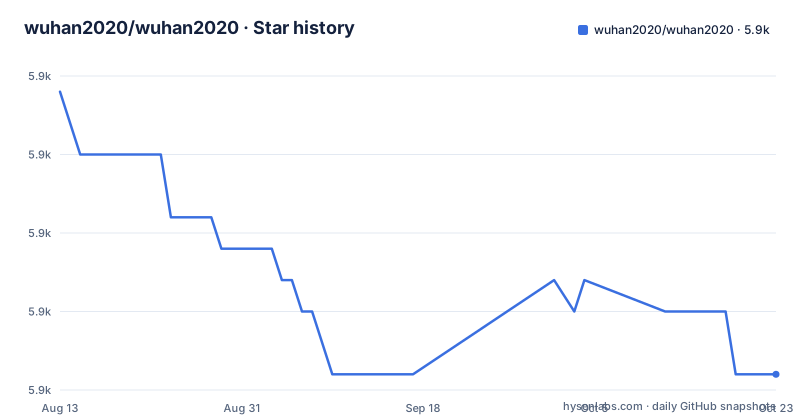
Star history
- wuhan2020/wuhan20205,908 ★ · -9
| Repository | 2026-08-13 | 2026-10-23 |
|---|---|---|
| wuhan2020/wuhan2020 | 5.9k | 5.9k |
-9 Stars in the last 71 days, measured from the daily GitHub snapshot. Compare with other projects
Editorial analysis
The data master repository asks you not to put data in it
The project describes itself as the data master for a platform that began in early 2020 to collect information about hospitals, hotels, factories, logistics, donations, money, prevention and treatment during the outbreak in Wuhan, then publish it in one place so that resources could be shared between parties. What the repository is not is code. The top level holds `.github/`, `.gitignore`, `CONTRIBUTING.md`, `CONTRIBUTING_EN.md`, `LICENSE`, seven README files, and two directories, `data/` and `static/`. There is no source directory and no package manifest of any kind.
That shapes every other instruction attached to it. All data is committed by script, and the opening section asks in bold that nobody submit data into this repository directly. Someone who arrives expecting to add a hospital record has picked the wrong layer of a five-repository system. The project's own primary language is recorded as unknown, which fits a repository whose payload is records rather than an implementation.
Seven README translations, but only two contributing guides
The language switcher offers seven editions: Simplified Chinese, Traditional Chinese in `README_TW.md`, English in `README_EN.md`, Japanese in `README_JP.md`, Italian in `README_IT.md`, Portuguese in `README_PT.md`, and Korean in `README_KO.md`. The tree at the root matches that list exactly, seven README files and nothing else in the documentation department.
Contributing documentation does not follow the same coverage. Exactly two versions of it exist, `CONTRIBUTING.md` and `CONTRIBUTING_EN.md`, and the developer section sends readers to `./CONTRIBUTING.md` alone. A volunteer who starts from the Japanese or Portuguese README therefore ends up reading Chinese instructions, since nothing in the switcher routes them to the English contributor file.
The final line of the FAQ section is a bare Shimo Docs link with no sentence attached to it, so what it contains is not stated anywhere in the text.
Seven spreadsheet categories and ten issue labels are two different taxonomies
Data reaches the platform through Shimo Docs spreadsheets, and seven sheets are linked: hospitals, hotels, logistics, production, donations, clinics, and lodging information for Wuhan residents travelling elsewhere. Editing rights are not open to the whole contributor base. An applicant fills in a Shimo form and invitations go out to specific forms, which makes the approval form itself the permission system for every record in the repository.
GitHub carries a second, parallel set of ten issue label types, and the two lists do not line up. No label corresponds to the travelling-visitor lodging sheet. Three of the ten, `news`, `doc`, and `bug`, describe repository work rather than a category of collected record. The only label whose English name differs from the sheet it serves is `factory`, which backs the production sheet.
/self-assign ends with the bot named as the assignee
For code work the README describes GitHub flow and the GitHub Projects board, with issues and pull requests as the entire interface and a GitHub account as the entry requirement. A volunteer picks an issue from the list and claims it by writing `/self-assign` in a comment. The next sentence is the curious one: the bot sets the issue's `Assignees` field to itself, so the assignee recorded after a self-assignment is the bot rather than the volunteer who typed the command.
The ten label types the bot applies are these, one per line as written in the source, with the mixed punctuation left exactly as found:
hospital: 医院相关信息
factory: 生产相关信息
logistical: 物流相关信息
hotel: 酒店相关信息
donation:捐款相关信息
clinic:义诊相关信息
news:疫情新闻动态相关信息
doc: 文档相关
bug: 缺陷反馈
feature: 新的特性
Six of those ten lines separate the label from its gloss with an ASCII colon and four with a fullwidth one, and `bug` carries a space after its colon. Any script that parses this list has to accept both forms.
Five sibling repositories, four Slack channels
The five code repositories named here are `wuhan2020/data-sync`, `wuhan2020/WebApp`, `wuhan2020/api-server`, `wuhan2020/map-viz`, and `wuhan2020/shimo-sheet2json`. One deployed address is given, for the progressive web app at `https://wuhan2020.kaiyuanshe.cn/`. The other four are described as code repositories with no address attached.
Slack coverage falls one short of that list. Thirteen channels are tabulated and four of them map to subprojects: data synchronisation, web frontend display, data map visualisation, and the API server. The spreadsheet synchronisation component gets no channel at all. The remainder are a default channel, general announcements, design, product requirements, frontend and backend skill groups, a channel for suggestions being sent to the authorities, one for overseas matters, and one run by the channel operations team. Every link is an `app.slack.com` deep link into a single workspace, so none of them resolves before joining the group.
The partner platform is documented with three links, one of them a console settings page
One partner is written up: an Aliyun log service analysis platform, described as completely free, that integrates and synchronises wuhan2020 data automatically and offers one-stop analysis visualisation, report subscription and alerting, plus data subscription or a platform for secondary development. Three links come with it. The public demo is a function compute proxy path carrying `?redirect=true&type=2020`. The analysis platform link points at `sls.console.aliyun.com/lognext/app/ncp/setting`, a settings page inside a console that needs an account of its own. The third is a help document.
Note the protocol split elsewhere in the same file. The project homepage is an `https` address at `wh.opensource-service.cn`, while the community site and its announcement page are written as plain `http` addresses on `community.wuhan2020.org.cn`. The Slack shared invitation, a long token, is printed in full twice, once under the volunteer entry heading and again under the Slack section.
The last commit is 2020-10-30 and there are no releases at all
The most recent commit to this repository is dated 2020-10-30. It is not marked as archived, and it has no GitHub releases, so the commit history is the only record of what changed and when. Everything the README describes as automated describes one period: it states that apart from manual review of submitted information, every other part runs without human intervention.
Two sets of pointers survive alongside that. A Google Groups mailing list is given with subscribe, unsubscribe and archive actions expressed as mail links, and three separate documents are offered as the FAQ: a project FAQ on the community site, an information team FAQ on Shimo, and the unlabelled Shimo link at the end of the file. The section closes on a slogan rather than on anything a reader can act on.
Editorial conclusion
This repository is worth reading as a worked example of how a volunteer data project separates ingestion from publication, and it should not be treated as software anyone can run. The implementation lives in five other repositories, editing rights to the source spreadsheets are granted by invitation rather than by account, and the last commit is dated 2020-10-30 with no tagged release to anchor it. If you want to reuse the arrangement, take the split between script-fed records and review-gated edits, and leave the addresses behind: a console settings page, a proxy demo URL and a Slack shared invitation all belong to one month of 2020.
Frequently asked questions
What is the wuhan2020 repository actually for?
It is the data master for a volunteer platform that collected information about hospitals, hotels, factories, logistics, donations, clinics, prevention and treatment during the outbreak in Wuhan in early 2020. All data is committed by script, and the README asks that nothing be submitted into the repository directly.
Where does the code behind the wuhan2020 web app live?
In sibling repositories rather than here. The README names wuhan2020/WebApp for the progressive web app, wuhan2020/api-server for the API service, wuhan2020/data-sync for data synchronisation, wuhan2020/map-viz for the map component, and wuhan2020/shimo-sheet2json for the spreadsheet synchronisation component.
How do volunteers submit information to wuhan2020?
Through Shimo Docs spreadsheets. Seven sheets are linked, covering hospitals, hotels, logistics, production, donations, clinics and lodging information for Wuhan visitors elsewhere. Editing rights are not open to everyone: applicants fill in a Shimo form and are then invited to specific forms for entry.
Which issue label types does the wuhan2020 bot apply?
Ten of them: hospital, factory, logistical, hotel, donation, clinic, news, doc, bug and feature. A volunteer claims an issue by writing /self-assign in it, and the README states that the bot then sets the issue's Assignees field to itself.
When was the last commit to the wuhan2020 repository?
2020-10-30. The repository is not marked as archived and has no GitHub releases, so the commit history is the only record of changes available here. The front-end deployment address given in the README is a single site at wuhan2020.kaiyuanshe.cn.
Official sources
Add this badge to your README
If you maintain this project, the badge below links readers to this analysis and shows its maintenance status from the daily GitHub snapshot. Paste the markdown into your README; add ?metric=license or ?metric=stars to the image URL for a different field.

[](https://hysenlabs.com/projects/wuhan2020-wuhan2020)Star history chart for your README
[](https://hysenlabs.com/projects/wuhan2020-wuhan2020)Was this useful?