llm-paper-daily lets your agent install the subscription, not a script
Daily updated LLM papers.
At a glance
- What is it?
- A daily digest of LLM and agent papers with Chinese summaries and arXiv links, where the README is generated in marked sections and subscribing is delegated to an agent reading a public feed file. The design promise is narrow and worth noting: the subscription skill reads a feed and never runs the fetching pipeline on your machine.
- Who is it for?
- llm-paper-daily fits someone who wants a filtered daily reading list without maintaining a scraper, since the fetch and summarisation run upstream and your side only consumes a feed file. The subscription path is the sensible one to use: hand the prompt to OpenClaw, Codex or Claude Code and let it follow SUBSCRIBE.md, rather than writing your own scheduled task against the repository.
- Can I use it commercially?
- Not without permission. GitHub finds no licence file in the repository, and without a licence all rights are reserved by default: you may read the code but not reuse it. Check the README, or ask the authors, before using it.
- Is it still maintained?
- Yes. The repository last received commits 1 day ago.
- What is it written in?
- Mainly Python, according to GitHub's language statistics.
Answers come from the project's GitHub data, last synced on November 15, 2026, and from our analysis. They are not legal advice.
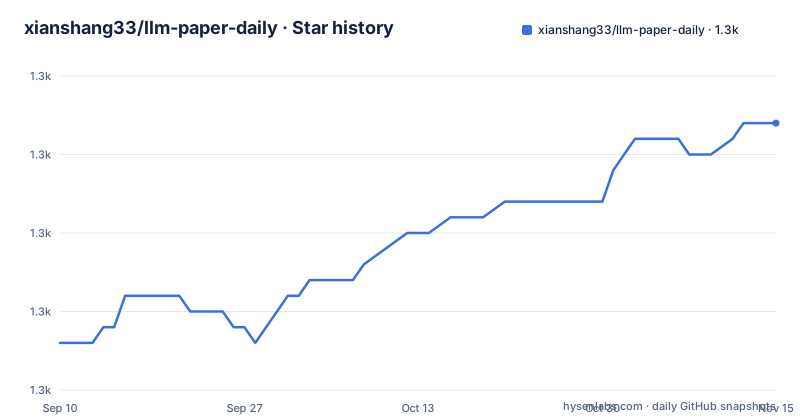
Star history
- xianshang33/llm-paper-daily1,342 ★ · +14
| Repository | 2026-09-10 | 2026-11-15 |
|---|---|---|
| xianshang33/llm-paper-daily | 1.3k | 1.3k |
14 Stars in the last 66 days, measured from the daily GitHub snapshot. Compare with other projects
Editorial analysis
The README is written in three delimited blocks
The repository description is a daily-updated list of LLM papers, and the README presents itself as a daily update and classification platform for LLM and agent research. Each entry arrives with an arXiv address, a related GitHub repository where one exists, and a summary.
What is more interesting is how the document is assembled. Three HTML comment markers appear in the text: a start and end pair around the recent-updates block, and a start marker around the monthly papers section. Those markers are machine-readable boundaries, which means a script rewrites those regions of the README on a schedule and leaves the surrounding prose alone.
That is the right architecture for a daily feed, since hand-editing a README that changes every morning is nobody's idea of a good afternoon. It also has a failure mode: the parts of the document a human wrote are only as current as the last time someone edited them, and nothing in the repository forces that to happen. The static introduction and the subscription instructions are the hand-written parts. The paper tables are not.
The updates block itself is a collapsed section with a timestamp, listing the most recent titles. In the version captured here it is stamped 2026年10月02日 07:31 and lists five papers.
Subscription is delegated to your coding agent
The subscription section starts by saying you do not need to configure a script by hand. Instead you paste a paragraph into a local OpenClaw, Codex or Claude Code session and let the agent do the setup:
请帮我配置 llm-paper-daily 的本地订阅。订阅仓库是 https://github.com/xianshang33/llm-paper-daily ,请阅读仓库根目录的 SUBSCRIBE.md,按文档创建本地配置、预览 digest、安装定时任务,并在完成后告诉我配置文件位置、运行时间、语言、每次推送数量和验证结果。Translated, the request asks the agent to read SUBSCRIBE.md from the repository root, then create a local configuration file, preview a digest, install a scheduled task, and report back the config file location, the run time, the language, how many items to push per run, and the verification result.
Two things are worth noting about how that is framed. The configuration choices are parameters rather than a fixed behaviour, so language and per-run volume are yours to set rather than the project's. And the final request is for verification results, which asks the agent to confirm the schedule actually works instead of declaring success.
This is the same onboarding pattern used by several projects in this space: no installer, no config file in the repository, and the agent reads one markdown file and does the rest. It works well when the agent can read URLs and run shell commands, which is the condition the text names explicitly.
The skill reads a feed and stops there
The sentence that follows the prompt is the most reassuring line in the README. The agent uses the paper-subscribe skill from the repository, reads only the public feed-papers.json file, and does not run the paper fetching or summarisation production pipeline on your machine.
That is a narrow and well-drawn boundary. It separates the part of the system that costs money and hits other people's servers from the part that only reads a file. The scraping and summarisation happen upstream where the maintainer runs them, and what lands on your machine is data plus a schedule.
It also explains the repository's shape. The tree is small and flat: a .github directory, .gitignore, the two READMEs, SUBSCRIBE.md, a data directory, feed-papers.json at the root, a skill directory, and two summary directories. There is no application code to run and no service to host, because the pipeline runs elsewhere.
The file being read is public and the file being written is local. Anything sensitive therefore lives on your side of that line, which is what makes the arrangement comfortable for an agent with shell access to run unattended.
Each row carries three links and a named institution
The paper tables are organised by month, with columns for the date, the paper, and links with a summary. Every row follows the same shape: a date, a bold title, the institution or institutions involved, a summary paragraph, then a set of links.
Three links recur. The first is an arXiv PDF. The second is a summary markdown file in the repository, pathed by month and arXiv identifier, so the October entry with identifier 2610.02002 links to a file under the October summary directory. The third is a GitHub repository, and this one is optional: Mem++ links to a repository, Reconstruct, Practice, Go Real does not, and neither do the IBM, Mimir or TRACE entries.
Keeping summaries in the repository rather than only on a website is the decision that makes this useful offline and diffable. The monthly table format also means the history is browsable: the October table and the September table sit side by side in the document, so a reader can look back through weeks without visiting anything.
The summaries themselves are written rather than extracted. Each one states the problem the work addresses, the approach, and what the experiments showed, which is the shape that makes a digest worth reading instead of a list of titles.
Ten arXiv identifiers, and two languages of summary
The captured tables cover five papers dated the first of October and five dated the thirtieth of September, with more September rows cut off below them. The October identifiers are 2610.02002, 2610.02204, 2610.01833, 2610.02038 and 2610.01887. The September ones are 2609.40221, 2609.40285, 2609.40111, 2609.40303 and 2609.40169.
Looking at what got selected says something about the filter. The October set covers organizational agent memory, self-improvement for embodied agents without weight updates, process-level evaluation of enterprise agent skills, physics-grounded control agents for irrigation, and heuristic design for resource assignment. The September set covers synthetic fictional environments for training search agents, recovery from pivotal mistakes in multi-turn agents, a fifty-thousand-pair agent error dataset for post-training, a controlled study of how much harness a strong model needs for machine learning engineering, and lifelong harness evolution from research papers.
The subject mix is agent infrastructure rather than model architecture: memory, evaluation, error recovery, harness design. That is a coherent editorial position for a daily list, and one worth checking against your own reading before you trust it as a filter.
The repository also carries summary_en alongside summary, and a separate English README, so the summaries exist in both languages even though the default document is Chinese.
The repository description ends mid-sentence
The repository description reads as a draft that was saved without finishing. It opens in English with daily updated LLM papers, switches to Chinese, asks people to subscribe, asks for a star with two emoji in the middle of the text, and then stops on a single orphaned Chinese character with no predicate attached to it.
It is a trivial defect and it is also the first thing a visitor sees, along with the fact that no homepage is set. Neither matters much once you are in the repository, since the README explains the project adequately in its first two sentences.
It is worth mentioning because it is a signal about how much polish to expect elsewhere, and the answer is: moderate. The generated blocks are careful and consistent. The subscription prompt is precise about what it wants the agent to report back. The hand-written parts are where the sloppiness sits, which is the opposite of what you would find in a project maintained by hand throughout.
There are no GitHub releases either, and the project is at version whatever the daily push produces rather than at a tag you can pin.
No licence file, and the repository redistributes summaries
The repository carries eleven top-level entries and none of them is a licence file. The licence field in the repository metadata is empty rather than set to MIT, Apache or anything else, so the terms are simply unstated.
That is a sharper problem here than it would be for most projects, because this repository does not contain only its own work. It contains summaries of other people's papers, written by the maintainer, alongside titles, author institutions and arXiv identifiers belonging to the original authors. The summaries are new text, but the material they describe is not, and arXiv hosts its own licensing expectations for redistributed metadata.
For personal reading this is almost certainly fine and nobody will act on it. For a team that wants to mirror the digest internally, build a dashboard on the summary files, or republish the tables, the absence of a stated licence is a real question rather than a formality.
The right move is to ask the maintainer, and to keep your own copy of what you rely on. The summaries are Markdown files in the repository, so the technical work of forking the digest is trivial; it is the terms that are unclear, not the mechanics.
Editorial conclusion
llm-paper-daily fits someone who wants a filtered daily reading list without maintaining a scraper, since the fetch and summarisation run upstream and your side only consumes a feed file. The subscription path is the sensible one to use: hand the prompt to OpenClaw, Codex or Claude Code and let it follow SUBSCRIBE.md, rather than writing your own scheduled task against the repository. Two cautions. The licence field is empty and there is no licence file, which matters if you plan to republish the summaries. And the README is partly machine-written, so the prose around the generated blocks can drift without anyone reviewing it.
Frequently asked questions
What is llm-paper-daily?
It is a daily update and classification platform for LLM and agent research papers. Each entry carries an arXiv address, a related GitHub repository where one exists, and a written summary, with tables organised by month.
How do I subscribe to llm-paper-daily?
Paste a setup prompt into a local OpenClaw, Codex or Claude Code session. The agent reads SUBSCRIBE.md from the repository root, creates a local configuration, previews a digest, installs a scheduled task, and reports the config path, run time, language, per-run count and verification result.
Does the llm-paper-daily subscription run scraping on my machine?
No. The agent uses the repository's paper-subscribe skill, reads only the public feed-papers.json file, and does not run the paper fetching or summarisation production pipeline locally.
Does llm-paper-daily have an English version?
Yes. The repository holds a README_en.md alongside the Chinese README, and summary files exist in both summary and summary_en directories.
What licence is llm-paper-daily under?
No licence file is present among the repository's top-level entries and the licence field is empty, so the terms are unstated. That matters if you plan to republish the summaries, which describe other authors' work.
Official sources
Add this badge to your README
If you maintain this project, the badge below links readers to this analysis and shows its maintenance status from the daily GitHub snapshot. Paste the markdown into your README; add ?metric=license or ?metric=stars to the image URL for a different field.

[](https://hysenlabs.com/projects/xianshang33-llm-paper-daily)Star history chart for your README
[](https://hysenlabs.com/projects/xianshang33-llm-paper-daily)Was this useful?