nlpm: a linter that scores the markdown files driving coding agents
Natural-Language Programming Manager — scan, lint, and score NL artifacts with Claude-native quality scoring
At a glance
- What is it?
- A validator that treats skills, agents, commands, rules and memory files as programs, scores them out of 100 with fixed penalties, and ships both as Claude Code slash commands and as a single dependency-free Python file for pre-commit hooks. Its own audit pipeline once found 990 mislabelled rule identifiers in its history.
- Who is it for?
- Use nlpm if you publish plugins or skills for a coding agent and want a deterministic score plus a check for artifacts that exist on disk but not in your manifest, since that is the failure it was built around. Do not use it as a general writing grader, because every penalty is a fixed number attached to a specific structural fault rather than a judgement about prose, and do not expect the model-driven commands to run in CI, since the CI path is the separate standalone file.
- Can I use it commercially?
- Yes. ISC is a permissive licence: you can use, modify and sell software built on it, as long as you keep its copyright and licence notices.
- Is it still maintained?
- Yes. The repository received new commits within the last day.
- What is it written in?
- Mainly HTML, according to GitHub's language statistics.
Answers come from the project's GitHub data, last synced on November 14, 2026, and from our analysis. They are not legal advice.
Star history
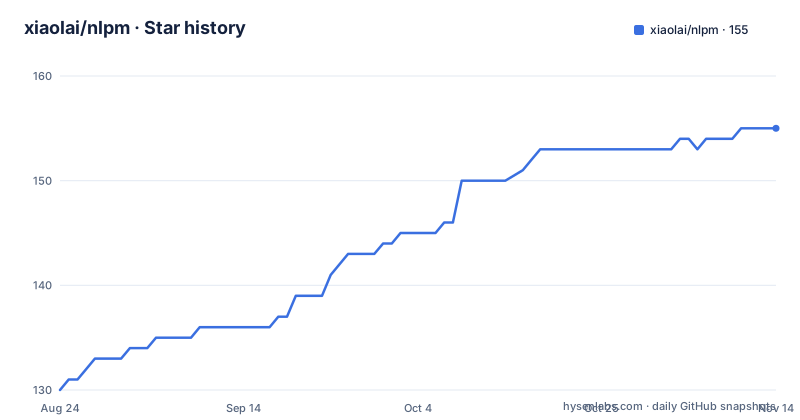
- xiaolai/nlpm155 ★ · +25
| Repository | 2026-08-24 | 2026-11-14 |
|---|---|---|
| xiaolai/nlpm | 130 | 155 |
25 Stars in the last 82 days, measured from the daily GitHub snapshot. Compare with other projects
Editorial analysis
Scores start at 100 and fall by fixed penalties
The scoring model is the easiest part of this project to understand and the easiest to argue with. A score begins at 100 and every issue found subtracts a fixed amount, so the same artifact with the same problems always produces the same number, which the readme states as a property of the design rather than a side effect. The bands are then simple: 90 to 100 is excellent and production-ready, 80 to 89 is good with minor gaps, 70 to 79 is adequate and should improve, 60 to 69 is weak and below threshold, and anything under 60 is a rewrite. The default pass threshold is 70, and it is changed in a local markdown file in the project, so the number a project enforces is a decision rather than a constant. The full penalty tables live in a scoring file, with separate tables for other tools, memory files and workflow programs indexed from it.
The check it claims nobody else runs: manifest against disk
One check is the reason this project exists, and the readme is explicit that it is the differentiator. The bug class is a skill file that exists on disk but is silently absent from the plugin manifest, which means it is invisible after a user installs the plugin. Nothing errors; the artifact is simply never loaded. The readme says this was verified across more than eight tools, naming the official validator and one from the Linux Foundation among them, and it claims no other validator covers it. That claim is documented in a research file in the tree rather than asserted in a footnote, which is the right place to look if you want to check it. The broader framing is the analogy the project leans on: a linter for JavaScript, a linter for Python, and now one for the markdown that drives agent behaviour.
Eight slash commands, and one file for everyone else
Inside a coding agent the tool is eight slash commands, and each does one thing: list and inventory the artifacts in a repository, score them, run cross-component consistency checks, auto-fix what is fixable, track score trends over time, run artifact tests against spec files, initialise the tool for a project, and scan plugins for security risks in executable artifacts. Scoring accepts a path or a changed-files flag. Everything above requires the agent runtime, which is why there is a second path. The standalone validator is a single Python file with no external dependencies, and the readme stresses that it runs the deterministic subset of the consistency check, exiting non-zero on high-confidence findings. It installs with a two-line fetch and a chmod:
curl -fsSL -o /usr/local/bin/nlpm-check \
  https://raw.githubusercontent.com/xiaolai/nlpm/main/bin/nlpm-check
chmod +x /usr/local/bin/nlpm-check
nlpm-check .               # exit 1 on high-confidence findings
Drop-in templates for a pre-commit hook and an Actions workflow are also provided.
Two marketplaces, and the maintainer's own can be stale on disk
There are two install routes and they differ in a way that catches people out. The first adds the vendor's curated community marketplace, and the readme warns that updates there lag the maintainer's own marketplace by up to about a day. The second adds the maintainer's marketplace, where the newest version lands first, and installs with either project or user scope, with project scope marked as the recommendation. The failure mode is documented as a specific error message about a plugin not being found, and the cause is a stale local clone of the marketplace rather than a missing plugin. The fix is to update the marketplace explicitly and retry, because the install command does not refresh the clone on its own. The readme notes that the community marketplace does not have this caveat, which is a small argument for the slower path if you hit it.
The rubric is per-tool, across three ecosystems
The word multi-tool in this project's claims refers to something specific: the scoring rubric covers three ecosystems through what the readme calls tier-aware overlays, those being the Claude Code plugin format, the Codex command line format, and a third one. The same structural fault is expressed differently in each, so the penalty tables are not shared, and the readme says outright that the tables for the second and third ecosystems, for memory files and for workflow programs, are kept in a references directory and indexed from the main scoring file. This is also why the manifest-versus-disk check matters beyond one runtime: a manifest format that differs per tool is exactly the kind of thing that gets updated in one place and forgotten in another. The rubric's per-tool structure is the answer to that, at the cost of needing to read the right table.
It audits other people's plugin repositories and writes back
Past the linting, the project describes itself as a self-evolving pipeline running in continuous integration, and the mechanism is worth understanding because it explains why the rule set grows. The pipeline audits real plugin repositories, contributes fix pull requests to them, harvests teaching examples from the ones that come out clean, and feeds what it learns back into its own rule catalogue. The exemplar stage does the harvesting: any repository auditing clean at a score of 90 or above produces a teaching artifact, and the readme counts 62 published so far, covering 31 of the 50 rules with real-world positive references. The citation stage then runs weekly and opens a pull request that adds a real-world example link next to each rule, with a human approving the merge. So each rule ends up documenting a bad case in its own body and a good case in a repository somebody actually runs.
The pipeline found 990 mislabelled rule IDs in its own history
The most revealing number in the readme is a self-inflicted defect. A two-stage detector re-validates every audit's rule identifier twice: once against the rubric, which catches a value of the wrong type, and once against the rule's own title keywords, which catches an identifier that is the right shape but points at the wrong rule. A sweep on May 13, 2026 found 990 mislabelled identifiers across 128 historical audits. That is a substantial fraction of the audit history being scored against the wrong rule, and the readme says the detector is now wired in as a soft warning in every new audit so the drift is caught as it happens rather than found later. A companion script then calibrates the per-rule health view, reporting validated hits as raw hits minus drift hits alongside the number of exemplars for that rule, so the rules that look broken are measured against real violations rather than labelling noise.
A plugin repository that is also a documentation website
The tree explains the rest. Alongside the readme are per-tool plugin manifests and per-tool configuration directories for three ecosystems, which is how one repository ships to all of them, plus rule, example, privacy and agent instruction files at the root and a badge file. The working directories split by role: the skills the tool itself uses, the auditor with its scripts and exemplars, the standalone binary, case studies, hook and command definitions, the documentation, the template directory, the tests, a self-test directory, and a site directory. That last one is why the repository's reported primary language is HTML rather than Python, since the tool itself is one Python file plus a small tree. The licence is ISC, there are no tagged releases, and the last push to the main branch is dated September 30, 2026.
Editorial conclusion
Use nlpm if you publish plugins or skills for a coding agent and want a deterministic score plus a check for artifacts that exist on disk but not in your manifest, since that is the failure it was built around. Do not use it as a general writing grader, because every penalty is a fixed number attached to a specific structural fault rather than a judgement about prose, and do not expect the model-driven commands to run in CI, since the CI path is the separate standalone file. Before you wire it into a pre-publish gate, read the penalty tables for your own tool, since the rubric is per-tool, and set the pass threshold deliberately rather than inheriting the default.
Frequently asked questions
What does NLPM check that other artifact linters do not?
It treats the markdown files that drive coding tools as programs: skills, agents, commands, rules, hooks, prompts, CLAUDE.md and memory files. Its distinguishing check is manifest-versus-disk consistency, where a skill file exists on disk but is missing from the plugin manifest and so is invisible after installation. The readme says it verified this against more than eight other tools.
How do I install NLPM?
Two routes, both reaching the same code. One adds the vendor's curated community marketplace and installs from it, accepting up to about a day of update lag. The other adds the maintainer's own marketplace, where the newest version lands first, and installs with project or user scope. A plugin-not-found error on the second route means your local clone is stale and the marketplace needs updating, because install does not refresh it.
How is NLPM scored and what is the pass threshold?
A score starts at 100 and falls, every issue subtracts a fixed penalty, and the same artifact always produces the same number. The bands run from excellent at 90 to 100 down to rewrite below 60, the default pass threshold is 70, and you change it in a local markdown file. The full penalty tables, including separate ones per tool, for memory files and for workflow programs, live in the scoring skill file.
Official sources
Add this badge to your README
If you maintain this project, the badge below links readers to this analysis and shows its maintenance status from the daily GitHub snapshot. Paste the markdown into your README; add ?metric=license or ?metric=stars to the image URL for a different field.

[](https://hysenlabs.com/projects/xiaolai-nlpm)Star history chart for your README
[](https://hysenlabs.com/projects/xiaolai-nlpm)Was this useful?