1000 Chinese Independent Developer Projects List
👩🏿💻👨🏾💻👩🏼💻👨🏽💻👩🏻💻中国独立开发者项目列表 -- 分享大家都在做什么;Chinese Independent Developers Projects List - Discover What Everyone Is Building 👩🏿💻👨🏾💻👩🏼💻👨🏽💻👩🏻💻
At a glance
- What is it?
- This repository is a categorized discovery list for products built by Chinese independent developers, with links to tools and ventures across infrastructure, AI, finance, security, productivity, and other fields. Its value is breadth and inspiration, not verified product selection.
- Who is it for?
- Adopt this repository as a research directory if you want examples of Chinese independent products and a fast way to discover narrow tools or business models. Do not adopt it as infrastructure, a software dependency, or evidence that a listed project is profitable or maintained.
- Can I use it commercially?
- Yes. Apache-2.0 is a permissive licence: you can use, modify and sell software built on it, as long as you keep its copyright and licence notices.
- Is it still maintained?
- Yes. The repository last received commits 1 day ago.
- What is it written in?
- GitHub does not report a main language for this repository.
Answers come from the project's GitHub data, last synced on November 7, 2026, and from our analysis. They are not legal advice.
Star history
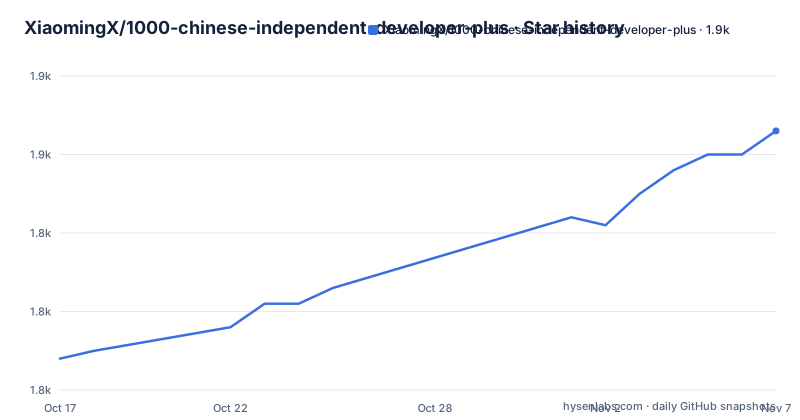
- XiaomingX/1000-chinese-independent-developer-plus1,853 ★ · +29
| Repository | 2026-10-17 | 2026-11-07 |
|---|---|---|
| XiaomingX/1000-chinese-independent-developer-plus | 1.8k | 1.9k |
29 Stars in the last 21 days, measured from the daily GitHub snapshot. Compare with other projects
Editorial analysis
A catalog for product discovery, not a runnable platform
This repository solves a discovery problem for developers and founders who want to see what Chinese independent developers are building. Its README presents a collection of products, tools, websites, and services, arranged by areas such as infrastructure, development workflow, security, finance, education, AI, frontend development, backend tools, content distribution, and tax compliance. Its intended value is not an application that every user installs. It is a map of ideas and destinations that can help someone identify an unmet need, compare product positioning, or find a specialized service.
The documented format is a Markdown table with a category, developer name, project name, external link, and description. A reader can scan rows without first learning a new API or command. The categories are broad, but many entries are narrow. Printery is described as a Figma-to-print workflow tool with CMYK and bleed support. EasyTransfer is listed as an anonymous, end-to-end encrypted transfer service. PDFLance is presented as a local-processing PDF tool, while Content Credentials is associated with C2PA verification. This variety makes the list useful for product research, although it also means that entries are not directly comparable.
The descriptions contain strong commercial opinions. They discuss market opportunity, technical barriers, retention, privacy, and monetization, but the README does not provide revenue figures, adoption counts, comparative tests, or a uniform quality score. A row should therefore be treated as a lead for further investigation. The repository itself does not turn these projects into an integrated software platform.
External links define each product experience
The actual product experience described by each row sits outside the repository. The README does not document installation instructions for the listed services because most entries are links to websites or hosted applications. CheckAIBots is linked through `checkaibots.com`, JSON Translator through `jsontrans.fun`, and Tiny RDM through `redis.tinycraft.cc/zh/`. The catalog does not provide a common client, shared configuration format, or deployment method for these destinations.
This boundary has practical consequences. A developer cannot assume that adding this repository as a dependency will give access to the services listed inside it. Nor does the table establish that every service has a free tier, an API, a self-hosted edition, or a stable endpoint. The descriptions sometimes identify important product attributes, such as local processing, Docker integration, or browser-based execution, but those claims apply to individual entries and should be checked against each product's own documentation.
The table is most useful when used as a sequence of hypotheses. A row about HTTPS automation may suggest investigating certificate renewal workflows. A row about local image processing may suggest comparing upload and offline-processing policies. A row about Redis desktop clients may point to a developer-tool category. The catalog can speed up discovery, but it cannot replace product-specific setup instructions or a technical comparison.
Contribution through GitHub issues, without a documented review process
The only documented contribution method is an issue submission. The README asks readers to submit articles, software, or resources through the repository's issue link. That makes the catalog relatively easy to extend without requiring a pull request or a release process. It also places review work on maintainers and contributors, because the README does not state who approves submissions, what fields a submission must contain, or how duplicate and outdated entries are removed.
The repository has no GitHub releases, so there is no release channel described in the README. Its visible files include `README.md`, `DATA_UPDATE.md`, `docs/`, and `src/`, but the README does not explain whether `src/` contains a generator, a scraper, or other maintenance code. Readers should not infer an automated update pipeline from those directory names alone.
The repository is not archived, and its last push was on 2026-10-17. That fact indicates recent repository activity, but it does not guarantee that every linked project remains available or that each project in the table is actively supported. Catalog entries point to external services, so their maintenance conditions may differ from the maintenance condition of this repository.
A first practical use is browse, select, then inspect
There are no installation steps for this repository as a user-facing product. The README does not document commands for running `src/`, starting a local site, or installing a package. For a first use, open the README and scan the category and project columns. Then open the external link for a project that matches your problem. That is the first real boundary: the repository helps you choose where to look, while the linked product documentation determines how to sign up, configure, or use the service.
The README suggests that contributors can submit a software product, article, or resource through an issue:
# Open the repository issue submission page in a browser
https://github.com/XiaomingX/1000-chinese-independent-developer-plus/issues/new
This is a link rather than a shell command. It is relevant to contributors, not to someone expecting to install the catalog. A reader interested in document conversion can locate TO MD in the table, follow its link, and use the information published by that service. The README does not state that all listed projects share a free account, that their features are available in every region, or that their terms are compatible with a particular deployment.
This absence of installation instructions is not necessarily a defect. It reflects the difference between a curated index and a software distribution. It does mean that the project should not be evaluated as though it were a command-line application.
Commercial commentary is useful for hypotheses, not proof
The README's strongest editorial contribution is its attempt to explain why each project may matter. It describes narrow workflows as opportunities to serve specific users, and it highlights mechanisms such as switching costs, local processing, encrypted transfer, browser-side GPU testing, document conversion, and API-like access. These observations can be useful when generating project ideas or deciding which categories deserve deeper research.
The problem is the evidence boundary. The repository does not provide a consistent scoring rubric, a comparison of pricing, independent usage data, or a method for verifying statements such as conversion potential, customer loyalty, or market growth. Terms such as strong market demand and high commercial value appear as editorial judgments in the descriptions, not as measured conclusions supplied by a test suite.
Readers should separate three questions. First, does the project address a real workflow? The README often identifies a concrete problem, such as Figma-to-print preparation, Redis administration, video editing, or certificate renewal. Second, does the product deliver that workflow? That must be checked on the linked service. Third, does the business sustain itself? The repository does not provide enough evidence to answer this question. It is best used for shortlisting and question generation, not for investment or procurement decisions.
Apache-2.0 applies to the catalog, not automatically to linked services
The repository is identified as licensed under Apache-2.0. That license applies to the repository's own code and documentation according to the repository's licensing structure, but the README does not reproduce the full license text or state which individual files it covers. Users who need exact obligations should inspect the `LICENSE` file.
The listed products are external destinations. The README does not say that those websites, hosted applications, APIs, or generated assets use Apache-2.0. A link in an Apache-2.0 catalog does not transfer the catalog's license to the linked product. Anyone planning to reuse code, data, branding, documentation, or service output should examine the relevant project's own license and terms.
The upgrade cost is divided into two parts. Maintaining this repository may involve checking whether links remain valid and whether new entries meet the catalog's criteria, although the README does not document an automated validation process. Selecting and operating a listed service is a separate cost. That may include learning its workflow, accepting its pricing, integrating its API, reviewing data handling, or replacing it if its availability changes.
When this directory is the wrong tool
This repository is the wrong tool when a team needs a deployable application, a dependable API, a vendor-neutral software catalog, or documented evidence for a purchase. The README contains no service-level commitments, compatibility matrix, benchmark data, or technical integration contract. It also does not explain whether entries are sorted by quality, popularity, revenue, or editorial preference.
It is also unsuitable as a dependency or as a security assurance list. Several descriptions mention privacy, encryption, content authenticity, or local processing, but those claims describe listed products rather than a verified security assessment by this repository. A team handling medical images, financial information, tax filings, private documents, or identity data should inspect the selected product's own documentation and policies before using it.
Compared with a focused product directory, this list offers breadth but less consistency. Compared with a technical evaluation, it offers interpretations but no tests. Compared with a software marketplace, it provides links without a shared purchase, deployment, or support framework. Its right role is discovery. A team that needs stronger evidence should use the entries as leads and evaluate each destination separately.
Editorial conclusion
Adopt this repository as a research directory if you want examples of Chinese independent products and a fast way to discover narrow tools or business models. Do not adopt it as infrastructure, a software dependency, or evidence that a listed project is profitable or maintained. First open the individual product link, inspect its current documentation and status, and check whether its data handling and license fit your intended use.
Frequently asked questions
What is 1000 Chinese Independent Developer Projects List used for?
It is a categorized directory for discovering products and tools built by Chinese independent developers. The README describes it as a source of product ideas, niche workflows, and commercial examples.
How do I add a project to 1000 Chinese Independent Developer Projects List?
The README asks contributors to submit an article, software product, or resource through the repository's issue submission page. It does not document a separate submission command or automated process.
Does this repository install or run the projects it lists?
No installation instructions are provided for the catalog as a user-facing application. Each row links to an external project, so setup and usage depend on that project's own documentation.
Official sources
Add this badge to your README
If you maintain this project, the badge below links readers to this analysis and shows its maintenance status from the daily GitHub snapshot. Paste the markdown into your README; add ?metric=license or ?metric=stars to the image URL for a different field.

[](https://hysenlabs.com/projects/xiaomingx-1000-chinese-independent-developer-plus)Star history chart for your README
[](https://hysenlabs.com/projects/xiaomingx-1000-chinese-independent-developer-plus)Was this useful?