llm-action: A Chinese-Language Field Guide to Training, Tuning, and Serving LLMs
Shares the technical principles and practical experience of large language models, covering LLM engineering and real-world application deployment.
At a glance
- What is it?
- llm-action is a Chinese-language repository of tutorials and code for training, fine-tuning, compressing, and serving large language models, aimed at engineers who want hands-on examples rather than abstract theory.
- Who is it for?
- Adopt llm-action if you read Chinese comfortably and want a structured path from 6B to 65B model fine-tuning with real commands and code, especially for LoRA, QLoRA, and RLHF. Skip it if you need English documentation or a maintained, packaged library with releases.
- Can I use it commercially?
- Yes. Apache-2.0 is a permissive licence: you can use, modify and sell software built on it, as long as you keep its copyright and licence notices.
- Is it still maintained?
- Yes. The repository last received commits 31 days ago.
- What is it written in?
- Mainly HTML, according to GitHub's language statistics.
Answers come from the project's GitHub data, last synced on November 14, 2026, and from our analysis. They are not legal advice.
Star history
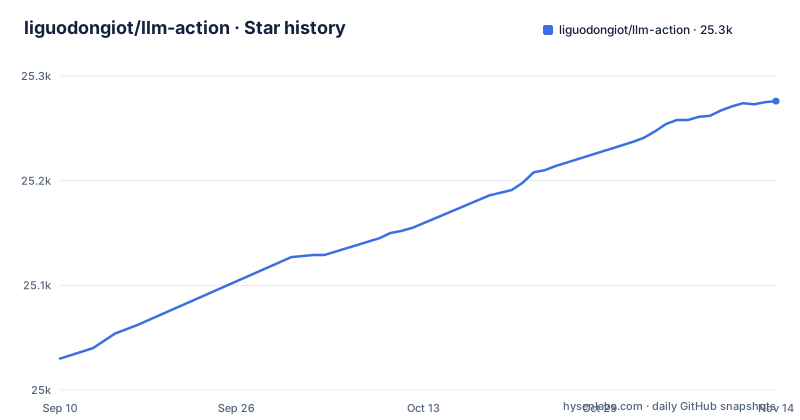
- liguodongiot/llm-action25,276 ★ · +246
| Repository | 2026-09-10 | 2026-11-14 |
|---|---|---|
| liguodongiot/llm-action | 25k | 25.3k |
246 Stars in the last 65 days, measured from the daily GitHub snapshot. Compare with other projects
Editorial analysis
What This Repository Actually Is
llm-action is not a software library. It is a curated collection of tutorials, code snippets, and links to Chinese-language articles, mostly hosted on Zhihu, covering the full lifecycle of large language models. The README organizes content into categories: training, fine-tuning, distributed training, inference, compression, evaluation, data engineering, prompt engineering, and even LLMOps. The author, liguodongiot, has written detailed walkthroughs for reproducing models like Alpaca, ChatGLM, Vicuna, and MiniGPT-4. For each entry, the table lists the base model, the technique used (full fine-tuning, LoRA, QLoRA, P-Tuning v2, RLHF), the parameter size, a link to a tutorial, and often a link to accompanying code. The intended audience is engineers who want to replicate specific training runs, not researchers looking for novel methods. The repository is a map to the author's own learning path, and it is honest about being a collection of practical experience rather than a formal textbook.
The Mechanism: A Table-Driven Index to Real Code
The core mechanism is a set of README tables that link each tutorial to a code directory within the repository. For example, the Alpaca full fine-tuning tutorial points to llm-train/alpaca, while the LoRA variant points to llm-train/alpaca-lora. The ChatGLM LoRA example has code under llm-train/chatglm-lora, and the full fine-tuning with P-Tuning v2 lives under llm-train/chatglm. This structure lets a reader jump from a conceptual article to a runnable script without hunting through a monolithic codebase. The repository also includes standalone scripts, like the GaLore example, which is a single file at llm-train/galore/torchrun_main.py. The repository's top level has no unified build system or dependency file such as requirements.txt.
Getting Started: Commands and Config Keys in the README
The README does not give a single set of installation commands. Instead, it points to specific tutorials that contain the actual steps. The GaLore example links to a single file, llm-train/galore/torchrun_main.py. For other examples, the pattern is to follow the linked Zhihu article. For instance, the QLoRA tutorial claims that fine-tuning LLaMA-65B requires only 48GB of VRAM, which suggests the code includes quantization parameters. This is a limitation: the repository is a pointer, not a self-contained guide. You must open the linked articles to get the real commands, environment variables, and dataset paths. The author does not provide a docker image or a requirements.txt at the top level, so expect to assemble dependencies per example.
The Scope: From 6B to 65B, But With a Chinese-Language Ceiling
The repository covers an impressive range of model sizes and techniques. The training section alone includes full fine-tuning of Alpaca 7B, LoRA on LLaMA 7B and 65B, QLoRA on LLaMA 65B, and P-Tuning v2 on ChatGLM-6B. There is also a section on distributed training parallel techniques. The inference section lists separate frameworks and optimization techniques, and the compression section covers quantization, pruning, knowledge distillation, and low-rank factorization. The author also includes a section on adapting LLMs to domestic Chinese platforms (国产化适配), which is rare in English-language resources. However, the entire corpus is in Chinese. Every tutorial link points to Zhihu or similar Chinese platforms. For a non-Chinese reader, this is a hard barrier. Even the code comments and variable names may be in Chinese. This is not a minor inconvenience; it means the repository is effectively inaccessible to engineers who do not read technical Chinese.
A Genuine Limitation: No Releases, No Versioning, and a Moving Target
The repository has no releases, and the last push was on 2026-10-14, which suggests it is actively maintained, but that also means the content can change without notice. The README is a living document, and the linked articles may be updated or removed independently. For example, the QLoRA tutorial may rely on an older version of the bitsandbytes library that behaves differently today. Because there is no release tag, you cannot reproduce a known-good state of the repository. If a tutorial breaks due to a dependency update, there is no fallback. This is a significant operational risk for anyone planning to run these examples in production or even in a classroom. The repository is best treated as a historical record of what worked at a certain time, not as a stable reference.
The Alternative: Official Framework Documentation and Model Cards
The direct alternative is to use the official documentation and example repositories of the underlying frameworks. For fine-tuning, Hugging Face's PEFT library provides maintained examples for LoRA and QLoRA, with versioned releases and clear installation instructions. For distributed training, the DeepSpeed documentation includes a full RLHF training example that is more likely to be current than a third-party tutorial. For inference, vLLM or TensorRT-LLM offer official guides with benchmark numbers and configuration files. The difference in approach is that llm-action is a narrative walkthrough written by one practitioner, while official docs are reference manuals maintained by the tool authors. The former can explain why a technique works, but the latter gives you exact, tested commands for a specific version. If you need to debug an issue, official issue trackers and changelogs are more useful than a static tutorial. The trade-off is that official docs rarely cover the Chinese-language models like ChatGLM or BELLE as thoroughly as this repository does.
Licence and Maintenance Cost
The repository is licensed under Apache-2.0, which is permissive for both commercial and personal use. That means you can copy the code and tutorials into your own projects, provided you retain the license notice. However, the license applies to the repository content, not to the linked articles on Zhihu, which are under the platform's terms. The maintenance cost is low in terms of code dependencies, since there is no package to upgrade. The real cost is the time you spend adapting each example to your own environment. Because the repository does not provide a unified environment, you will likely need to create separate virtual environments for different examples, each with its own framework versions. The author's own effort is ongoing, as indicated by the active push history, but there is no guarantee that older tutorials are updated to match new library releases. You should check the date of each linked article and compare it with the current versions of the tools it uses.
Editorial conclusion
Adopt llm-action if you read Chinese comfortably and want a structured path from 6B to 65B model fine-tuning with real commands and code, especially for LoRA, QLoRA, and RLHF. Skip it if you need English documentation or a maintained, packaged library with releases. Before relying on it, verify that the linked Zhihu articles are still accessible and that the code examples match the versions of frameworks (DeepSpeed, Transformers) you plan to use. The repository is a curated index and tutorial set, not a tool you install, so treat it as a starting point for your own experiments, not as a dependency.
Frequently asked questions
What is liguodongiot/llm-action and who is it for?
It is a personal collection of Chinese-language tutorials on LLM training, inference and application deployment, published as a Zhihu column with supporting code kept in a git repository. It is aimed at engineers who want guided walk-throughs of specific fine-tuning methods, not at users looking for an installable tool.
Does llm-action ship runnable code for every tutorial?
No. Most rows in the training table link to a code directory under llm-train/, but the BELLE, Vicuna and MiniGPT-4 entries list the code column as N/A, so those walk-throughs ship without code. The GaLore row exposes a single script at llm-train/galore/torchrun_main.py.
Can I install llm-action as a package?
There is nothing to install. The repository has no setup.py, no pip package and no GitHub releases. You read the content on the linked Zhihu column, or browse topic directories such as llm-train/ and llm-inference/ directly in the repository.
Is llm-action available in English?
No. The prose is Chinese, hosted on Zhihu, Juejin and a CSDN blog, with no English translation in the repository. An English-only reader can still use the code directories and the method-to-model-size mapping in the training table.
Official sources
Add this badge to your README
If you maintain this project, the badge below links readers to this analysis and shows its maintenance status from the daily GitHub snapshot. Paste the markdown into your README; add ?metric=license or ?metric=stars to the image URL for a different field.

[](https://hysenlabs.com/projects/liguodongiot-llm-action)Star history chart for your README
[](https://hysenlabs.com/projects/liguodongiot-llm-action)Was this useful?