Weekly: a transcript-derived archive with two broken index links
Archive of the various software and projects mentioned in Xuanli199's weekly tech roundup.
At a glance
- What is it?
- This repository collects the software and open source projects mentioned in a weekly Chinese technology video, published as a static site and a collaborative wiki. The author says plainly that the text comes from the video transcript, and the index itself carries a handful of copy and paste errors worth knowing before you rely on it.
- Who is it for?
- This repository suits a reader who watched the videos and wants the links in a searchable form, rather than anyone treating the summaries as reviewed technical writing. Three things to understand before you cite it.
- Can I use it commercially?
- Not without permission. GitHub finds no licence file in the repository, and without a licence all rights are reserved by default: you may read the code but not reuse it. Check the README, or ask the authors, before using it.
- Is it still maintained?
- Yes. The repository last received commits 14 days ago.
- What is it written in?
- Mainly TypeScript, according to GitHub's language statistics.
Answers come from the project's GitHub data, last synced on November 7, 2026, and from our analysis. They are not legal advice.
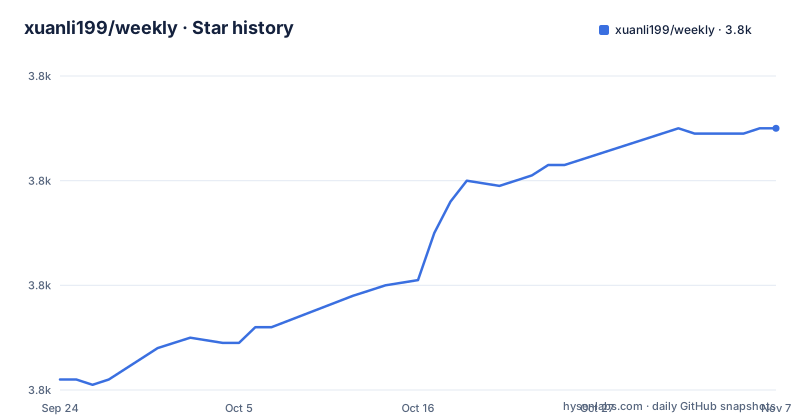
Star history
- xuanli199/weekly3,830 ★ · +48
| Repository | 2026-09-24 | 2026-11-07 |
|---|---|---|
| xuanli199/weekly | 3.8k | 3.8k |
48 Stars in the last 44 days, measured from the daily GitHub snapshot. Compare with other projects
Editorial analysis
The content comes from a video transcript, and the page admits it
The second paragraph of the repository page sets expectations, and it is the most useful thing on it. The project is a summary of the software and open source projects mentioned in a weekly technology video series, written so viewers can bookmark and search them. Then the sentence that matters: the content comes from the video's transcript, so some of it reads strangely on its own, and the page recommends watching the video alongside. That is a transcript, not an edited article, and the author is telling you so rather than letting you find out. It also explains the shape of the whole repository. There is no analysis and no opinion in it; there is an index of links with short descriptions, generated week by week from speech. Anyone using it for technical decisions should read past the summary and open the project itself, because a spoken one-line description of a tool is the weakest possible source for what a tool does.
Three homes for one archive, one of them a shared wiki
The content is published in three places. There is the repository itself, holding one markdown file per episode. There is a static site, served from a project pages address, which is what most people will read. And there is a page on a collaborative document platform, the kind used for team wikis, whose address includes what looks like a workspace or document token in the path. That third home is the interesting one. A collaboratively editable wiki is a good fit for an archive that a community can add to, and it is also a place where the content can be edited by people who never touch the repository. Nothing on the page explains which of the three is authoritative or how they are kept in step, so a reader who finds a tool in one of them has no way to know whether the others agree.
One index entry links to the wrong episode's file
The index is the whole navigation of the repository, and it is maintained by hand, which means it carries hand-maintained errors. One is unambiguous: the entry for episode ninety-two, covering the first week of March 2026, links to the file for episode ninety-five. So a reader who wants the first week of March gets the third week instead, with no indication that anything is wrong. It is the kind of mistake that only happens once, and it survives because nothing checks that the number in the link matches the number in the label. It is also the error most likely to be found and fixed quickly once reported, and it is a good illustration of the trade-off in a repository whose entire value is being a reliable index.
Two pairs of episodes share an identical date range
The dates have their own errors. Two pairs of consecutive episodes are listed with exactly the same week. Episodes thirteen and fourteen in August 2024 both claim the same range, and episodes twenty-five and twenty-six in November 2024 both claim a different but also identical range. Since each episode covers one week and the numbering is otherwise strictly sequential, one entry in each pair must be wrong. There is also a year typo in one January 2025 entry, whose end date is written with the previous year, and one November 2025 entry whose start date is missing the character that ends a date while every neighbouring row has it. None of these change what you read; all of them change which week you think you are reading, which for an archive whose purpose is finding a specific tool from a specific week is the difference between a useful index and a misleading one.
The stated purpose includes search, and the build suppresses the search client
The repository's stated purpose has two halves: making the links easy to bookmark, and making them easy to search. The second half is where the configuration gets interesting. The project manifest asks the package manager to ignore a missing peer dependency, and the dependency it names is a search client library. In other words the build is explicitly configured not to fail on the absence of the search component. That can be read two ways. Either the search integration is optional and the site works without it, in which case the configuration is a routine way to silence a peer dependency warning for an optional feature. Or the search integration is present in the site and resolves at runtime rather than through the package graph, in which case the missing dependency is real and the suppression is hiding it. The page does not say which. Either way, anyone arriving at the static site expecting a working search box is relying on something the build does not guarantee.
The first ten episodes use Chinese numerals and the rest use digits
Watch the index move from the top and the labelling convention changes at episode eleven. Episodes one through ten are written with Chinese numerals, and every episode from eleven onward uses Arabic digits. The file names are Arabic throughout, zero padded to two digits for the single digit ones, which means the earliest episodes have a two character filename and everything later has a three character one. It is a small inconsistency and it is the kind that matters for anything scripted: a scraper that parses the visible numbering has to handle both forms, and a scraper that reads only filenames will find the first ten episodes out of order unless it sorts numerically rather than lexically. The rest of the index is consistent: month headings in descending order, newest first, one bullet per episode.
The archive stops about four weeks before today, on a weekly cadence
The most recent episode listed is number one hundred and eighteen, covering the last week of August and the first days of September 2026. The repository was last pushed on 10 September 2026. Today is early October. So on a series that has run weekly since June 2024 without a break in the numbering, roughly three or four episodes are missing from the index, and the repository has not been touched for about three and a half weeks. That is not a long absence by the standards of this kind of project, and it may simply mean the author is catching up or taking a break. It does mean that if you arrive looking for what was mentioned in the last three weeks of September, there is nothing here, and nothing on the page indicates a gap. The commit date is the only freshness signal available, since there are no releases and no per-episode timestamps beyond the week each one covers.
Editorial conclusion
This repository suits a reader who watched the videos and wants the links in a searchable form, rather than anyone treating the summaries as reviewed technical writing. Three things to understand before you cite it. The page itself says the content comes from the video transcript, that some of it reads oddly because of that, and that it is best read alongside the video. The index is maintained by hand and has errors, including one entry that opens the wrong week's file and two pairs of entries that share an identical date range. And the archive is a mirror of someone else's publishing, kept in three places at once, so if the primary source changes this will drift from it.
Frequently asked questions
What does "weekly" mean?
In this repository, weekly is the name of a Chinese technology video series and the archive of the tools mentioned in it. The repository collects the software and open source projects covered each week so viewers can bookmark and search them, with one markdown file per episode numbered sequentially from one to one hundred and eighteen, covering June 2024 to September 2026.
Is weekly every 7 days?
The archive treats each episode as one week, and the index gives each entry a start and end date within a single week, so yes by convention. Two pairs of consecutive episodes, however, are listed with identical date ranges, so for those entries the convention does not hold and one of each pair is wrong. The most recent episode also ends in early September while the series is otherwise unbroken, so the archive currently stops a few weeks short of the present.
what is weekly planner
Nothing in this repository is about planners. It is an archive of software and open source projects mentioned in a weekly technology video series, published in three places: this repository of markdown files, a static site, and a page on a collaborative wiki platform. The author states that the summaries are derived from the video transcript, so some entries read oddly when read on their own.
how to use weekly planner
This repository does not document a planner or any other application to use. What it documents is itself: episodes are markdown files under one directory, indexed from the repository page by month, and rendered as a site built with a documentation site generator plus an RSS feed plugin, with a preview server for local work. Both of those build dependencies are pinned to exact versions and the project pins its package manager version too.
What are weekly days?
The repository does not use that phrase. Its unit of publication is an episode numbered in sequence, each covering one week of calendar dates, and episodes are grouped under month headings in descending order. The only day-specific instruction anywhere on the page is the author's recommendation to watch the source video alongside the transcript-derived summaries.
Official sources
Add this badge to your README
If you maintain this project, the badge below links readers to this analysis and shows its maintenance status from the daily GitHub snapshot. Paste the markdown into your README; add ?metric=license or ?metric=stars to the image URL for a different field.

[](https://hysenlabs.com/projects/xuanli199-weekly)Star history chart for your README
[](https://hysenlabs.com/projects/xuanli199-weekly)Was this useful?