YichiZhang98/SAM4MIS: a literature tracker for SAM in medical imaging
Segment Anything Model for Medical Image Segmentation: Open-Source Project Summary
At a glance
- What is it?
- SAM4MIS is a curated reading list rather than a model or a library. It tracks how the Segment Anything family has been adapted to medical image and video segmentation, with a survey paper, dated tables of adaptations and links to the code where authors published it.
- Who is it for?
- Adopt SAM4MIS as a starting point when you are surveying how the Segment Anything family has been applied to medical imaging, and when a dated table with links to the available code saves hours of reading. Do not adopt it as a tool, a model or a dataset pipeline, because the repository contains a README and images only, with no code, no licence statement and no releases.
- Can I use it commercially?
- Not without permission. GitHub finds no licence file in the repository, and without a licence all rights are reserved by default: you may read the code but not reuse it. Check the README, or ask the authors, before using it.
- Is it still maintained?
- Yes. The repository last received commits 2 days ago.
- What is it written in?
- GitHub does not report a main language for this repository.
Answers come from the project's GitHub data, last synced on November 7, 2026, and from our analysis. They are not legal advice.
Star history
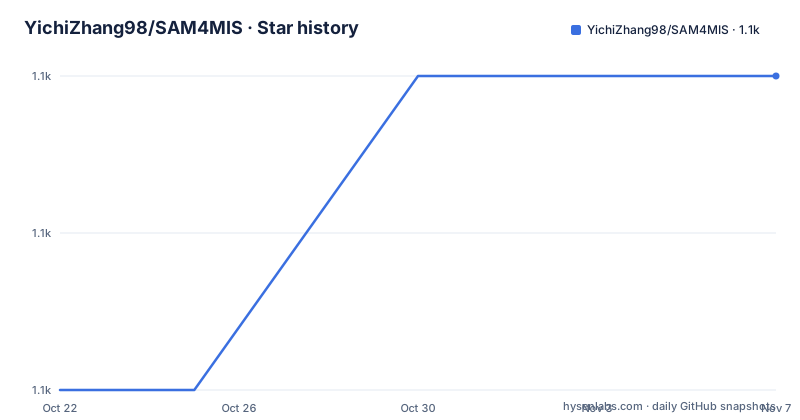
- YichiZhang98/SAM4MIS1,128 ★ · +2
| Repository | 2026-10-22 | 2026-11-07 |
|---|---|---|
| YichiZhang98/SAM4MIS | 1.1k | 1.1k |
2 Stars in the last 16 days, measured from the daily GitHub snapshot. Compare with other projects
Editorial analysis
What SAM4MIS is, and what it deliberately is not
SAM4MIS is a repository whose product is a reading list. The stated purpose is to track and summarize the latest research progress of SAM and foundation models in medical image segmentation, in order to support ongoing research. The project says it will continue to track that progress, invites suggestions, and asks contributors to open an issue rather than to send pull requests, which is the behaviour of a curated survey rather than of a software project.
That distinction matters for anyone who arrives from the name. Despite the acronym, there is no model here to download, no inference script and no training code. The top level of the repository holds a README and four images: `SAM.jpg`, `SAM2-Framework.png`, `SAM_v2.jpg` and `timeline.png`. The primary language of the repository is not recorded, and the licence field is also unstated, so the repository is best treated as a set of notes and pointers.
The reading list itself is organised into sections that the table of contents names explicitly: an introduction to the Segment Anything Model, literature reviews of SAM 2 and SAM 3 adaptations for medical image segmentation, literature reviews of foundation models for the same task, a section on datasets for developing and validating medical foundation models, and entries for two CVPR workshops, one on foundation models for interactive 3D biomedical image segmentation in 2025 and one on running SAM in medical images on a laptop in 2024.
The README covers the introduction, the two surveys and the opening of the dated adaptation table. The dataset section and the workshop sections appear in the table of contents, so a reader should treat those entries as headings to follow rather than as summaries.
The mechanism the introduction describes in SAM itself
The introduction explains how the Segment Anything Model works, which is the piece of technical background the repository assumes. SAM uses a vision transformer based image encoder to extract image features and compute an image embedding, and a prompt encoder to embed prompts and to incorporate user interactions. Information extracted by the two encoders is then combined to feed a lightweight mask decoder, which produces segmentation results from the image embedding, the prompt embedding and an output token.
That three-part structure is the reason prompting matters so much for this family of models. The encoder is run once over an image, and the prompt encoder is what lets a user change the target afterwards, whether by a point, a box or a mask. For medical imaging this is the property that makes the models interesting and also the property that makes them hard to use naively: the same generality that lets a single model segment an organ, a lesion and a vessel also means the model has no built-in notion of which anatomical structure is meant.
The repository's own framing is that foundation models emerged as a predominant force in natural language processing and computer vision, and that the introduction of SAM and the later SAM2 and SAM3 papers expanded the prompt driven paradigm into image and video segmentation. The image files in the repository support that story visually: a framework diagram for SAM2 and a chronology of the model family in medical image segmentation during 2023.
The dated table that follows is the practical payload. Entries run from 202602 back through 2025, covering 3D medical segmentation, dermoscopy, lung segmentation, stroke lesions, ultrasound video, breast lesions, mammography, breast MRI, retinal vessels, medical object tracking and universal segmentation, each with a paper link and, where the authors published one, a code link.
Two survey papers, one of them recent, and a citation block
The repository is anchored by two of its own publications. The first, marked [24.1] in the project notes, is described as a survey of recent work aimed at extending the efficacy of SAM to medical image segmentation, covering both empirical benchmarking and methodological adaptations, and it explores possible future directions for SAM in medical segmentation. The paper is linked as CIBM'24.
The second, marked [26.4], is a survey on the development, adaptation and application of generalist segmentation foundation models in biomedical image and video analysis, published online in iRadiology in 2026. The newer one is the better entry point for work that cares about video as well as still images.
Both are cited in a BibTeX block included in the README, which is the machine readable part of the project and the easiest thing to reuse. The two references, the SAM4MIS article in Computers in Biology and Medicine from 2024 and the generalist segmentation foundation models article in iRadiology from 2026, are given with their authors, journals, volume, pages and year. Reproducing that block in your own bibliography is the concrete way to point a reader at this project.
A note on the citation itself: the repository asks readers to consider stars or citing, and the first entry carries a page range and a volume, while the 2026 entry has a year but no volume or pages. That difference is a small reminder that the two references are at different stages of publication, so a reader who relies on the block should check the final bibliographic details of the 2026 paper against the publisher record rather than copying the year alone.
Reading the adaptation table: what is listed and how often code exists
The table is the part a working researcher will use most, and its structure is consistent: a date, the authors, the title, a paper link and a code column. The code column is where the table becomes opinionated by omission, because for most entries it reads None.
Looking at the listed rows, the pattern is clear. The 202602 entry on a SAM2 dual-teacher framework for semi-supervised 3D segmentation has no code. The 202511 entries on zero-shot capillary segmentation in dermoscopy, a comparative evaluation of SAM, SAM2, MedSAM and MedSAM2 on lung segmentation, a comparison of SAM 2 and SAM 3 on 3D medical data, and a study of ultrasound video segmentation all list None. MedSAM3, on medical concepts, does link to code. A 202511 entry on zero-shot stroke lesion segmentation with CAM-guided prompting of MedSAM2 lists None.
Further down, a 202508 entry on SAM 2-driven self-training for mammogram segmentation links to code, a 202507 entry on depthwise-dilated convolutional adapters links to code, and a 202507 entry on multi-planar datasets in medical segmentation links to code. So among the rows shown, a minority of adaptations ship an implementation, and the rest are paper-only at the time of listing.
That distribution is the single most useful signal in the table. If you are choosing a method to build on, the code column tells you which adaptations you can actually run today, and the entries marked None are reading assignments rather than starting points. A second signal is the subject mix: breast imaging alone appears in several different forms, ultrasound appears in both still and video variants, and 3D volumes from CT or MRI recur through the semi-supervised and self-training entries.
The two workshop entries and the datasets section
The table of contents names two workshop entries, and they are worth reading separately from the paper table because they answer different questions. The 2025 entry is a CVPR workshop on foundation models for interactive 3D biomedical image segmentation, and the 2024 entry is a CVPR workshop on Segment Anything in medical images on a laptop.
The second title is more revealing than it first appears. A workshop on running SAM on a laptop addresses the practical gap that the rest of the repository's notes keep circling: these models are large, and a clinical or academic user without a research GPU budget is a real constraint rather than an edge case. It also suggests why the list separates a laptop-scale path from the general 3D interactive work, since the two need different compute assumptions and, often, different interaction models.
The datasets section is the other part of the structure that matters for anyone planning work in this area. The project lists it as covering datasets for the development and validation of medical foundation models, which is exactly the question a newcomer asks after reading a table of adaptations: which data was used, and is it public. The section itself is where the named datasets and their grouping appear. Following the table of contents link is the way to settle that.
Taken together, the two workshops and the dataset section frame the repository as a research map. The paper table tells you what has been tried, the workshop entries tell you where the community met to compare approaches, and the dataset section is where a reader is meant to find the data behind all of it.
What this repository cannot give you, and its maintenance state
The limitations are structural rather than fixable by reading more carefully. There is no code to run, no model weights, no dataset download script and no evaluation harness, so the repository cannot be adopted in the way a tool is adopted. It is a map of other people's work, and the value it offers is the time it saves in locating papers, the dates it attaches to them, and the small number of code links it does surface.
The bibliography is the second limitation. The project asks readers to cite its two surveys, and for a literature tracker the citation is the deliverable, so those two references deserve a check against the publisher records before they are reused, particularly the 2026 one, whose entry in the BibTeX block carries a year without a volume or page range.
The maintenance state is the third. The notes in the project say the last update was 2026-4-30, the repository's last push was on 2026-04-30, and the repository has no GitHub releases. It is not archived, but a repository whose entire product is a table loses value as soon as the table stops growing, and the listed rows end at 202602 while the 2026 survey is the newest dated item in the notes. Nothing here promises a refresh schedule, and the project instead asks readers to open an issue with suggestions, which puts the maintenance burden on the community it is trying to serve.
There is also no licence recorded for the repository, so the usual assumption about reusing a README's text and images does not hold automatically. For a project that asks to be cited, that is the one detail to sort out with the authors before republishing their tables.
Editorial conclusion
Adopt SAM4MIS as a starting point when you are surveying how the Segment Anything family has been applied to medical imaging, and when a dated table with links to the available code saves hours of reading. Do not adopt it as a tool, a model or a dataset pipeline, because the repository contains a README and images only, with no code, no licence statement and no releases. Before citing the survey as a starting point, read the two linked papers directly and check the entries against the venues, because the table is a link list maintained by one group rather than a peer reviewed index.
Frequently asked questions
What is SAM4MIS?
It is a repository that tracks and summarizes research on the Segment Anything Model and related foundation models applied to medical image segmentation. It is a literature list with survey papers, dated tables of adaptations and links to published code, not a model or a library.
Does SAM4MIS contain code for medical image segmentation?
No. The repository holds a README and four images, and the code column of its adaptation table points to the separate repositories of the paper authors, with many rows marked as having no code.
How does the Segment Anything Model produce a mask?
A vision transformer based image encoder computes an image embedding, a prompt encoder embeds prompts and user interactions, and a lightweight mask decoder combines both with an output token to produce the segmentation result.
Which surveys does SAM4MIS cite?
Two: a 2024 survey of extending SAM to medical image segmentation, linked as CIBM'24, and a 2026 survey on generalist segmentation foundation models in biomedical image and video analysis, published in iRadiology. Both are given in a BibTeX block in the README.
What workshops does SAM4MIS point to?
A CVPR2025 workshop on foundation models for interactive 3D biomedical image segmentation, and a CVPR2024 workshop on Segment Anything in medical images on a laptop.
Official sources
Add this badge to your README
If you maintain this project, the badge below links readers to this analysis and shows its maintenance status from the daily GitHub snapshot. Paste the markdown into your README; add ?metric=license or ?metric=stars to the image URL for a different field.

[](https://hysenlabs.com/projects/yichizhang98-sam4mis)Star history chart for your README
[](https://hysenlabs.com/projects/yichizhang98-sam4mis)Was this useful?