mxnet-seq2seq is a 2016 open-domain chatbot with a shared embedding layer
Sequence to sequence learning with MXNET
At a glance
- What is it?
- A small Python implementation of the two recurrent network sequence to sequence architecture, borrowing its bucketing scheme from another MXNet example and rebuilding the embedding layer. Three model files, one data preparation script, two commands to run, and a last recorded commit in November 2016, which is the first fact anyone evaluating it should hold onto.
- Who is it for?
- Read this as a teaching artefact rather than a starting point. It is small enough to understand in an afternoon, it names the architecture it implements and the paper that introduced it, and it explains the two awkward parts of the design, the shared embedding and the bucketing, in enough detail to reason about.
- Can I use it commercially?
- Not without permission. GitHub finds no licence file in the repository, and without a licence all rights are reserved by default: you may read the code but not reuse it. Check the README, or ask the authors, before using it.
- Is it still maintained?
- Probably not. The repository last received commits 120 months ago, on November 24, 2016.
- What is it written in?
- Mainly Python, according to GitHub's language statistics.
Answers come from the project's GitHub data, last synced on October 22, 2026, and from our analysis. They are not legal advice.
Star history
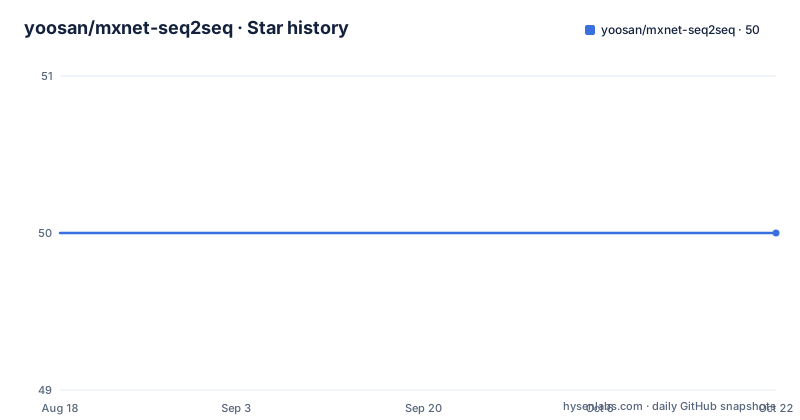
- yoosan/mxnet-seq2seq50 ★ · +0
| Repository | 2026-08-18 | 2026-10-22 |
|---|---|---|
| yoosan/mxnet-seq2seq | 50 | 50 |
0 Stars in the last 65 days, measured from the daily GitHub snapshot. Compare with other projects
Editorial analysis
The last recorded commit is from November 2016
Before reading anything else, look at the dates. The most recent push recorded to the default branch carries a date of 24 November 2016, and there are no tagged releases at all. The repository is not marked archived, but nothing has been added to it in close to a decade, which for a deep learning repository means the framework version it was written against, the library APIs it calls, and the paper ecosystem it lived in have all moved several times. That does not make the code wrong. A sequence to sequence model is a sequence to sequence model, and the file structure still expresses the architecture clearly. It does mean you should treat anything you find here as reference material to read, and expect to resolve framework compatibility yourself before a single line runs.
Two commands, no configuration, and no recorded settings
The entire run instruction is two lines. The first processes the data, the second runs the model. There is no configuration file, no command line flag documentation, no environment variable and no model checkpoint path mentioned anywhere on the page. That absence is the most important structural fact about this repository. In a project written today you would expect at least a place where the hidden size, the learning rate, the batch size and the data location live, and the readme would point at it. Here, whatever settings the code uses are whatever is inside the Python files, and the readme does not say. The final section of the page is titled as more details to come and closes by inviting questions by email, which suggests the author intended to document the settings and did not.
python datautils.pypython main.pyThe encoder and the decoder share one embedding layer
The architecture section explains the design decision that a tutorial reader most needs, and it is worth quoting the reasoning rather than the shape. A sequence to sequence model has two recurrent networks: one encodes the source sequence, the other decodes the target. For natural language the source is a sentence, which means both sides draw on the same vocabulary, so the two halves must agree about what a word is. The stated consequence is that the encoder and the decoder share the word embedding layer. That is not an optimisation, it is a correctness requirement: if each side built its own table, a token numbered seven on one side would not mean the same thing as seven on the other. The readme also says this project's embedding layer was reconstructed rather than reused.
Zero padding on the source side, buckets on the target side
Sequence length is arbitrary and a recurrent network needs a fixed shape, which is the problem this implementation addresses with two different techniques on the two sides. On the encoding side it pads with zeros up to a fixed length, which is simple and wastes compute on short sentences. On the decoding side it makes buckets, which is the more interesting half: sequences of similar length are grouped so a batch contains sentences of comparable length, and the model learns to recognise a sentence boundary rather than a fixed stop index. The readme calls bucketing a good solution to the arbitrariness of sequence length without qualification, which is generous but fair for the era. If you are reading this in order to implement the same scheme yourself, the bucketing half is the part that pays.
The data format is one pair per line, split by a separator
The page shows the data format directly, which is generous and rare. Each line is a pair: a source sequence, a double bar separator, and a target sequence, with the numbers being word indices. The source side is right-padded with zeros so that every source has the same width. The target side is not padded, because a bucket's contents are defined by where the sentence actually ends. Three lines are shown as one bucket, then a line of dashes marks the boundary to the next bucket, which is repeated. So the separator tells you where the target starts and the dash line tells you where the batch ends. If you are regenerating the data, the readme does not say what corpus was used or how the vocabulary was built, which is the gap you would have to fill yourself.
0 0 ... 0 23 12 121 832 || 2 3432 898 7 323
0 0 ... 0 43 98 233 323 || 7 4423 833 1 232
0 0 ... 0 32 44 133 555 || 2 4534 545 6 767
---
0 0 ... 0 23 12 121 832 || 2 3432 898 7
0 0 ... 0 23 12 121 832 || 2 3432 898 7
0 0 ... 0 23 12 121 832 || 2 3432 898 7
---
Three model files and one data script, and nothing else
The repository is six entries and you can hold the whole architecture in your head. There is the readme, a gitignore, a data directory holding whatever the preparation step produces, and four Python files. One is the data preparation script. One is the training or running entry point. One is named for the recurrent network itself, which is where the layer definitions live. One is named for the sequence to sequence model, which is where the encoder, the decoder and the data iterators live. The naming is conventional for this framework and it maps directly onto the architecture described on the page. There are no tests, no example scripts, no notebooks and no trained parameters checked in, so you get the model definition and nothing to compare it against.
The borrowed idea and the cited paper are both named
Two attributions on the page are worth carrying forward. The architecture itself is credited to a specific paper on sequence to sequence learning with neural networks, linked by its archive identifier, which is the canonical reference for the encoder-decoder with a fixed-length vector bottleneck. Separately, the implementation is credited as borrowing from another MXNet example, named for its bucketing approach, with the note that it was slightly modified and that the embedding layer was reconstructed. That is an unusually clear statement of what is original: the loop and the data shapes are standard, the bucketing came from someone else's example, and the embedding layer was the part rewritten. For anyone reading this as a tutorial, that sentence tells you exactly where to look next.
Editorial conclusion
Read this as a teaching artefact rather than a starting point. It is small enough to understand in an afternoon, it names the architecture it implements and the paper that introduced it, and it explains the two awkward parts of the design, the shared embedding and the bucketing, in enough detail to reason about. Do not adopt it for new work, and treat the absence of configuration, of tests and of documentation beyond the readme as decisive: the last recorded commit to the default branch carries a date in November 2016 and the repository has never published a release, so there is no version to pin and no compatibility surface anyone has maintained since.
Frequently asked questions
What is sequence 2 sequence (seq2seq)?
In this repository's terms it is an architecture built from two recurrent networks: one encodes the source sequence and the other decodes the target. For natural language tasks both sides draw on the same vocabulary, so the two halves share a word embedding layer. The architecture is credited to a paper on sequence to sequence learning with neural networks.
What is seq2seq used for?
The stated purpose here is an open-domain chatbot: the project implements sequence to sequence learning for conversational text. More generally the same encoder-decoder shape handles any pair of variable-length sequences, which is why the implementation had to solve the variable-length problem at all, using zero padding on the source side and bucketing on the target side.
What is MXNet used for?
The repository treats it purely as the framework the model is written against and says nothing broader about it. The readme names another MXNet example as the source of the bucketing idea, and the whole repository is three model files plus a data preparation script with no configuration file and no framework version recorded.
What are sequence models in machine learning?
The page covers one of them and does not survey the category. What it does explain is the part that makes this family awkward: sequence length is arbitrary while a recurrent network needs a fixed shape, which is why the source side is zero-padded to a fixed width and the target side is grouped into buckets of comparable length.
Official sources
Add this badge to your README
If you maintain this project, the badge below links readers to this analysis and shows its maintenance status from the daily GitHub snapshot. Paste the markdown into your README; add ?metric=license or ?metric=stars to the image URL for a different field.

[](https://hysenlabs.com/projects/yoosan-mxnet-seq2seq)Star history chart for your README
[](https://hysenlabs.com/projects/yoosan-mxnet-seq2seq)