English-Writing: a phrase book for papers, organised by the section it belongs to
Enhance Your English Writing for Science Research 写论文英语素材
At a glance
- What is it?
- The English-Writing repository is a collection of academic English phrasing gathered while reading papers, split into one Markdown file per section of a research article, from the abstract to the rebuttal, plus a guide to polishing drafts with ChatGPT. It is a reference list rather than a tool, and it is written in Chinese with Chinese filenames.
- Who is it for?
- Adopt this repository if you are a non-native English speaker writing a research paper and you want phrasing organised by the section you are writing, rather than a general list of useful words. Do not adopt it as a style guide with rules, because it is a collection of expressions gathered from papers, and do not expect the ChatGPT guide to replace judgement about what your claim actually means.
- Can I use it commercially?
- Not without permission. GitHub finds no licence file in the repository, and without a licence all rights are reserved by default: you may read the code but not reuse it. Check the README, or ask the authors, before using it.
- Is it still maintained?
- Activity is slowing. The repository last received commits 6 months ago.
- What is it written in?
- GitHub does not report a main language for this repository.
Answers come from the project's GitHub data, last synced on November 7, 2026, and from our analysis. They are not legal advice.
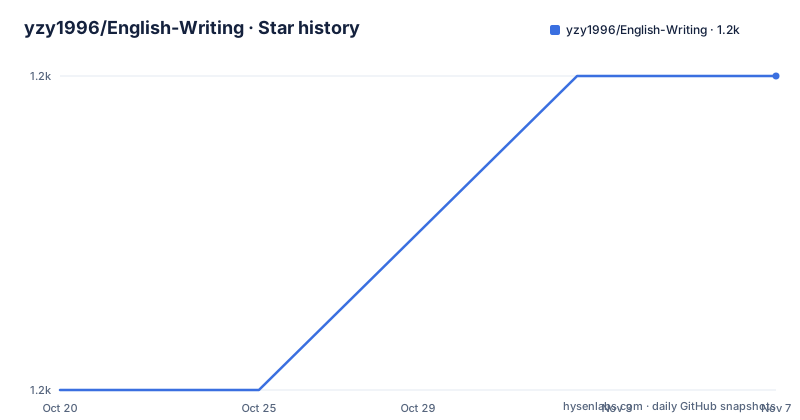
Star history
- yzy1996/English-Writing1,199 ★ · +1
| Repository | 2026-10-20 | 2026-11-07 |
|---|---|---|
| yzy1996/English-Writing | 1.2k | 1.2k |
1 Stars in the last 18 days, measured from the daily GitHub snapshot. Compare with other projects
Editorial analysis
The organising idea is the structure of a paper
The English-Writing repository describes itself as a place where the author collected good English usage while reading papers, in the hope that it would help with writing. The Chinese description says exactly that, and the title is Enhance Your English Writing for Science Research.
The structure is the interesting part. Rather than one long list of phrases, the material is split by the section of a paper, on the reasoning that the English you need for an abstract is not the English you need for a rebuttal. The README lays out two top level groups.
The first is General, described as common vocabulary and phrasing, which includes a file for good English words and then, beneath it, the phrasing divided by article structure: the abstract, the introduction, the related work, the method, the experiment, the conclusion, the appendix and the rebuttal. The second top level group is AI assisted polishing, with a single file, the ChatGPT polishing guide.
So the repository is nine markdown files in the main body of the work, plus a folder of notes about reading papers. The whole thing is a set of curated notes rather than a codebase, and the repository metadata reflects that: the primary language is not recorded, there is no release history, and the last push was on 2026-04-17.
Eight files that mirror a submission
The file list is the clearest description of what is inside, and it is worth reading as a checklist for a submission.
The files are numbered in the order a paper is written, which is the order the author found useful for collecting phrases: `0-好的英语词汇.md` for general vocabulary, then `1-Abstract.md`, `2-Introduction.md`, `3-Related-Work.md`, `4-Method.md`, `5-Experiment.md`, `6-Conclusion.md`, `7-Appendix.md` and `8-Rebuttal.md`.
The numbering is a small design decision that pays off when you are actually writing. Most people gather phrases as they encounter them, which produces a list with no structure, and then spend an hour at the end sorting it. Here the sorting is done, and the reviewer response file is the one that most people forget to prepare at all, so having a dedicated file for it is a prompt to write it while the reviewer comments are fresh.
The naming is in Chinese, with the English section names kept in the filenames, so the files sort correctly in a file browser and the reference is still recognisable to a non-Chinese reader. The `0-好的英语词汇.md` file is the one that would be worth reading first for a newcomer, because general academic vocabulary is what a non-native speaker runs into before the section specific problems.
The README also links out rather than duplicating. There is a separate repository of LaTeX writing experience, a set of curated paper lists in four areas, a link to a paper writing tips repository, and a book titled Science Research Writing for Non-Native Speakers of English.
The ChatGPT guide is a separate file, deliberately
The AI assisted polishing guide, `ChatGPT-Help.md`, is kept out of the phrase files and given its own top level entry, and that separation is worth thinking about.
The phrase files and the polishing guide answer different questions. The phrase files tell you how a claim is usually worded in a given section, which is a question about convention. The polishing guide is about the mechanics of using a language model on a draft, which is a question about workflow.
Keeping them apart also keeps the advice honest. A repository that mixed conventional phrasing with model instructions would be telling the reader to do two things at once, one of which is to trust a tool and the other of which is to imitate other people's prose. A separate file lets the reader take the second one or leave it.
The README does not describe what the guide contains, so the claims it makes cannot be assessed from the repository index alone. What can be said is that it exists as a distinct artefact, aimed at the same audience as the rest of the repository, which is a researcher whose native language is not English and who is preparing a submission.
The notes are packaged for agents as well as readers
Two directories at the repository root are not mentioned in the README's own table of contents.
There is a `skills/` directory and a `.claude-plugin/` directory. A `skills` directory in that position, next to a plugin manifest, is the layout used to package a body of material as instructions for a coding or research agent, so that the phrases and the section structure are available to a model as a skill rather than only to a person browsing GitHub.
That is a meaningful change in what the repository is. The original artifact is a curated reference that a human reads; the plugin and skills layout is the same content addressed to an agent that will draft or revise a section. The README does not describe the contents of either, so it is not possible to say from the index alone how much the material has been restructured for that use, and whether the section files are read as-is or converted into a different format.
Another unlisted entry is `关于读论文/`, a folder about reading papers, separate from the writing material. Reading and writing are different skills with different vocabularies, and a collection of notes on how to read a paper properly fits next to one on how to write one, though the README's own table of contents does not point at it.
Where this repository is the wrong tool
The first wrong case is a writer who needs a style guide with rules in it. This is a collection of expressions that the author found useful, organised by section. It is not a specification of what the field considers good, it does not tell you which conventions are enforced and which are merely common, and it carries no opinion about register, hedging or claim strength beyond the phrases themselves.
The second wrong case is a field with its own conventions. The sections are generic to computer science and machine learning, and the repository's own links point at curated paper lists in 3D generation, shape correspondence, GANs and neural radiance fields. If you write in a field with a different sentence structure, the method and experiment sections in particular will be less useful than the general vocabulary file.
The third is a writer who expects the model to be the author. The polishing guide is one file in a repository of collected phrases, and the risk of using a language model to polish a scientific claim is that the claim changes while the words improve. The repository does not claim to address that, and no phrase collection would.
The fourth is reuse in a commercial product. The repository records no licence, and the primary language is not even identified in the metadata, so there is no stated permission to copy the content. For a personal reading and writing aid that is a footnote, and for anything published, it is a question to settle before the material is quoted.
The fifth is a search use case. There is no search index, no tag structure and no index beyond the README, so the practical way to use it is to open the file for the section you are writing and read it, which is a slower loop than a searchable phrase bank and also the more reliable one, since the entries are grouped by the context they came from.
Editorial conclusion
Adopt this repository if you are a non-native English speaker writing a research paper and you want phrasing organised by the section you are writing, rather than a general list of useful words. Do not adopt it as a style guide with rules, because it is a collection of expressions gathered from papers, and do not expect the ChatGPT guide to replace judgement about what your claim actually means. Before you rely on it, read one section file end to end to see how the entries are presented, and note that the repository records no licence, so any phrasing you reuse should be checked against the sources it points at.
Frequently asked questions
What is in the English-Writing repository?
It collects academic English phrasing gathered while reading papers, split into a general vocabulary file and one file per section of a research article, from the abstract through to the rebuttal, plus a guide to polishing drafts with ChatGPT.
How is the English-Writing material organised?
In numbered Markdown files in writing order: general vocabulary, abstract, introduction, related work, method, experiment, conclusion, appendix and rebuttal, with the AI polishing guide as a separate top level file.
Does the repository have a licence?
The repository records no licence, and the metadata does not identify a primary language, so the terms for reusing the collected phrasing are not stated.
What else does the English-Writing README link to?
A separate repository of LaTeX writing experience, curated paper lists for 3D aware generation, shape correspondence, GANs and neural radiance fields, a paper writing tips repository, and a book on science research writing for non-native speakers of English.
Official sources
Add this badge to your README
If you maintain this project, the badge below links readers to this analysis and shows its maintenance status from the daily GitHub snapshot. Paste the markdown into your README; add ?metric=license or ?metric=stars to the image URL for a different field.

[](https://hysenlabs.com/projects/yzy1996-english-writing)Star history chart for your README
[](https://hysenlabs.com/projects/yzy1996-english-writing)Was this useful?