zeroboot benchmarks VM sandbox spawn at 0.79ms, but ships zero GitHub releases and a README that points issues at a different account
Sub-millisecond VM sandboxes for AI agents via copy-on-write forking
At a glance
- What is it?
- zeroboot forks Firecracker snapshots with copy-on-write memory mapping to hand AI agents what it claims are real KVM virtual machines at sub-millisecond cost. The mechanism is specific and the limitations are listed honestly, but the repository's release story, its benchmark table and its own issue link do not line up with each other.
- Who is it for?
- Adopt it if you want to read one of the cleanest snapshot-forking explanations available and you have a KVM capable Linux host to try it on. Do not plan around the benchmark table: the comparison columns are empty for four of five rows, three of the four named competitors are absent from the dependencies entirely, and the project itself calls the fork primitive real but not production hardened.
- Can I use it commercially?
- Yes. Apache-2.0 is a permissive licence: you can use, modify and sell software built on it, as long as you keep its copyright and licence notices.
- Is it still maintained?
- Yes. The repository last received commits 35 days ago.
- What is it written in?
- Mainly Rust, according to GitHub's language statistics.
Answers come from the project's GitHub data, last synced on November 22, 2026, and from our analysis. They are not legal advice.
Star history
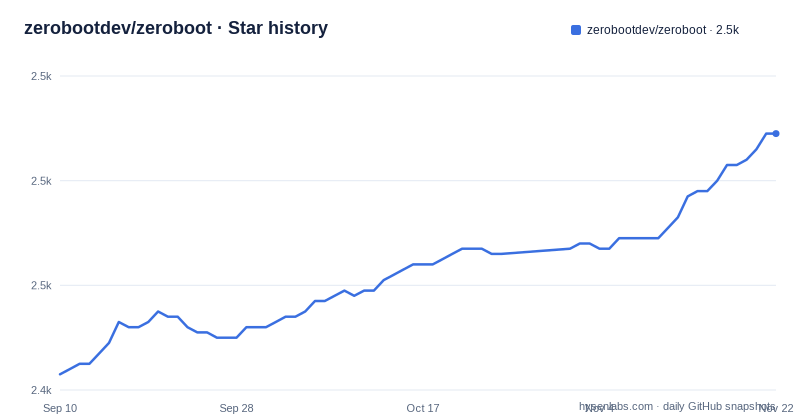
- zerobootdev/zeroboot2,489 ★ · +46
| Repository | 2026-09-10 | 2026-11-22 |
|---|---|---|
| zerobootdev/zeroboot | 2.4k | 2.5k |
46 Stars in the last 73 days, measured from the daily GitHub snapshot. Compare with other projects
Editorial analysis
The benchmark table compares against three projects it does not depend on
The comparison names E2B, microsandbox and Daytona, with four of the five rows carrying no figure at all for those three. Only spawn latency is filled in, and the shape of the numbers invites disbelief rather than confidence: 0.79ms at the median against roughly 150ms, 200ms and 27ms, with memory per sandbox given as roughly 265KB against 128MB, 50MB and 50MB. A 265KB sandbox cannot hold a user program, so the figure describes the fork of a snapshot rather than a usable environment. Two rows, fork plus exec for Python at about 8ms and a thousand concurrent forks in 815ms, have dashes across every competitor column. Nothing in the repository says what hardware, template or payload produced these numbers, and no script to reproduce them is in the tree.
bench runs a script that is not in the repository
The Makefile is five targets. `build` runs a release cargo build, `serve` starts the binary with a `serve workdir` argument, `clean` runs cargo clean and removes workdir, and `guest` compiles a C file for the guest side:
musl-gcc -static -Os -march=x86-64 -mno-avx -mno-avx2 -o guest/init guest/init.cThe fifth is `bench`, which depends on `build` and then executes `./bench.sh`. There is no `bench.sh` in the tree. What is at the root instead is `verify.sh`, along with `guest/`, `sdk/`, `src/`, `demo/`, `deploy/`, `docs/` and `assets/`. So the documented way to reproduce the headline numbers in the README runs a file that does not exist under that name, and the README says nothing about `verify.sh` or what it checks. The guest build is also a host musl build with AVX disabled, which means whatever runs inside a fork sees a CPU without those instruction sets even though the template it came from was created elsewhere.
The API key shown in the try it block is a demo credential
The quickstart curls the managed endpoint with a bearer token that is printed in the file:
curl -X POST https://api.zeroboot.dev/v1/exec \
  -H 'Content-Type: application/json' \
  -H 'Authorization: Bearer zb_demo_hn2026' \
  -d '{"code":"import numpy as np; print(np.random.rand(3))"}'
The same four line command is repeated verbatim in the self-hosting section, under a heading about running the service yourself, so the file shows the managed host being called twice and explains nothing about the local path. The SDK examples take a different shape of credential, `Sandbox("zb_live_your_key")` in both Python and TypeScript, which is a placeholder rather than something a reader can paste. Nobody is told how the demo token is scoped, how many calls it allows, or whether the code in that request body runs on the shared host. Three further badges sit above this section, and one of them links to a health endpoint at the same API host, so the service exposes its liveness in the header block of the README.
There are no releases, and no tag information is offered
The repository publishes no GitHub releases. That is the whole release story, and the manifest carries `version = "0.1.0"` under `[package]`, alongside `edition = "2021"` and a keywords list of `vm`, `sandbox`, `kvm`, `isolation` and `firecracker`. There is no tag reference, no nightly channel, no install instruction from a registry, and no statement anywhere in the README about where to get a binary. To run the thing you clone it and either build it with cargo or write to a managed endpoint that the file points at. The self-hosting section says the service can run on any Linux box with KVM, and the deployment guide is linked as `docs/DEPLOYMENT.md`, but the README never says which of the five Makefile targets a self-hoster should start with, and the serve target passes a `workdir` argument that appears nowhere else in the documentation.
The status section links issues to a repository under another account
The status paragraph describes the project as a working prototype, states that the fork primitive, benchmarks and API are real but not production hardened, and then says to open an issue if interested. The link points at `https://github.com/adammiribyan/zeroboot/issues`. The repository publishing this file lives under `zerobootdev`, and the manifest's own repository field records `https://github.com/zeroboot/zeroboot`, which is a third name again. Three different accounts appear across three lines of the same file, and the one a reader is told to file bugs against is not the one hosting the code. The date picture matches a prototype rather than a product: the last push to this tree was 2026-03-21, roughly six months before the release that carries no release at all.
The known limitations lead with entropy, not with performance
Four limitations are listed, and the first is the one that would matter most in production. Forks share CSPRNG state from the snapshot. Kernel entropy is reseeded through RNDADDENTROPY, but userspace generators including numpy and OpenSSL need explicit reseeding per fork, and the file links Firecracker's own guidance on random numbers for cloned snapshots. So a sandbox that runs a Monte Carlo sample, as the quickstart does, produces correlated values across forks unless the caller handles it. The remaining three are structural: one vCPU per fork, with multi vCPU described as architecturally possible but not implemented; no networking inside forks, with serial I/O as the only channel; and template updates that require a full re-snapshot of about fifteen seconds with no incremental patching. The fifteen second figure is the only timing in this section, and it is the one that governs iteration speed.
The dependency list names the whole virtualization stack
The manifest is short and every entry is doing something specific. `kvm-ioctls` and `kvm-bindings` with the fam-wrappers feature are the kernel interface, `vmm-sys-util` handles the memory mapping side, and `libc` is a plain caret dependency. `axum` with `tokio` at full features is the HTTP layer of the API endpoint in the quickstart, `serde` and `serde_json` handle the request body, `uuid` with feature v7 supplies identifiers for sandboxes, `anyhow` carries errors, and `nix` with the fs, mman and ioctl features covers file mapping. Firecracker itself does not appear anywhere in that list. The sandboxing story is built directly on KVM through those crates, and the snapshot format is Firecracker's, so the project sits above a virtualisation layer it does not vendor or depend on.
Two SDKs ship in a Rust project with no packaging metadata for either
The SDK section gives one Python snippet and one TypeScript snippet, each three lines, each pointing at a directory in the tree, `sdk/python` and `sdk/node`. The TypeScript import is `import { Sandbox } from "@zeroboot/sdk"`, a package name that the repository has no manifest for, since the only manifest in the tree is the Cargo file at the root. Both snippets construct the client with a key argument and call a single `run` method that takes a string of source and, in Python, returns a result object whose fields are never shown. There is no streaming example, no timeout parameter, no error handling, no mention of what happens when the code inside a fork exits non-zero, and no listing of what the `run` result contains. The repository does carry a `demo/` directory with an agent script, an environment example and a recorded gif, none of which the README points at.
Editorial conclusion
Adopt it if you want to read one of the cleanest snapshot-forking explanations available and you have a KVM capable Linux host to try it on. Do not plan around the benchmark table: the comparison columns are empty for four of five rows, three of the four named competitors are absent from the dependencies entirely, and the project itself calls the fork primitive real but not production hardened. If you are running untrusted code today, the limitation that matters is entropy, not latency, because forks inherit the CSPRNG state of the template and userspace generators need explicit reseeding per fork. Before you pin anything, check the release channel, because the manifest sits at version 0.1.0 with no published releases and no tags, and check the account you file issues against, since the README directs bug reports to a repository under a different owner than the one hosting this code.
Frequently asked questions
How fast does zeroboot start a sandbox?
The README reports spawn latency at 0.79ms at the median and 1.74ms at the ninety ninth percentile, fork plus exec for Python at about 8ms, and a thousand concurrent forks in 815ms. The table leaves the comparison columns empty for all but the spawn latency rows.
Is each zeroboot sandbox a real virtual machine?
Yes. Each fork is a separate KVM VM with hardware enforced memory isolation, created by mapping Firecracker snapshot memory as copy on write and restoring CPU state, which the README puts at about 0.8ms.
What are the known limitations of zeroboot sandboxes?
Forks share CSPRNG state from the snapshot so userspace generators need explicit reseeding, each fork gets a single vCPU, there is no networking inside a fork and sandboxes communicate over serial I/O only, and template updates need a full re-snapshot of about fifteen seconds.
How do I run zeroboot on my own machine?
The project is Apache licensed and can be self-hosted on any Linux host with KVM. The Makefile provides `build`, `guest`, `bench`, `serve` and `clean` targets, with `serve` starting the binary as `./target/release/zeroboot serve workdir`.
Which SDKs does zeroboot offer?
A Python SDK in `sdk/python` and a TypeScript SDK in `sdk/node`, both exposing a `Sandbox` object constructed with a key and a `run` method that takes a string of source code. The README shows no error handling, timeout or streaming options.
Official sources
Add this badge to your README
If you maintain this project, the badge below links readers to this analysis and shows its maintenance status from the daily GitHub snapshot. Paste the markdown into your README; add ?metric=license or ?metric=stars to the image URL for a different field.

[](https://hysenlabs.com/projects/zerobootdev-zeroboot)Star history chart for your README
[](https://hysenlabs.com/projects/zerobootdev-zeroboot)Was this useful?