DeepClustering's code column mixes four different meanings, and two different papers share one abbreviation
Methods and Implements of Deep Clustering
At a glance
- What is it?
- DeepClustering is a curated reading list for deep clustering papers, not an implementation, and the repository says so in its first sentence while its own metadata says something else. What makes it useful to read is the table structure: a paper list with a code column that is trying to be four columns at once, and a visible scope that reaches past clustering into fairness and optimal transport.
- Who is it for?
- Read this as a bibliography with a pointer column, not as an implementation index, and read the table cells rather than scanning them, because a dash and a framework name and a release promise mean different things in the same column.
- Can I use it commercially?
- The repository metadata does not identify a licence. Check the project’s published terms and any component-specific licences before reuse.
- Is it still maintained?
- Yes. The repository last received commits 19 days ago.
- What is it written in?
- GitHub does not report a main language for this repository.
Answers come from the project's GitHub data, last synced on November 24, 2026, and from our analysis. They are not legal advice.
Star history
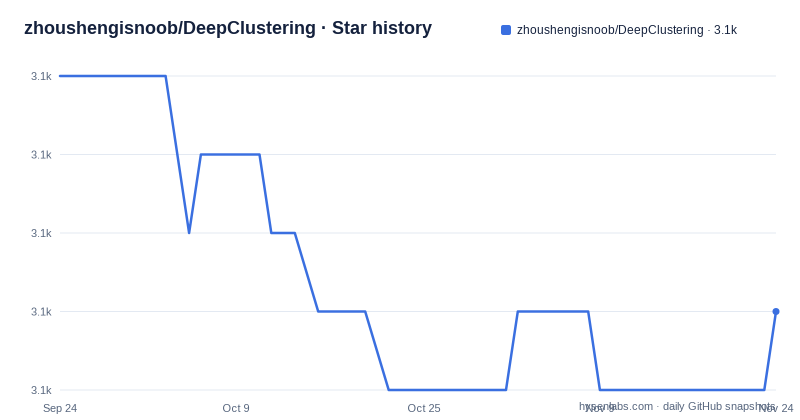
- zhoushengisnoob/DeepClustering3,061 ★ · -3
| Repository | 2026-09-24 | 2026-11-24 |
|---|---|---|
| zhoushengisnoob/DeepClustering | 3.1k | 3.1k |
-3 Stars in the last 61 days, measured from the daily GitHub snapshot. Compare with other projects
Editorial analysis
Three descriptions of the same repository, and none of them is code
The repository's own metadata describes it as methods and implementations of deep clustering, with implementations spelled in a form that suggests a typo. The heading inside the file calls it papers and resources. The first sentence of the body calls it a curated reading list for deep clustering and related methods, designed as a lightweight entry point for researchers who want a broad view, representative papers and public codebases when available. The file is right and the metadata is not. The language recorded for the repository is unknown, the top level holds three entries, and none of them is source code. What you are looking at is a bibliography that links out, and the links are the product.
One column carries four different meanings
The main table has four columns, and the last one is called code. Look at what actually appears in it. Some cells name a framework, such as a PyTorch implementation or a TensorFlow one or even a Matlab one. Some cells state provenance, using the word official to mean the authors' own repository rather than a reimplementation. One cell states a status, promising a release that has not happened, with a link to a repository that exists but has nothing released. Everything else is a dash. So a single column mixes what a thing is written in, who wrote it, whether you can get it yet, and whether it exists at all. You cannot filter the table for implementations in a given framework, or for papers with runnable code, without reading every cell.
Two unrelated papers answer to the same three-letter method name
Two rows in the visible portion of the table use the same method abbreviation. One is an interactive deep clustering paper from a 2024 conference, marked as having official code. The other is an interpretable clustering paper for tabular data from a different 2024 conference, marked as to be released. They are different papers by different groups, and they share an acronym. Anyone scanning the method column for that acronym gets both, and anyone citing by acronym gets it wrong. It is the kind of collision that a method column is supposed to prevent rather than cause, and the fix is a longer or more distinctive name.
The links point at five different kinds of artefact
The paper column is not uniformly a paper. One row links to a submission forum rather than a proceedings page, which means the linked artefact is a preprint under review and may never appear at that venue. Another links to a submission PDF with the same implication. One row links to a preprint server page for work that the table dates to a conference year. One row's paper link is a numbered PDF file sitting inside a code repository, so the paper column contains no paper at all and the reader lands on a document. Two rows link to repositories hosted on a university GitLab instance rather than a public forge. And in the survey table, one entry is hosted as a PDF on a university department's web server, with no identifier of any kind.
Two near-identically titled surveys sit in the same table
The survey table lists five surveys, and the first two are titled almost the same way: one is a comprehensive survey on deep clustering with a taxonomy, challenges and future directions, accepted at a computing-surveys venue, and the other is a comprehensive survey on deep clustering at a different publisher. The first is highlighted in the file's own highlights section as the maintainers' own survey. The second is not mentioned anywhere else. If the two are related, and the near-identical titles and overlapping subject suggest they might be, the table gives a reader no way to know, and nothing in the highlights connects them.
The scope deliberately reaches fairness and optimal transport
The scope section states that the repository intentionally has a relatively broad scope, and names what that includes beyond the canonical deep clustering papers: multi-view clustering, graph clustering, subspace clustering, fairness, optimal transport, and application-driven clustering. Two of those six are not clustering methods in the ordinary sense, and fairness in particular belongs to a different literature entirely. The inclusion test offered is that such work may appear when it is useful to the community, which is a judgement rather than a rule. The consequence for a reader is that absence from the list proves very little: this is not a field-by-field bibliography of deep clustering, it is one maintainer's judgement about what belongs.
Three entries at the root, one licence question unanswered
The repository contains a README, an image, and a single subdirectory whose name matches one of the five sections in the table of contents. There is no licence file, and the recorded licence is unknown, so nothing in the repository grants any terms for the image or for whatever lives in that subdirectory. There is also no contributing guide, no code of conduct and no automation directory, which is consistent with a project that expects contributions to arrive as pull requests against the README table rather than as code. Both entries in the highlights section are about the maintainers' own survey paper, one announcing its acceptance and one announcing its release, rather than about anything newly added to the list.
Editorial conclusion
Read this as a bibliography with a pointer column, not as an implementation index, and read the table cells rather than scanning them, because a dash and a framework name and a release promise mean different things in the same column. If you want reproducible starting points, the rows marked with a specific framework are the shortlist, and you will still need to check each repository yourself, since one of those links is a pre-submission page and another is a PDF inside a repository rather than the code. Treat the scope as deliberately wide: entries on fairness and optimal transport are in scope by the project's own statement, so absence from the list means little.
Frequently asked questions
What is DeepClustering?
A curated reading list for deep clustering and closely related methods, described in its first sentence as a lightweight entry point for researchers. It organises survey papers and method papers into tables with a column pointing to public codebases where they exist.
Does DeepClustering implement any clustering algorithms?
No. The repository's recorded language is unknown, its top level holds a README, an image and one subdirectory, and the file describes itself as a reading list of papers with links to external codebases rather than as an implementation.
What is in scope for the DeepClustering list?
The file says the scope is intentionally broad: canonical deep clustering papers plus multi-view, graph and subspace clustering, fairness, optimal transport, and application-driven clustering, included when they are useful to the community. That last condition is a judgement rather than a rule.
How does the DeepClustering table mark available code?
With a fixed set of cell values that mean different things: a framework name such as PyTorch, TensorFlow or Matlab, the word official for the authors' own repository, the phrase to be released for a promised but absent release, and a dash for nothing. One method abbreviation is shared by two different papers.
What licence does DeepClustering use?
None is declared. The recorded licence metadata is unknown and no licence file appears at the repository root, although the file links to licences indirectly by pointing at the venues and codebases it lists.
Official sources
Add this badge to your README
If you maintain this project, the badge below links readers to this analysis and shows its maintenance status from the daily GitHub snapshot. Paste the markdown into your README; add ?metric=license or ?metric=stars to the image URL for a different field.

[](https://hysenlabs.com/projects/zhoushengisnoob-deepclustering)Star history chart for your README
[](https://hysenlabs.com/projects/zhoushengisnoob-deepclustering)Was this useful?