zizmor: a Rust workspace of ten crates that audits CI workflows
Static analysis for GitHub Actions
At a glance
- What is it?
- A static analysis tool for CI/CD systems that looks for template injection, credential leakage, excessive runner permissions and confusable git references in GitHub Actions, Dependabot and pre-commit setups, built as a ten crate Rust workspace whose schemas and sink definitions are generated files kept in the repository.
- Who is it for?
- zizmor fits a team that owns GitHub Actions workflows and wants template injection and credential persistence caught before review, and that can build with Rust 1.97.0 or newer, the workspace's declared rust-version. Before adopting it, read the audit catalogue at docs.zizmor.sh/audits/ and check which of your workflows fall outside the four findings the README names.
- Can I use it commercially?
- Yes. MIT is a permissive licence: you can use, modify and sell software built on it, as long as you keep its copyright and licence notices.
- Is it still maintained?
- Yes. The repository last received commits 1 day ago.
- What is it written in?
- Mainly Rust, according to GitHub's language statistics.
Answers come from the project's GitHub data, last synced on November 21, 2026, and from our analysis. They are not legal advice.
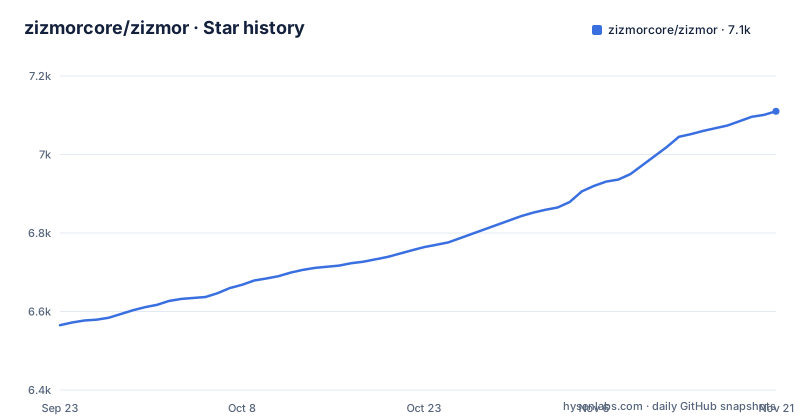
Star history
- zizmorcore/zizmor7,110 ★ · +545
| Repository | 2026-09-23 | 2026-11-21 |
|---|---|---|
| zizmorcore/zizmor | 6.6k | 7.1k |
545 Stars in the last 59 days, measured from the daily GitHub snapshot. Compare with other projects
Editorial analysis
Installing zizmor means reading a page, not copying a command
The README contains no command line. It describes what the tool finds, then hands you five links: the documentation site, an installation page at docs.zizmor.sh/installation/, a quickstart, a set of detailed usage recipes, and the audit catalogue at docs.zizmor.sh/audits/. Anything you would paste into a terminal is behind those pages, not in this repository.
What is in the repository is the build machinery, and it is honest about how the binary is produced. The Dockerfile installs uv on a Wolfi base image and then lets uv fetch the release:
apk update && apk add uv
uv tool install zizmor==${ZIZMOR_VERSION}
/usr/bin/zizmor --version
That third line is a build time smoke test, not something you run by hand. The pinned ZIZMOR_VERSION build argument is how the image is cut for a specific release, and the resulting image copies one file to /usr/bin/zizmor and sets ENTRYPOINT to it.
Four findings, and only three of them are injection bugs
The README names four things the tool finds, and the categories are worth separating. Template injection vulnerabilities lead to attacker controlled code execution, which is the classic case: untrusted input reaching an expression that the runner evaluates. Accidental credential persistence and leakage is a different shape, about state written somewhere it will be read again. Excessive permission scopes and credential grants to runners is about the blast radius a workflow asks for, not about the code in it.
The fourth category is outside the usual CI linter remit: impostor commits and confusable `git` references, which is about source authenticity rather than script injection. A tool that mixes provenance checking with injection analysis covers more ground than one that only looks at expression evaluation, but it also means a single invocation reports on two different kinds of risk.
The list ends with a link and the phrase and much more, so treat the four above as a sample rather than the full audit set.
Ten crates, and seven of them are not the binary
The Cargo workspace lists ten members, and reading the list tells you more about the design than the README does. Three crates model the problem domain rather than solve it: github-actions-expressions, github-actions-models and pre-commit-models. Three more are tree sitter and traversal helpers: subfeature, tree-sitter-iter and yamlpath. Then there are yamlpatch, the main zizmor crate, zizmor-dev and zizmor-sarif.
The workspace pins edition 2024 and rust-version 1.97.0, and carries version 1.32.0 across the shared workspace metadata and every published crate dependency entry. Resolver 2 is set, so feature unification is per target rather than across the whole build.
Most dependencies are pinned to an exact version
The dependency table gives a specific minimum version for most entries (a bare version in Cargo is a caret requirement, not an exact pin), and the exact resolved versions live in the committed Cargo.lock. annotate-snippets sits at 0.12.16, anstream at 1.0.0, anyhow at 1.0.102, clap at 4.6.1, csv at 1.3.1, etcetera at 0.11.0, fst at 0.4.7, http at 1.4.1, human-panic at 2.0.8, ignore at 0.4.25 and indexmap at 2.13.1. futures is given only as 0.3.
Two entries carry deliberate feature trimming. flate2 is taken with default-features off and the zlib-rs feature instead of the bundled backend, and clap-verbosity-flag is taken with default-features false. The http-cache-reqwest entry is the one to watch: it is pinned as a 1.0.0-alpha.7 pre release with a manager-cacache, manager-moka, reqwest-middleware and url-standard feature set, so a cache layer in the dependency tree is still tracking an alpha.
The committed Cargo.lock is what makes two builds of the same commit resolve the same dependency versions.
The container image routes around Wolfi's release lag
The Dockerfile opens with a comment explaining a deliberate detour. The right way to bootstrap the tool inside the image, the comment says, is to install it directly from apk, because Wolfi OS provides a build. In practice that does not work for this project, because Wolfi's downstream cadence can diverge by more than 24 hours from theirs. They had accepted that lag before and no longer can, because they need faster turnarounds.
So the prep stage uses Wolfi only as a bootstrap for uv, then runs uv tool install to fetch the architecture specific binary. The comment adds a second payoff: it avoids rebuilding zizmor from source, because the PyPI builds can be reused.
Both stages are built FROM cgr.dev/chainguard/wolfi-base:latest, which means the tag is not pinned to a digest. For a security tool that is a reasonable trade, but it is the kind of detail worth knowing before you allow the image into a pipeline.
pyproject.toml exists so the docs command stops failing
There is a pyproject.toml in a Rust project, and the file explains itself. Its build system is maturin with bindings set to bin and the manifest pointed at crates/zizmor/Cargo.toml, but a comment marks the [project] section as a stub, needed to prevent uv run --only-group docs from failing. The Python is documentation and benchmark tooling, not something you pip install.
requires-python is set to >=3.11 with a note that this value was picked arbitrarily as the oldest non EOL Python. The dependency groups make the split clear: a bench group with pytest>=9.1.1, pytest-codspeed>=5.0.3 and urllib3>=2.6.2, and a docs group containing zensical.
The Makefile drives those groups, building the site with uv run --only-group docs zensical build --clean and serving it with zensical serve. A mkdocs.yml also sits at the top level, which suggests the docs toolchain has moved and the old configuration file stayed behind.
Schemas, sinks and expression tests are generated, not hand written
A block of make targets regenerates the files the analyzer depends on, which tells you where its knowledge comes from. refresh-schemas runs support/fetch-schemas.py, webhooks-to-contexts runs support/webhooks-to-contexts.py, and archived-repos runs support/archived-repos.py. sync-expression-tests runs support/sync-expression-tests.py, so the expression parser has a test corpus that is refreshed rather than written by hand.
The one worth reading closely is codeql-injection-sinks, which writes crates/zizmor/data/codeql-injection-sinks.json through support/codeql-injection-sinks.py. That is the relationship with CodeQL stated plainly in the build: zizmor does its own parsing, modelling and reporting, but the list of expressions considered injection sinks is generated from external data and committed. generate-schema does the same for its own configuration, writing support/zizmor.schema.json from a cargo run with the schema feature enabled.
So the tool's idea of a dangerous sink is a build artifact. If it looks stale, the fix is a make target, not a code change.
v1.30.1 shipped in September 2026 and the tree pushes daily
Release cadence is tight. v1.31.0 went out on 2026-10-15, v1.31.1 followed later the same day, and v1.32.0 landed on 2026-11-02. The repository is not archived, and the last push was on 2026-11-02. The workspace version in Cargo.toml matches the newest tag exactly, so a checkout of the default branch tells you which release it is derived from.
Two other things sit at the top level. AGENTS.md and CLAUDE.md are committed alongside CONTRIBUTING.md, which tells you the repository expects to be worked on by coding agents as well as people. And the README is mostly a sponsor table: Grafana Labs, Trail of Bits, Kusari, Tracebit, Coder, glueckkanja AG and prospex at logo level, with Alexander Riccio and Carol Willing named individually.
Editorial conclusion
zizmor fits a team that owns GitHub Actions workflows and wants template injection and credential persistence caught before review, and that can build with Rust 1.97.0 or newer, the workspace's declared rust-version. Before adopting it, read the audit catalogue at docs.zizmor.sh/audits/ and check which of your workflows fall outside the four findings the README names.
Frequently asked questions
What is zizmor?
A static analysis tool for CI/CD systems, written in Rust and published as the zizmor crate. It can find and fix security issues in common CI/CD setups, including GitHub Actions, Dependabot and pre-commit.
How do you use zizmor?
The README itself contains no command line. It points at docs.zizmor.sh for installation steps, a quickstart and detailed usage recipes, and at docs.zizmor.sh/audits/ for the catalogue of what it detects. In the repository, the Makefile captures the help output through cargo run -- -h into docs/snippets/help.txt.
How does zizmor relate to CodeQL?
The injection sink list is generated, not hand written. The make target codeql-injection-sinks writes crates/zizmor/data/codeql-injection-sinks.json through support/codeql-injection-sinks.py, while the analysis itself runs on zizmor's own crates for GitHub Actions expressions, models and tree traversal.
Is zizmor an alternative to actionlint?
The repository draws no comparison with actionlint. What it states is scope: a static analysis tool for CI/CD systems that finds template injection, accidental credential persistence, excessive permission scopes and grants to runners, and impostor commits with confusable `git` references.
Official sources
Where developers are discussing it
Posts on Hacker News, dev.to and Lobsters that link to this repository, found by our scan of those communities. 0 in the last 30 days; newest first.
- We Read 760 Repositories That Run AI Agents in CIdev.to · Oct 12, 2026 · 2 points · 2 comments
Add this badge to your README
If you maintain this project, the badge below links readers to this analysis and shows its maintenance status from the daily GitHub snapshot. Paste the markdown into your README; add ?metric=license or ?metric=stars to the image URL for a different field.

[](https://hysenlabs.com/projects/zizmorcore-zizmor)Star history chart for your README
[](https://hysenlabs.com/projects/zizmorcore-zizmor)Was this useful?