KnowledgeEditingPapers is a paper list that turned into a taxonomy of the field
Must-read Papers on Knowledge Editing for Large Language Models.
At a glance
- What is it?
- The zjunlp KnowledgeEditingPapers repository collects must-read papers on knowledge editing for large language models, and its most useful feature is not the list but the structure. The contents divide the methods into those that preserve the parameters and those that modify them, and the repository also ships the slide decks from a year of conference tutorials.
- Who is it for?
- Adopt this repository as a map of the knowledge editing field, since the taxonomy is more durable than any individual paper list and the tutorial decks are the fastest way to see the terminology a community has settled on. Do not treat it as a settled reading list, because it was created in December 2022 and a field this fast moving will have moved on.
- Can I use it commercially?
- Yes. MIT is a permissive licence: you can use, modify and sell software built on it, as long as you keep its copyright and licence notices.
- Is it still maintained?
- Yes. The repository last received commits 80 days ago.
- What is it written in?
- GitHub does not report a main language for this repository.
Answers come from the project's GitHub data, last synced on November 6, 2026, and from our analysis. They are not legal advice.
Star history
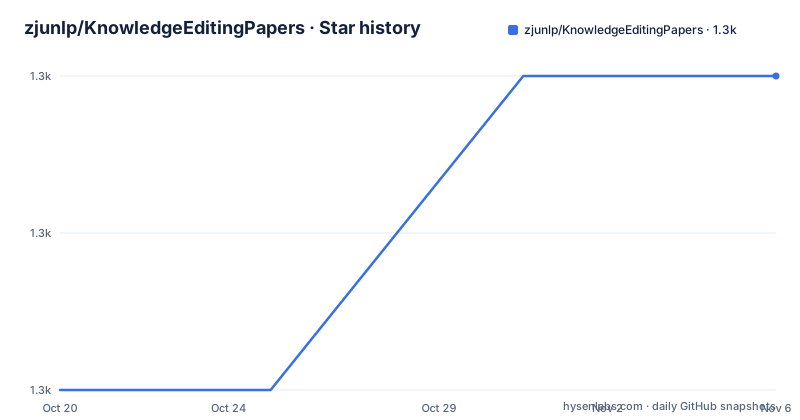
- zjunlp/KnowledgeEditingPapers1,256 ★ · +2
| Repository | 2026-10-20 | 2026-11-06 |
|---|---|---|
| zjunlp/KnowledgeEditingPapers | 1.3k | 1.3k |
2 Stars in the last 17 days, measured from the daily GitHub snapshot. Compare with other projects
Editorial analysis
A list that grew into a map
This repository maintains a paper list on knowledge editing, and it carries the Awesome badge that marks a curated list in the open source world.
The description is short. Must-read papers on knowledge editing for large language models, with a link to the survey paper on arXiv that the list is built around.
The important detail is in the news section, at the bottom of which the entry for December 2022 says the repository was created to maintain a paper list on knowledge editing. Everything above that date is the list becoming a research programme. The EasyEdit framework and the survey on editing large language models come out of it, then a benchmark, then a series of papers on knowledge mechanisms, then a series of conference tutorials, then a second survey on knowledge mechanisms in large language models with a perspective.
The implementation is mostly prose, with the licence MIT, the last push on 2026-08-20, and no GitHub releases, since a reading list is versioned by its commits rather than by tags.
The topic tags tell you where the list sits in the ecosystem, with knowledge-editing, model-editing, large-language-models, foundation-models, rome, survey, review, easyedit and knowlm among them.
What the field is trying to do
The Why Knowledge Editing section gives the definition in one paragraph, and it is worth quoting the shape of it.
Knowledge Editing is a compelling field of research that focuses on facilitating efficient modifications to the behavior of models, particularly foundation models. The aim is to implement these changes within a specified scope of interest without negatively affecting the model's performance across a broader range of inputs.
That last clause is the whole problem. A naive way to change what a model says about a fact is to fine-tune it on the correction, and that works, and it also tends to damage everything else the model knew. The field is the search for edits that are local, and the taxonomy in the repository is organised around how different methods achieve that locality.
The keywords section lists the neighbouring topics the field draws on, starting with updating and fixing bugs for large language models. The structure of the section, a short list of related areas, tells you this is a discipline that sits between model training and applied debugging rather than a subfield of either.
The taxonomy: preserve the parameters or modify them
The contents of the readme are the real contribution here, because the list is organised as a decision tree rather than as a bibliography.
The methods section divides into two families. Under preserve parameters there are three groups: memory-based, additional parameters, and changing the language model's representation space. Under modify parameters there are three more: finetuning, meta-learning, and locate and edit.
That split is the field's own consensus about where the work happens, and it maps onto a single question. If the weights stay as they are, the edit has to live somewhere else, either in a memory that is consulted alongside the model, in extra parameters bolted onto it, or in the representation space the model already has. If the weights change, you are either training them, learning how to learn them, or finding the specific weights responsible for the fact and touching only those.
There is a separate section on comparisons of different technologies, which is where the survey material and the evaluation discussions live, and an analysis section underneath the methods for the papers that measure rather than propose.
If you are new to the field, reading the list in that order tells you more in an hour than reading the papers alphabetically will.
The tutorial slide decks sit in the repository itself
The top level listing has a surprise in it, which is a set of PDF files with the tutorial decks, one per conference.
There is the AAAI 2024 tutorial on knowledge editing for large language models, the AACL 2023 one, the COLING 2024 one, the IJCAI 2024 one, a Chinese language deck from the CCL 2024 conference on knowledge mechanisms, fusion and editing in large models, and the slides for an invited talk on editing large language models to advance machine understanding and control.
The news table pairs each of those with a download link for the slide resource, on Google Drive for most of them and on BaiduPan for the Chinese-language ones, which is the practical detail that matters if you are behind a network where either host is unreachable.
The table also shows the itinerary, with an NLPCC 2024 tutorial, an invited talk, a CCL 2024 tutorial, an IJCAI 2024 tutorial, a COLING 2024 tutorial, a Beijing conference session, a VALSE 2024 tutorial and an AAAI 2024 tutorial, and one of the rows is commented out entirely, which is the AAAI 2024 entry with the note that the tutorial had been cancelled because the speakers could not present in person and that the slides were being made available to the community anyway.
So the repository doubles as a teaching resource, and a set of slides on the taxonomy is a faster way to bring somebody up to speed than a reading list.
The papers, and the framework and benchmark that came with them
The news entries name the outputs of the list, and they read as a research programme rather than a bibliography.
The first is a survey on editing large language models, the problems, methods and opportunities paper, and the 2023 release of EasyEdit, an easy-to-use knowledge editing framework, followed by the tutorial commitments at AACL 2023, AAAI 2024 and COLING 2024.
Then the papers. A study of whether multimodal large language models can be edited, accepted at EMNLP 2023. Editing language model based knowledge graph embeddings, accepted at AAAI 2024. A comprehensive study of knowledge editing for large language models with a new benchmark called KnowEdit, hosted on the Hugging Face hub, released in January 2024. Detoxifying large language models via knowledge editing, accepted at ACL 2024. A survey and perspective on knowledge mechanisms in large language models. WISE, on rethinking the knowledge memory for lifelong model editing. And knowledge circuits in pretrained transformers.
The framework and the benchmark are the two that outlive the list. A benchmark on a public dataset is something other people can run, and a framework is something other people can build on, and both of those turn a reading list into infrastructure.
The KnowEdit dataset on the Hugging Face hub is the concrete artefact here, and it is the part of the repository that a reader without access to the conference talks can still use.
The repository itself, and how to contribute to it
The top level listing is short. There is the README.md, the LICENSE file, an img/ directory with the images the readme uses, and the tutorial PDFs.
There is no code and no build, and that is the point. The repository is a document, and the readme says as much with its sections for perspective, tutorials, surveys, methods, analysis, benchmarks and tasks, tools, citation, contribution, contributors and acknowledgement.
The Citation section is the part that tells you what kind of artefact this is. A paper list that is itself citable is a contribution to the field rather than a bookmark collection, and the same applies to the Benchmarks and Tasks and Tools sections, which point at the resources other people can run.
The contribution section is what a reader who wants to help should look at. The readme has separate sections for contributing to the paper list, for the contributors, and for the acknowledgement, which is the convention in this kind of repository.
The Awesome badge is worth a second look, because it is the marker that this list is meant to be part of a wider curation ecosystem rather than a private reading habit. A list that other people are expected to extend is a different thing from a list you keep for yourself, and the difference shows in how much structure it needs.
Editorial conclusion
Adopt this repository as a map of the knowledge editing field, since the taxonomy is more durable than any individual paper list and the tutorial decks are the fastest way to see the terminology a community has settled on. Do not treat it as a settled reading list, because it was created in December 2022 and a field this fast moving will have moved on. Verify first which survey or benchmark you take as your entry point, since the repository has several, and that the tools and benchmarks it links, such as EasyEdit and the KnowEdit dataset, still run against the model versions you care about.
Frequently asked questions
What is the KnowledgeEditingPapers repository?
It is a curated list of must-read papers on knowledge editing for large language models, created in December 2022 and marked with the Awesome badge. It also ships the slide decks from a series of conference tutorials and links to the framework and benchmark released alongside the list.
What is knowledge editing for large language models?
It is a research field focused on facilitating efficient modifications to the behaviour of models, particularly foundation models, with the aim of implementing the changes within a specified scope of interest without negatively affecting the model's performance across a broader range of inputs.
How does the KnowledgeEditingPapers list organise the methods?
Into two families. Preserve parameters covers memory-based approaches, additional parameters, and changing the language model's representation space, while modify parameters covers finetuning, meta-learning, and locate and edit, with a separate analysis section for the papers that measure rather than propose.
What software and benchmarks come with the paper list?
EasyEdit, an easy-to-use knowledge editing framework for large language models, and KnowEdit, a benchmark dataset for knowledge editing hosted on the Hugging Face hub, released with the comprehensive study of knowledge editing for large language models.
Does the repository include the conference tutorial slides?
Yes. The top level of the repository holds PDF decks from the AAAI 2024, AACL 2023, COLING 2024, IJCAI 2024 and CCL 2024 tutorials and from an invited talk, with download links for each listed in the news table.
What licence does the paper list use?
The MIT licence, with the licence file in the repository root, and the readme includes a citation section so that the list itself can be referenced.
Official sources
Add this badge to your README
If you maintain this project, the badge below links readers to this analysis and shows its maintenance status from the daily GitHub snapshot. Paste the markdown into your README; add ?metric=license or ?metric=stars to the image URL for a different field.

[](https://hysenlabs.com/projects/zjunlp-knowledgeeditingpapers)Star history chart for your README
[](https://hysenlabs.com/projects/zjunlp-knowledgeeditingpapers)Was this useful?