Zsvirt is ZStack's ZSphere engine under a GPL name, with a header that renders no images
Core IaaS engine and cloud infrastructure foundation of ZSvirt
At a glance
- What is it?
- Zsvirt is the Java core of a GPL-3.0 virtualization platform built on ZStack's ZSphere engine, installable as a management node from a qcow2 or OVA image. Its README ships in twenty-two languages, and its screenshot links point into a different repository.
- Who is it for?
- Zsvirt is worth reading as infrastructure code rather than as something to install this afternoon. It is the engine layer of a larger product, the description calls it the core IaaS engine and the foundation of ZSvirt, and the tree shows a Maven project with management plane, compute, network, storage, identity, console and extension modules rather than a turnkey appliance.
- Can I use it commercially?
- Yes, with conditions. GPL-3.0 is a copyleft licence: if you distribute software that includes it, you must release that software's source code under the same licence. Running it internally without distributing it does not trigger that obligation.
- Is it still maintained?
- Yes. The repository last received commits 2 days ago.
- What is it written in?
- Mainly Java, according to GitHub's language statistics.
Answers come from the project's GitHub data, last synced on November 15, 2026, and from our analysis. They are not legal advice.
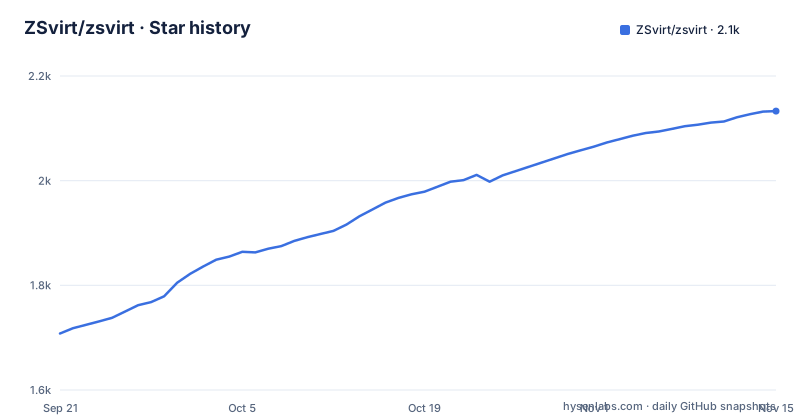
Star history
- ZSvirt/zsvirt2,133 ★ · +425
| Repository | 2026-09-21 | 2026-11-15 |
|---|---|---|
| ZSvirt/zsvirt | 1.7k | 2.1k |
425 Stars in the last 55 days, measured from the daily GitHub snapshot. Compare with other projects
Editorial analysis
Twenty-two translations, and a header whose links have no bodies
The top of the page is one block of centred HTML, and most of its links are empty anchors with no text and no image inside, so what renders is a row of invisible link targets: the project site, its English documentation, a hosted demo and a download page. The trendshift badge is written twice, as two anchors pointing at the same repository URL with identical campaign parameters, one carrying target and rel attributes and one without, and neither carrying an image. Below that sits the language switch, which is the most substantial part of the header: English in bold, then Simplified Chinese, Traditional Chinese, Korean, German, Spanish, French, Italian, Danish, Japanese, Polish, Russian, Bosnian, Arabic, Norwegian, Brazilian Portuguese, Thai, Turkish, Ukrainian, Bengali, Greek and Vietnamese, each pointing at its own README file. The repository root carries all of those files, plus a README with no extension next to README.md, a GLOSSARY.md, a GOVERNANCE.md, a SECURITY.md, a CONTRIBUTORS file, a PJNUM file and a VERSION file. Twenty-two translations of one landing page is an unusual commitment for a project whose code documentation is elsewhere.
The management node boots as a virtual machine, nested if necessary
The page opens with an offer to skip the hardware: take the qcow2 or OVA image from the download page, boot it as a virtual machine on VMware, VirtualBox or KVM, or on a cloud host that supports nested virtualization, give it an IP address, and the ZSvirt management node is up. That is a whole evaluation environment from one image file, and the two documentation pages behind the offer cover it separately, one on running the management node inside a VM and one quick start page. The hosted route is a live demo that needs no installation and no sign-up, where the only action is clicking a Demo Login button. The quick start itself, for a real deployment, has three stages: prepare compute, network and storage resources, initialize the management service, then create the first virtual machine. Nothing in the page gives the hardware sizing for either path, nor a database requirement, so the two decisions a reader has to make before starting, how much memory the management node needs and where its metadata is stored, are answered on the documentation site rather than in the repository.
ZSphere is the engine, and three surfaces drive it
The project's own account of what it is: it brings ZStack's ZSphere virtualization engine, described as enterprise proven, into the open-source world, backed by ZStack, and positions itself as a lightweight scalable platform for running virtual machines without vendor lock-in. The deployment shape is one management node with KVM-based hosts attached to it, and from there the environment of virtual machines, clusters, storage and networks is driven through three surfaces rather than one. There is a web interface, a RESTful API with Terraform provider support and SDKs for Go, Python and Java, and a command line. That third surface is why the repository carries a sdk/ directory among its modules, since the claim about three language SDKs is a source-level promise. VMware migration is described as built in rather than bolted on, with online migration, OVF import and VMDK upload named as the three pieces, which is the capability the rest of the page is organised around.
The product tour screenshots are hosted in a different repository
The tour is three collapsible sections, Dashboard for a unified operations overview, Inventory for centralized infrastructure management, and Migration Management for workload migration. Each one is supposed to show a screenshot, and each screenshot is an anchor whose image is a raw file URL under the .github repository rather than this one, for example zsvirt-dashboard.png, zsvirt-inventory.png and zsvirt-migration-management.png. Two consequences follow. The anchor bodies are empty, exactly as in the header, so no image tag is present and the reader gets a block of whitespace where the interface should be. And the files live outside the code repository, in a separate assets repository under the same organisation, which means the screenshots of the product are versioned independently of the code they depict. The first section carries an open attribute so it is expanded by default while the other two are collapsed. The rest of the page is a single migration link, to a VMware alternative page on the documentation site, introduced by a paragraph about enterprises reassessing their virtualization strategies for cost control and flexibility, and followed by another empty anchor pointing at the same URL.
A Maven tree with header/ and headers/ side by side
The repository is a Maven project, with pom.xml at the root and modules named for the architecture the page describes. The virtualization layers are visible as compute/, network/, image/ and storage-adjacent configuration under resourceconfig/. The management plane appears as core/, identity/, console/, rest/ and header/, with configuration split across conf/ and configuration/. Supporting services have their own modules: externalservice/, longjob/, agents/, platforms/, plugin/ and portal/, plus abstraction/ and assets/. Two naming collisions are worth a second look. There is both a header/ and a headers/ directory, and both a conf/ and a configuration/ directory, and nothing visible in the page says which of each pair is current. There is also a module named premium/ sitting inside a tree licensed GPL-3.0, which is a fact the repository does not explain and which a reader with commercial plans will want resolved before building. Alongside the code sit a runMavenProfile file, a PJNUM file, and the policy documents named earlier, so build and governance artifacts share the root with the sources.
Six architecture commitments, four of them about failure
The architecture section is organised by layer first, then by software property. The layers are virtualization resource management, the management plane, extension services and operational tooling, expanded into six capability groups: compute virtualization covering hosts, clusters, virtual machines, images and lifecycle; network virtualization covering virtual networks, network services and security groups; storage virtualization covering primary and backup storage, volumes, snapshots and storage resources; the management plane with its API framework, permission model, events, alarms, auditing and system operations; extension services for migration, disaster recovery, monitoring, quota management and access control; and the tooling group of installers, diagnostics, migration tools, automation scripts, agents, CLI and external integrations. The software properties are six commitments. Asynchrony, through asynchronous messages, methods and HTTP calls, to reduce blocking and raise throughput. Stateless services, where one request does not depend on another. Plugin-based extensibility for resource types and business capabilities. A workflow engine that owns execution order and supports rollback and recovery when something fails. Tagging and query for attribute extension, classification and unified queries. And automated deployment, so deployment, configuration and operations are handled by tooling rather than by hand.
No releases, and a version that lives in a plain file
The repository has no GitHub releases, so there is no tag to install and no changelog on the releases page; the only version indicator named is the VERSION file at the root, readable from a plain checkout. The last push to main was 2026-09-24, so the tree is moving. What the repository does carry is governance: a CONTRIBUTING.md, a CODE_OF_CONDUCT.md, a SECURITY.md and a GOVERNANCE.md, plus a CONTRIBUTORS file, which is a reasonable set for a project that positions itself as community driven. The rest of the documentation is not here. The quick start, the nested virtualization guide, the plugin inventory, the download images and the live demo all sit on zsvirt.io and its documentation path, and the architecture page in this repository is a summary of a design that is documented elsewhere. The glossary is worth noting too: for a project that inherits ZStack's terminology, a GLOSSARY.md at the root is the file that tells a new reader which words in the docs are load bearing.
Editorial conclusion
Zsvirt is worth reading as infrastructure code rather than as something to install this afternoon. It is the engine layer of a larger product, the description calls it the core IaaS engine and the foundation of ZSvirt, and the tree shows a Maven project with management plane, compute, network, storage, identity, console and extension modules rather than a turnkey appliance. Two things to settle first. Where you would get the platform itself, since the download images, the documentation, the live demo and the migration guide all live on zsvirt.io and none of them is in this repository, and the product tour screenshots are hosted in a separate .github repository. And what the licensing means for the module named premium that sits inside a GPL-3.0 tree, which the repository does not explain. There are no GitHub releases, so there is no version to pin except the VERSION file, and the last push to main was 2026-09-24.
Frequently asked questions
What is ZSvirt?
ZSvirt is an open-source virtualization platform that brings ZStack's ZSphere virtualization engine into the open-source world, backed by ZStack. The repository is its Java core: a management node with KVM-based hosts attached, driven through a web interface, a RESTful API with Terraform support and Go, Python and Java SDKs, and a command line.
How can I try ZSvirt without physical hardware?
Take the qcow2 or OVA image from the download page and boot it as a VM on VMware, VirtualBox or KVM, or on a cloud host with nested virtualization, then set an IP address and the management node is ready. There is also a hosted live demo that needs no installation and no sign-up, opened with a Demo Login click.
What layers does the ZSvirt architecture have?
Compute virtualization for hosts, clusters, virtual machines, images and lifecycle, network virtualization for virtual networks, network services and security groups, storage virtualization for primary and backup storage, volumes and snapshots, a management plane with API framework, permissions, events, alarms and auditing, extension services for migration, disaster recovery, monitoring and quotas, and tooling for installation, diagnostics and automation.
Does ZSvirt support migrating from VMware?
Yes. The page names online migration, OVF import and VMDK upload as built-in capabilities, and points at a VMware migration guide hosted on the documentation site, introduced as a way to evaluate and plan a move for cost control and flexibility.
How is the ZSvirt source code laid out?
It is a Maven project with pom.xml at the root and modules for compute, network, image, resource configuration, core, identity, console, rest, external services, long jobs, agents, platforms, plugins, portal, abstraction, assets and an SDK, plus a module named premium. There are no GitHub releases, so the VERSION file is the only version indicator.
Official sources
Add this badge to your README
If you maintain this project, the badge below links readers to this analysis and shows its maintenance status from the daily GitHub snapshot. Paste the markdown into your README; add ?metric=license or ?metric=stars to the image URL for a different field.

[](https://hysenlabs.com/projects/zsvirt-zsvirt)Star history chart for your README
[](https://hysenlabs.com/projects/zsvirt-zsvirt)Was this useful?