novel: a Spring Boot 3 and Vue 3 reading platform built as a teaching project
novel is a learning-oriented novel platform built with Spring Boot 3 and Vue 3 as a decoupled frontend/backend project, with step-by-step tutorials for building and launching a production-grade Java system from scratch. It consists of a reader portal, a writer admin backend and a platform admin backend, with features including recommendations, search, rankings, reading, comments, a membership center, a writer zone, paid subscriptions and news publishing.
At a glance
- What is it?
- A four repository Chinese novel platform with a step-by-step tutorial attached, where the interesting part is the stack list and the sharding decision.
- Who is it for?
- novel earns its place as a reference implementation rather than as software you would deploy unchanged. The stack table is precise about versions down to Tomcat 10.1.24 and Redisson 3.17.4, the three optional services are off by default so a first run needs only MySQL and Redis, and ShardingSphere-JDBC 5.5.1 is part of the listed stack.
- Can I use it commercially?
- Yes. Apache-2.0 is a permissive licence: you can use, modify and sell software built on it, as long as you keep its copyright and licence notices.
- Is it still maintained?
- Yes. The repository received new commits within the last day.
- What is it written in?
- Mainly Java, according to GitHub's language statistics.
Answers come from the project's GitHub data, last synced on November 26, 2026, and from our analysis. They are not legal advice.
Star history
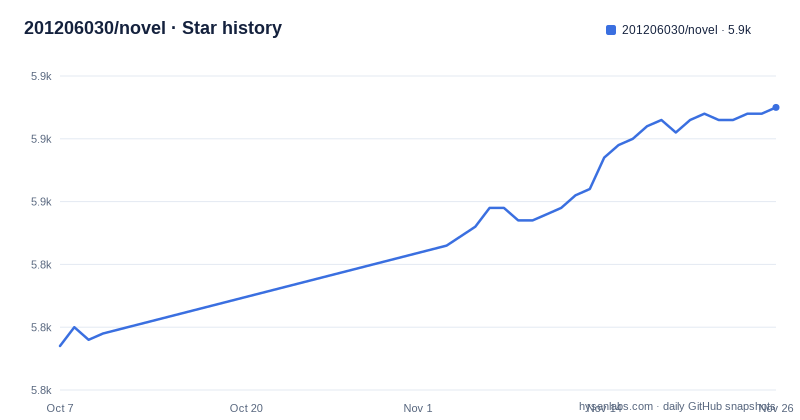
- 201206030/novel5,865 ★ · +38
| Repository | 2026-10-07 | 2026-11-26 |
|---|---|---|
| 201206030/novel | 5.8k | 5.9k |
38 Stars in the last 50 days, measured from the daily GitHub snapshot. Compare with other projects
Editorial analysis
One product spread across four repositories
The project description sets expectations clearly: this is a full stack novel platform, built as a learning exercise, with a tutorial that walks from an empty directory to something deployed. The feature list is long and specific enough to be useful as a scope statement. Reading, recommendations, search, leaderboards, comments, a membership centre, a writer area, paid subscriptions and news publishing are all named, and they are split across a novel portal system, a writer backend and a platform admin backend.
What is more interesting than the feature list is the repository layout, which is four separate projects. The backend is at 201206030/novel, with mirrors on Gitee and GitCode. The Vue frontend is a different repository, novel-front-web. Then there is novel-plus, described as the online application version, and novel-cloud, the microservice version. novel-plus and novel-cloud are mirrored on Gitee.
So the platform is not one codebase with optional modules, it is a product line at three levels of operational ambition, and the tutorial picks one. The README marks both the backend and the frontend repositories as still being updated, which is a more honest signal than a version badge. The tree of the backend is small and conventional by contrast: `pom.xml`, `mvnw`, `mvnw.cmd`, `.mvn/`, `src/`, `doc/`, and `LICENSE`. The Maven wrapper is checked in, which is the first practical detail that matters when you clone it.
The environment list, and why three of the five services are optional
The stated development environment is MySQL 8.0, Redis 7.0, JDK 21, Maven 3.8 and Node 16.14, with IntelliJ IDEA marked optional. Three more services are listed but marked optional: Elasticsearch 8.2.0, RabbitMQ 3.10.2 and XXL-JOB 2.3.1.
The note under the list explains the mechanism rather than just the outcome. Each of those three can be switched on through a matching `enable` property in `application.yml`, and all three are off by default. That is the single most useful line in the README for anyone about to clone this, because it turns a five service system into a two service one. MySQL and Redis are the floor; everything else is opt in.
The versions are worth reading as a set rather than individually. JDK 21 with Spring Boot 3.3.0 is a deliberate pairing rather than a coincidence. Node 16.14 on the frontend side is older than you would pick today, and it is a number to notice before you start building a frontend toolchain around it.
Reading the backend stack table for what the project actually uses
The technology table is the most information dense part of the README, and it is worth reading closely because several entries explain an architectural choice rather than naming a library.
MyBatis at 3.5.9 with MyBatis-Plus at 3.5.3 on top of it is the persistence layer. ShardingSphere-JDBC at 5.5.1 is listed as the support for database sharding and table partitioning. Redisson 3.17.4 provides the distributed lock and Redis 7.0 the distributed cache, while Caffeine 3.1.0 sits alongside as the local cache, so there is a two tier cache arrangement rather than a single one.
The observability and operations entries are just as telling. Sentinel 1.8.4 is there for traffic control, Springdoc-openapi 2.0.0 generates Swagger 3 documentation from the code, and Spring Boot Admin 3.0.0-M1 handles application management and monitoring. Sentinel, an Alibaba component, is not a default choice in a Spring project, so its presence says the author expects real traffic shapes rather than a demo. One detail worth flagging: several of these versions are pre-release milestones, Spring AI at 1.0.0-M6 and Spring Boot Admin at 3.0.0-M1 in particular. A reader copying this stack into production would be adopting milestone builds that the author chose for teaching convenience.
What v3.5.0 changed, and what it says about the direction
There are three tagged releases in the repository. v3.5.0 came on 2025-02-20, v3.4.1 on 2024-06-02, and v3.4.0 on 2023-04-25.
The current README's environment list and stack table show JDK 21, Spring Boot 3.3.0, ShardingSphere-JDBC 5.5.1, Spring AI 1.0.0-M6 and Tomcat 10.1.24.
Where the repository ends and the documentation begins
The README is an index, not a manual, and it is built around a link to the tutorial at docs.xxyopen.com/course/novel described as step by step from zero. The homepage novel.xxyopen.com is the deployed application.
So the repository's job is to be the thing the tutorial diffs against, and its `doc/` directory is presumably part of that. That is a reasonable division for a teaching project, where the prose is the product, but it means evaluating the code quality means reading both.
Editorial conclusion
novel earns its place as a reference implementation rather than as software you would deploy unchanged. The stack table is precise about versions down to Tomcat 10.1.24 and Redisson 3.17.4, the three optional services are off by default so a first run needs only MySQL and Redis, and ShardingSphere-JDBC 5.5.1 is part of the listed stack. What the repository does not settle is the one thing a reader most wants: the backend and the Vue frontend are separate repositories, and the backend one is marked as still being updated, so the pair you clone today is not a frozen matching set.
Frequently asked questions
What do I need installed before I can run the novel backend?
MySQL 8.0, Redis 7.0, JDK 21, Maven 3.8 and Node 16.14. Elasticsearch 8.2.0, RabbitMQ 3.10.2 and XXL-JOB 2.3.1 are listed as optional and are switched on through matching enable properties in application.yml, so a first run needs only the database and the cache.
Is the frontend in the same repository as the backend?
No. The Vue frontend lives in novel-front-web, the online application version in novel-plus and the microservice version in novel-cloud, each mirrored on Gitee, with the frontend also on GitCode. The README marks both the backend and frontend repositories as still being updated.
Does the project support splitting the database across shards?
ShardingSphere-JDBC at 5.5.1 is in the stack specifically for database sharding and table partitioning.
What changed in the latest tagged release?
v3.5.0, published 2025-02-20, is the latest tagged release. The current README's stack lists JDK 21, Spring Boot 3.3.0, ShardingSphere-JDBC 5.5.1, Spring AI 1.0.0-M6 and Tomcat 10.1.24.
Official sources
Add this badge to your README
If you maintain this project, the badge below links readers to this analysis and shows its maintenance status from the daily GitHub snapshot. Paste the markdown into your README; add ?metric=license or ?metric=stars to the image URL for a different field.

[](https://hysenlabs.com/projects/201206030-novel)Star history chart for your README
[](https://hysenlabs.com/projects/201206030-novel)Was this useful?