Obfuscate for hiding C++ string literals at compile time
Guaranteed compile-time string literal obfuscation header-only library for C++14
At a glance
- What is it?
- Obfuscate is a header-only C++14 library that encrypts string literals with a compile-time XOR operation and decrypts them when the program runs. It reduces the visibility of ordinary strings in binaries, but its own documentation rejects it as protection for passwords or other sensitive secrets.
- Who is it for?
- Developers may adopt Obfuscate when the goal is limited binary-string obfuscation for non-secret values and they accept binary size and thread-local state. It is unsuitable for passwords, keys, or other security-sensitive strings, and callers must first verify that their toolchain accepts the header's C++14 constant-expression implementation and that their threading model does not share one decoded object across threads.
- Can I use it commercially?
- Yes. Unlicense is a permissive licence: you can use, modify and sell software built on it, as long as you keep its copyright and licence notices.
- Is it still maintained?
- Yes. The repository last received commits 142 days ago.
- What is it written in?
- Mainly C++, according to GitHub's language statistics.
Answers come from the project's GitHub data, last synced on October 23, 2026, and from our analysis. They are not legal advice.
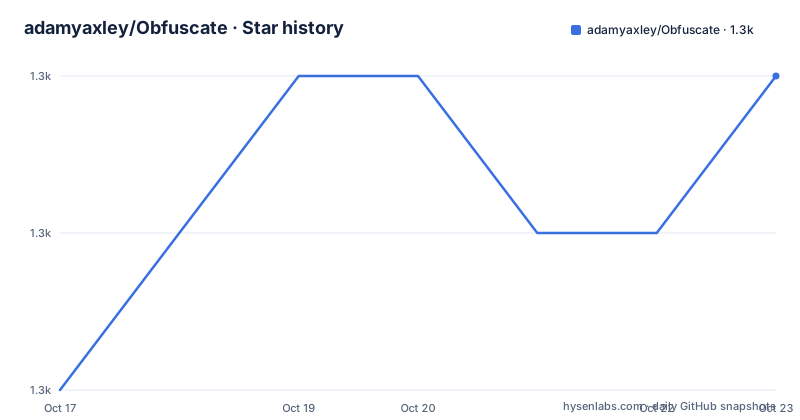
Star history
- adamyaxley/Obfuscate1,347 ★ · +2
| Repository | 2026-10-17 | 2026-10-23 |
|---|---|---|
| adamyaxley/Obfuscate | 1.3k | 1.3k |
2 Stars in the last 6 days, measured from the daily GitHub snapshot. Compare with other projects
Editorial analysis
Why Obfuscate targets plaintext strings in C++ binaries
Ordinary C++ string literals are easy to locate because the compiler places readable text in the executable. The README points to the Unix `strings` utility as a direct way to search a binary for those values. That matters when a program contains labels, identifiers, messages, or other strings that an observer can extract without executing the code.
Obfuscate addresses that narrow discovery problem. The library encrypts a literal during compilation, stores the encrypted representation instead of the readable literal, and reconstructs the text at runtime. Its README describes the transformation as a compile-time XOR cipher using a random 64-bit key. The resulting `ay::obfuscated_data` object provides implicit `char*` conversion, so it can be passed to many existing interfaces without changing those interfaces.
This is obfuscation, not secure secret storage. The author explicitly warns that determined attackers can still recover the strings and does not recommend using the library for private passwords or other security-sensitive values. The intended users are C++ developers who want casual string discovery to produce fewer immediate results in a binary image. The project does not document protection against debugger inspection, runtime memory scanning, controlled input, program instrumentation, or analysis of decrypted buffers.
The compile-time and runtime path in AY_OBFUSCATE
The core interface is the `AY_OBFUSCATE` macro. A caller supplies a string literal, and the library processes it with a constant expression during compilation. According to the README, the plaintext does not need to remain as an ordinary string in the compiled executable. Instead, the compiler works with encrypted data and a random 64-bit key.
At runtime, the encrypted data is held in a `thread_local` variable inside a unique lambda. The README describes this as global lifetime per thread, which permits the object to be used in local and temporary contexts. The object can then decrypt its contents when the application needs a readable `char*`. It can also encrypt them again, as shown in the project's thread-safety example.
The design does more than prepend a pointer to encrypted bytes. The README says the macro avoids the constant pointer normally associated with a small literal, and that this may cause the compiler to inline the encrypted string construction into runtime assembly operations. That behavior is intended to complicate a simple scan for the original literal and a direct XOR decryption pattern. It is still a best-effort deterrent. The exact assembly layout and binary contents depend on compiler behavior, and the project does not document guarantees for every optimizer, target, or C++ standard mode beyond its stated C++14 baseline.
Installing the single header and running the first example
There is no package-manager installation procedure in the README. The documented setup is to copy `obfuscate.h` into the project, then wrap string literals with `AY_OBFUSCATE`. The repository also contains `CMakeLists.txt`, but the README does not provide a CMake command or an installed package name, so those details cannot be assumed.
The following example comes from the README. It creates the obfuscated value directly in `main` and streams it through the implicit pointer conversion. A reader should see the decoded `Hello World` text when the program runs, even though the README states that this literal is not stored in plain text in the compiled executable.
#include "obfuscate.h"

int main()
{
    std::cout << AY_OBFUSCATE("Hello World") << std::endl;
    return 0;
}
The examples also show assignment to raw character pointers, construction of `std::string`, and use as a function argument. These forms work because the generated object is implicitly convertible to `char*`. That convenience makes migration incremental, but callers should pay attention to when the object is decrypted. The README's API exposes `decrypt()` and `encrypt()`, so the surrounding application must preserve the intended state while consuming the text.
Thread-local storage narrows safe concurrent use
Thread safety is one of the most important adoption constraints. The README supports using `AY_OBFUSCATE` in a local context per thread. Each thread creates its own object, decrypts it, uses it, and encrypts it again. The underlying storage is `thread_local`, which gives separate local instances separate state.
The unsupported case is sharing one returned obfuscated object between threads. If one thread decrypts the value while another reads it, the output operation can race with `encrypt()`. The README says such sharing requires locks in the appropriate locations, and it explicitly marks the captured-reference example as unsupported.
A practical distinction is therefore between creating an object inside each thread and moving one object's lifetime across threads. The first is documented as supported when local to each thread. The second is outside the supported model unless the caller adds synchronization. Obfuscate does not provide its own shared-object mutex, ownership transfer, or atomic snapshot API according to the documentation.
Binary growth from inlining encrypted strings
Obfuscation adds a measurable size cost. The README publishes a comparison from `test_bloat.py` for a small login program that obfuscates a username and password. In the Release configuration, the plain version is listed as 18,944 bytes and the obfuscated version as 21,504 bytes, producing 2,560 bytes of reported bloat, or 13.5 percent. In Debug, the corresponding figures are 95,232 bytes and 101,888 bytes, with 6,656 bytes of bloat, or 7.0 percent.
These figures are project-specific examples rather than a promise about every application. The README attributes the increase to the runtime construction pattern described for inline encrypted strings. Adding more literals, changing compiler optimization settings, or targeting a different architecture could change the result.
The library may therefore be inappropriate for a binary with a strict size budget, especially when the values are not sensitive and can be recovered from source or runtime behavior anyway. The correct trade-off is not simply obfuscation versus no obfuscation. It is added executable size and more complicated runtime state versus a modest reduction in immediate plaintext discoverability.
What Obfuscate does not replace
A real alternative is to keep sensitive values outside the executable and obtain them from an authenticated service at runtime. This changes the problem from hiding a literal in a binary to controlling where the value comes from and how it is delivered. For application credentials, this can avoid placing the value in the executable in the first place, although the transport, authorization, and runtime handling still require separate security design.
Another alternative is ordinary plaintext literals when the data is genuinely non-sensitive and binary size, debuggability, or build simplicity matter more than casual obfuscation. Obfuscate's value is narrower: it makes a literal less immediately visible to tools such as `strings`, while adding size and runtime behavior.
The distinction is important for technical reviewers. Obfuscate does not claim to prevent determined reverse engineering, and its README says so directly. It should not be used as a substitute for encryption at rest, secret management, authentication, authorization, or careful handling of sensitive values. It is a source-level C++ convenience for a binary-inspection deterrent, not a complete security boundary.
Maintenance, licensing, and the cost of adopting the header
The repository is not archived, and the last push was on 2026-06-03. The project has a `v1.0.0` release dated 2025-09-03. That indicates a recent published version and recent repository activity, but the README does not describe a compatibility policy, release cadence, or migration plan. Since the project is a single header, integration itself is small, yet changes to the implementation or compiler requirements could still require rebuilding consumers.
The repository identifies the Unlicense as its license. The project-specific implication is that the library is distributed under that permissive license, but the Unlicense file and applicable law should be reviewed for an organization's normal compliance process. No package dependencies are shown in the documented quick start.
Upgrade cost is mostly source maintenance. Because adoption means copying `obfuscate.h` rather than consuming a documented package API, teams must decide whether to copy a specific revision, vendor changes, or track the repository directly. The repository includes test programs such as `test_unit.cpp`, `test_obfuscated.cpp`, and `test_bloat.cpp`, which are concrete places to inspect when validating behavior in a consuming build.
Editorial conclusion
Developers may adopt Obfuscate when the goal is limited binary-string obfuscation for non-secret values and they accept binary size and thread-local state. It is unsuitable for passwords, keys, or other security-sensitive strings, and callers must first verify that their toolchain accepts the header's C++14 constant-expression implementation and that their threading model does not share one decoded object across threads.
Frequently asked questions
How do I install Obfuscate in a C++ project?
The README says to copy `obfuscate.h` into the project. It does not document a package-manager installation command.
Does Obfuscate protect passwords in a binary?
No. The README explicitly says that determined hackers can still access the strings and does not recommend the library for private passwords or other security-sensitive strings.
Can one Obfuscate object be shared between threads?
The README supports local `AY_OBFUSCATE` objects per thread. Sharing one object across threads is unsupported unless the application adds appropriate locks.
Does Obfuscate increase binary size?
Yes. The README reports 2,560 bytes of bloat for its Release example and 6,656 bytes for its Debug example.
Official sources
Add this badge to your README
If you maintain this project, the badge below links readers to this analysis and shows its maintenance status from the daily GitHub snapshot. Paste the markdown into your README; add ?metric=license or ?metric=stars to the image URL for a different field.

[](https://hysenlabs.com/projects/adamyaxley-obfuscate)Star history chart for your README
[](https://hysenlabs.com/projects/adamyaxley-obfuscate)Was this useful?