UniSD shows LLMs can teach themselves without a stronger teacher
Official implementation for "Towards a Unified Self-Distillation Framework for Large Language Models" (https://arxiv.org/abs/2605.06597).
At a glance
- What is it?
- A unified self-distillation framework from Georgia Tech, UCLA, CMU, William and Mary, and Microsoft researchers combines multi-teacher agreement, EMA stabilization, contrastive learning, feature matching, and divergence clipping, gaining 5.4 points over base models using only self-derived supervision.
- Who is it for?
- UniSD converts self-distillation for LLMs from scattered tricks into a mapped design space: five mechanisms spanning supervision reliability, representation alignment, and training stability, evaluated across six benchmarks and six models from three families, with the integrated recipe gaining 5.4 points over base models and 2.8 over the strongest baseline using no external teacher.
- Can I use it commercially?
- Yes. Apache-2.0 is a permissive licence: you can use, modify and sell software built on it, as long as you keep its copyright and licence notices.
- Is it still maintained?
- Yes. The repository last received commits 165 days ago.
- What is it written in?
- Mainly Python, according to GitHub's language statistics.
Answers come from the project's GitHub data, last synced on November 25, 2026, and from our analysis. They are not legal advice.
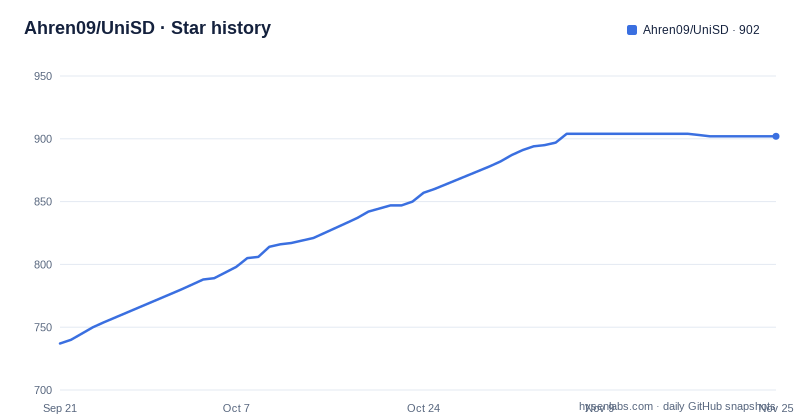
Star history
- Ahren09/UniSD902 ★ · +165
| Repository | 2026-09-21 | 2026-11-25 |
|---|---|---|
| Ahren09/UniSD | 737 | 902 |
165 Stars in the last 65 days, measured from the daily GitHub snapshot. Compare with other projects
Editorial analysis
Self-distillation without a stronger teacher
The standard recipe for improving a language model is distillation from a stronger teacher, which works until you reach the frontier, where no stronger model exists, or until licensing and cost rule one out. Self-distillation offers another path: a model improves from its own outputs. The catch is that self-distillation for autoregressive LLMs is genuinely hard. Self-generated trajectories are free-form, correctness depends on the task, and a rationale that sounds plausible can still provide unstable or unreliable supervision.
UniSD, from researchers at Georgia Tech, UCLA, Carnegie Mellon, William and Mary, and Microsoft Research, addresses the fragmentation in this space. Its argument is that existing methods each examine isolated design choices, leaving their effectiveness, roles, and interactions unclear. The project is the official implementation of the associated paper, and it turns self-distillation from a collection of one-off tricks into a framework where each mechanism can be enabled, disabled, and compared under controlled conditions.
Five mechanisms, one framework
The framework organizes self-distillation along three axes: supervision reliability, representation alignment, and training stability. On the reliability axis, multi-teacher agreement exists at sequence level and token level, with random, retrieval, and induction variants for constructing auxiliary teacher contexts, controlled by the number of auxiliary contexts and an agreement strength parameter. On the alignment axis, token-level contrastive learning pushes representations apart where they should differ, and feature matching distills from final-layer features in joint or representation-only modes.
On the stability axis, two mechanisms do the quiet work. EMA teacher stabilization maintains an exponentially moving averaged copy of the model as a steadier supervision target, with configurable sync steps and mixing. Divergence clipping, called JSD-Clip, bounds the divergence objective so a single unstable token or batch cannot destabilize training. Each mechanism maps to a training mode flag, and the integrated recipe simply turns on the right combination of them.
What the study found
The evaluation scale is what separates UniSD from a single-model case study: six benchmarks, six models, three model families, with the five mechanisms studied both in isolation and in combination. That grid answers questions isolated papers cannot. When does self-distillation actually beat static imitation? Which components drive the gains, and which contribute nothing for a given model family? How do the mechanisms interact when composed?
The headline result comes from UniSD with a star, the integrated pipeline assembled from those findings. It achieves the strongest overall performance in the study, improving over the base model by 5.4 points and over the strongest baseline by 2.8, using only self-derived supervision. The practical claim underneath the numbers matters more for practitioners: efficient LLM adaptation does not require access to a stronger external teacher, and the recipe for extracting improvement from a model own outputs is now documented, reproducible, and open source under Apache 2.0.
UniSD with a star: the integrated recipe
The strongest configuration combines EMA teacher stabilization, feature matching, token-level contrastive learning, and multi-teacher agreement into a single training run. The composition is not arbitrary; it reflects the study's finding that the mechanisms cover complementary failure modes. Agreement filtering improves the reliability of the supervision signal, the EMA teacher keeps the target from shifting under the learner's feet, contrastive learning sharpens token-level representations, and feature matching anchors the deeper representations.
For teams running the code, the integrated recipe is a single mode value, unisd_star, alongside the individual modes for each mechanism. Every component exposes its key flags, from the number of auxiliary contexts and agreement gamma for the agreement mechanisms, through sync steps and mixing beta for the EMA teacher, to contrastive weight and margin, final-layer distillation weight, and the two clipping parameters. That granularity means the framework doubles as a laboratory: reproduce the paper, then perturb one axis at a time on your own model and tasks.
Setting up the environment
The install targets Python 3.12 with CUDA 12.8, and the README walks through the prerequisite steps that trip up most PyTorch research repos. The environment is built with conda, then cu128 PyTorch installs from the PyTorch wheel index before anything else, because flash-attention-2 must compile against the installed torch:
# 1) Create and activate the env
conda create -n unisd python=3.12 -y
conda activate unisd
pip install -U pip setuptools wheel packaging ninja

# 2) Install cu128 PyTorch from the PyTorch wheel index (must precede flash-attn build)
pip install --index-url https://download.pytorch.org/whl/cu128 \
    torch==2.11.0 torchvision==0.26.0 torchaudio==2.11.0

# 3) Point flash-attn's CUDA build at a 12.x toolkit
#    (on many hosts /usr/local/cuda → 13.x, which mismatches torch's cu128 ABI)
export CUDA_HOME=/usr/local/cuda-12.6

# 4) Install everything else — flash-attn builds from source here (~20 min the first time)
pip install -r requirements.txt --no-build-isolation
Any CUDA 12.x toolkit between 12.4 and 12.8 works for the flash-attn build. Verification is a one-liner that imports torch, vllm, flash_attn, and flashinfer and prints versions plus CUDA availability:
python -c "
import torch, vllm, flash_attn, flashinfer
print('torch       ', torch.__version__, 'cuda_ok:', torch.cuda.is_available())
print('vllm        ', vllm.__version__)
print('flash_attn  ', flash_attn.__version__)
print('flashinfer  ', flashinfer.__version__)
"
Two optional environment variables cover the extras: WANDB_API_KEY for logging and HF_TOKEN for gated models.
Running experiments and compatibility notes
Training launches two ways. The preferred path is a preset orchestrator, scripts/run_experiments.py, which handles GPU scheduling, dependency-aware sweeps, and sensible defaults, with subcommands matching the mechanism names such as contrastive with its weight flag. The second path invokes training directly for full per-flag control, which is the route to take when reproducing a specific configuration from the paper or ablate-testing one component.
One compatibility note saves debugging time: the environment ships trl 1.4.0, which officially supports vLLM 0.12.0 through 0.18.0, alongside vllm 0.20.2. The combination passes the project's smoke tests but trl prints a warning at import time, and if a runtime error comes out of the VLLM client, the fix is pinning vllm below 0.19. Between the orchestrator defaults, the per-mechanism flags, and the documented environment quirks, the repository is set up so that the distance between cloning the code and running the integrated recipe is an afternoon of environment setup rather than a research project of its own.
Editorial conclusion
UniSD converts self-distillation for LLMs from scattered tricks into a mapped design space: five mechanisms spanning supervision reliability, representation alignment, and training stability, evaluated across six benchmarks and six models from three families, with the integrated recipe gaining 5.4 points over base models and 2.8 over the strongest baseline using no external teacher. With the full implementation, per-mechanism flags, and experiment orchestrator open sourced under Apache 2.0, it is both a research result and a working toolkit for teams that need to keep improving a model they have already maxed out.
Frequently asked questions
What is self-distillation in LLM training?
Self-distillation is a training approach where a language model improves from its own generated outputs instead of supervision from a stronger external teacher. UniSD shows the challenges are free-form trajectories, task-dependent correctness, and unstable supervision from plausible but unreliable rationales, and it addresses them with agreement filtering, EMA stabilization, contrastive learning, feature matching, and divergence clipping.
How is self-distillation different from knowledge distillation?
Knowledge distillation transfers capability from a stronger teacher model to a student, which requires access to that teacher. Self-distillation derives all supervision from the model itself, through mechanisms like multi-teacher agreement over self-generated contexts and an EMA-averaged copy of the same network. UniSD reports that this approach can beat static imitation and strong baselines without any external teacher.
What results does UniSD report?
Across six benchmarks, six models, and three model families, the study measures each of the five mechanisms in isolation and in combination. The integrated UniSD recipe improves over the base model by 5.4 points and over the strongest baseline by 2.8, using only self-derived supervision, demonstrating self-distillation as a practical adaptation method.
Official sources
Add this badge to your README
If you maintain this project, the badge below links readers to this analysis and shows its maintenance status from the daily GitHub snapshot. Paste the markdown into your README; add ?metric=license or ?metric=stars to the image URL for a different field.

[](https://hysenlabs.com/projects/ahren09-unisd)Star history chart for your README
[](https://hysenlabs.com/projects/ahren09-unisd)Was this useful?