Akka HTTP: a streaming HTTP toolkit for Scala and Java
The Streaming-first HTTP server/module of Akka
At a glance
- What is it?
- Akka HTTP provides server and client modules built on akka-actor and akka-stream. It suits developers who need HTTP, HTTP/2, WebSocket, or routing control inside an Akka application, but it is not presented as a browser-focused web framework.
- Who is it for?
- Adopt Akka HTTP when a service already uses Akka Streams or Actors and needs explicit control over server, client, HTTP/2, WebSocket, or marshalling behavior. Do not treat it as a conventional web framework or assume that the README provides an installation path.
- Can I use it commercially?
- Check first. The repository uses a licence we do not classify automatically, so read its LICENSE file before any commercial use.
- Is it still maintained?
- Yes. The repository received new commits within the last day.
- What is it written in?
- Mainly Scala, according to GitHub's language statistics.
Answers come from the project's GitHub data, last synced on November 7, 2026, and from our analysis. They are not legal advice.
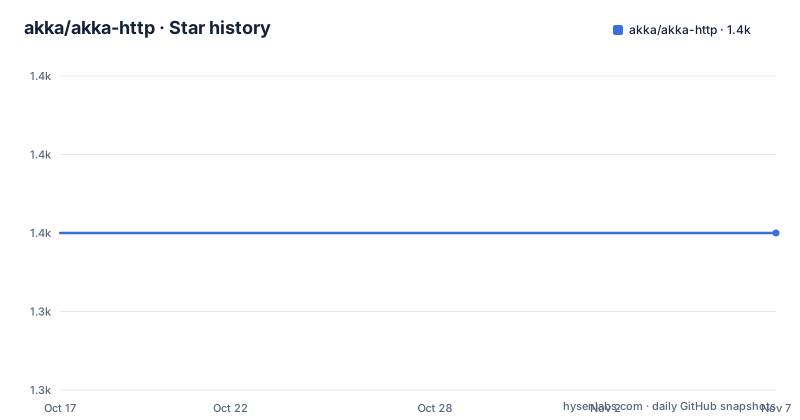
Star history
- akka/akka-http1,350 ★ · +0
| Repository | 2026-10-17 | 2026-11-07 |
|---|---|---|
| akka/akka-http | 1.4k | 1.4k |
0 Stars in the last 21 days, measured from the daily GitHub snapshot. Compare with other projects
Editorial analysis
Why Akka HTTP exists in an Akka service
Akka HTTP addresses applications that need to provide or consume HTTP-based services while their surrounding logic is already modeled with Akka. The repository describes the library as a server-side and client-side HTTP stack implemented on top of `akka-actor` and `akka-stream`. That makes its primary audience clear: developers building services in the Akka ecosystem who need HTTP to fit an actor or stream architecture rather than sit inside a framework centered on controllers, routes, and request lifecycles.
The project supports more than request and response handling. Its topics include `http-client`, `http-server`, `http2`, `websocket`, caching, JWT, marshalling, compatibility testing, testkit support, and native-image tests. The repository layout backs up that broader scope. Directories include `akka-http-core`, `akka-http`, `akka-http-caching`, `akka-http-jwt`, `akka-http-testkit`, `akka-http2-tests`, `akka-parsing`, and separate Java and Scala marshaller modules. This is a library collection rather than a single web application.
Browser interaction is within scope, but the README explicitly says it is not the primary focus. That distinction matters when selecting a project. Akka HTTP can serve HTTP and support WebSocket work, yet the library presents itself as a general HTTP toolkit. It is therefore better aligned with service communication and streaming integration than with teams looking primarily for a browser-oriented application framework.
The actor and stream foundation of Akka HTTP
The core architectural fact is explicit: the modules implement a full server-side and client-side HTTP stack on top of `akka-actor` and `akka-stream`. The repository also uses an open design in which several API levels can perform similar tasks. A higher-level interface can reduce application code, while a lower-level interface exposes more control at the cost of requiring more code from the developer.
That design affects data flow decisions. At the abstract level, Akka HTTP handles the HTTP stack while applications work with the abstractions selected for their use case. At lower levels, developers can move closer to the underlying request and response processing and provide more application logic themselves. The README does not document a single mandatory request pipeline, route model, entity-decoding policy, or middleware sequence, so those details cannot be inferred from this repository overview.
The module split also suggests that some concerns are packaged independently rather than forced into one facade. `akka-http-core` is the central core module, `akka-http` is the main library module, `akka-http-caching` covers caching, `akka-http-jwt` covers JWT functionality, and the marshaller modules provide Scala and Java marshalling support. `akka-http-testkit` is available for tests, while compatibility and HTTP/2 tests have separate directories. The repository layout establishes these boundaries, but the README does not specify their internal APIs or dependency wiring.
Server, client, HTTP/2, and WebSocket scope
Akka HTTP is suitable when the same application needs both sides of HTTP communication. The README calls it a full server- and client-side stack, and its reference documentation provides separate Scala and Java entry points. This makes it relevant to services that expose APIs, consume external APIs, or need both behaviors within an Akka-based system.
The topic list and repository directories broaden the scope beyond ordinary request routing. HTTP/2 has dedicated compatibility coverage in `akka-http2-tests`, while WebSocket appears as a supported topic. Caching and JWT have dedicated modules. Java and Scala marshallers are separate modules, which reflects the library's support for two language ecosystems rather than one thin Scala wrapper with an unspecified Java interface.
The available API levels are a meaningful adoption constraint. Teams should not assume that a high-level route or client abstraction will expose every protocol option they need. The README says that lower-level APIs are likely to exist when a high-level approach cannot achieve a requirement, but it also warns that they can require more application code. Conversely, choosing the lowest-level API for every operation would discard the abstraction offered by the higher layers. The documentation does not give a matrix showing which levels cover WebSocket, HTTP/2, server binding, client execution, or entity handling, so those choices need to be checked in the reference documentation.
Starting from the Akka HTTP quickstart samples
The repository provides `samples/akka-http-quickstart-scala` and `samples/akka-http-quickstart-java`, so Scala and Java developers have separate quickstart projects from which to begin. However, the README does not include build commands, dependency coordinates, binding syntax, or a runnable hello-world program. Inventing an installation command would risk producing a setup that does not match this repository or the selected Akka release.
A first useful review therefore starts in one of those two sample directories and follows the build definition and source files stored there. Because those file contents are not included in the repository overview, this review cannot state what port the sample binds, which routes it defines, or which commands it expects. The reference documentation linked by the README remains the authoritative place to inspect current Scala and Java APIs.
Release selection is also part of a real first use. The repository lists releases on its GitHub releases page, while current versions across Akka libraries are published on the Akka Dependencies page. Recent releases include `v10.7.6`, `v10.7.5`, and `v10.7.4`. The README does not map a specific quickstart branch to one of those releases, so version alignment must be checked in the sample build and dependency documentation rather than inferred from the repository name.
Where Akka HTTP is the wrong abstraction
The clearest mismatch is a team seeking a conventional web framework. The README explicitly says that Akka HTTP is not a web framework and places browser interaction outside its primary focus. A project whose main requirements are a large collection of web-oriented conventions may find Akka HTTP's multiple API levels and actor or stream foundations harder to map to its established model. The repository overview does not provide the controller, template, form, or asset features that would be needed to make that comparison complete.
A second constraint is abstraction choice. Moving to a lower API level may be necessary for flexibility, but the README explicitly associates that flexibility with more application code. This creates direct maintenance work for request handling, response handling, or protocol behavior when a high-level API cannot express the requirement. The overview does not quantify that cost, so adopters should inspect the exact API rather than assume the library removes implementation detail.
A realistic alternative is to select another library whose programming model centers on HTTP routes and browser application development. The actual difference is architectural: such a library organizes the application around its own web abstractions, whereas Akka HTTP composes HTTP behavior with `akka-actor` and `akka-stream`. Another alternative for a service that does not use Akka at all is a general-purpose HTTP library selected for its standalone API. The repository README does not name a specific competitor, so no named comparison or claim about its capabilities would be supportable here.
Release upkeep, modules, and BSL licensing
The repository is not archived, and its last push was on 2026-10-13. Recent Akka HTTP releases were published on 2026-09-30, 2026-08-18, and 2026-03-20. These facts indicate recent repository activity and recent release work. They do not by themselves define the effort required to upgrade an application, which will also depend on API changes, dependency alignment, and the behavior of code built on lower-level interfaces.
The upgrade surface is potentially meaningful because the project is split across core HTTP code, server and client modules, caching, JWT, marshalling, testkit, parsing, compatibility tests, and native-image tests. The README directs users to the Akka Dependencies page for current Akka library versions. That cross-library version selection should be treated as part of adoption, even though the repository overview does not document a formal upgrade procedure.
Akka is licensed under the Business Source License 1.1, according to the README. Tests and documentation use a separate license, with details available in the relevant `LICENSE` file under each documentation and test root directory. This is not legal advice. Before commercial or other production use, review `LICENSE.txt` and the linked Akka License FAQ for the terms that apply to the planned use and distribution model.
Editorial conclusion
Adopt Akka HTTP when a service already uses Akka Streams or Actors and needs explicit control over server, client, HTTP/2, WebSocket, or marshalling behavior. Do not treat it as a conventional web framework or assume that the README provides an installation path. Before adoption, inspect samples/akka-http-quickstart-scala or samples/akka-http-quickstart-java, confirm the Akka Dependencies version that matches the intended release, and review LICENSE.txt for the Business Source License 1.1 terms that apply to your use.
Frequently asked questions
What is Akka HTTP used for?
Akka HTTP is a server-side and client-side HTTP stack built on `akka-actor` and `akka-stream`. It is intended for providing and consuming HTTP-based services rather than serving primarily as a browser-focused web framework.
Does Akka HTTP support Scala and Java?
Yes. The README provides separate reference documentation for Scala and Java, and the repository includes `akka-http-marshallers-scala` and `akka-http-marshallers-java` modules plus a quickstart sample for each language.
Where should I start when learning Akka HTTP?
The repository contains `samples/akka-http-quickstart-scala` and `samples/akka-http-quickstart-java`. The README does not provide installation or run commands, so it directs developers to the language-specific reference documentation for current API details.
Official sources
Add this badge to your README
If you maintain this project, the badge below links readers to this analysis and shows its maintenance status from the daily GitHub snapshot. Paste the markdown into your README; add ?metric=license or ?metric=stars to the image URL for a different field.

[](https://hysenlabs.com/projects/akka-akka-http)Star history chart for your README
[](https://hysenlabs.com/projects/akka-akka-http)Was this useful?