steve-jobs-skill ships a reasoning persona as a Markdown file
乔布斯.skill — Steve Jobs的认知操作系统。6个心智模型 + 8条决策启发式 + 完整表达DNA。由女娲.skill生成。
At a glance
- What is it?
- steve-jobs-skill is an agent skill that gives a coding agent a Steve Jobs persona to answer with, and the interesting part is that the persona is backed by a research corpus rather than a prompt written from memory. Six files totalling nearly two thousand five hundred lines of notes on writings, interviews, rhetoric, outside criticism, decisions and a timeline sit behind a single SKILL.md.
- Who is it for?
- steve-jobs-skill fits a team that wants to explore a product decision from a specific point of view, and the design is the interesting part, because the persona is a distillation with a stated source list and even a section on the tensions in the subject's character rather than a caricature. It does not fit a project that wants a trustworthy source of facts about a company, since the output is a deliberately opinionated performance and the README says as much.
- Can I use it commercially?
- Yes. MIT is a permissive licence: you can use, modify and sell software built on it, as long as you keep its copyright and licence notices.
- Is it still maintained?
- Yes. The repository last received commits 26 days ago.
- What is it written in?
- GitHub does not report a main language for this repository.
Answers come from the project's GitHub data, last synced on November 7, 2026, and from our analysis. They are not legal advice.
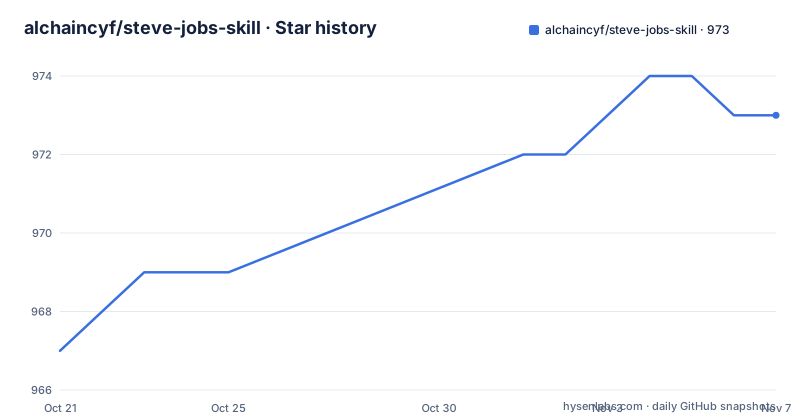
Star history
- alchaincyf/steve-jobs-skill973 ★ · +6
| Repository | 2026-10-21 | 2026-11-07 |
|---|---|---|
| alchaincyf/steve-jobs-skill | 967 | 973 |
6 Stars in the last 17 days, measured from the daily GitHub snapshot. Compare with other projects
Editorial analysis
A persona, not a quote collection
The project describes itself in its own framing as a cognitive operating system rather than a collection of quotes, and the README is explicit that it is not ChatGPT wearing a Jobs mask. The claim is that each response applies a specific mental model of the subject, naming four of them in the example, focus meaning saying no, end-to-end control, the death filter, and not asking the user what they want, and that it does not recite quotations but analyses the question with the framework. The examples show what that means in practice. Asked which of two AI companies is heading the right way, the answer reframes the question as one of taste rather than direction, compares one to a company that did everything, and concludes with a line about the company that controls the chip, the model and the interface at once. Asked what AI hardware to build, the answer declines to create a category and asks instead which existing category is bad enough to redefine. The persona also admits when it has no answer, which is the detail that separates it from a parody.
One command installs it
The skill is based on the open Agent Skills protocol and is meant to run in any skills-compatible runtime, with the README naming Claude Code, Codex, Cursor, OpenClaw, Hermes Agent, CodeBuddy, Workbuddy, Gemini CLI and OpenCode among fifty or more. The recommended install is a single line:
npx skills add alchaincyf/steve-jobs-skillThe general purpose CLI installer comes from the vercel-labs/skills project and supports more than fifty runtimes, and it detects the current runtime automatically and puts the skill in the right directory. When you need to be explicit, the runtime can be named with a flag such as -a claude-code, -a codex, -a cursor or -a openclaw. A manual route exists too, which is a git clone into the runtime's skills directory, with the paths for Claude Code, Codex CLI, Cursor and OpenClaw listed in the README and Hermes Agent handled by running that runtime's install script or cloning into its skills directory. There is a third option for runtimes with no skills support at all, since the skill is essentially a Markdown file with YAML frontmatter and the contents of SKILL.md can be pasted straight into a conversation.
The corpus behind the persona
The repository carries six research files with 2497 lines in total under the references/research directory, and the README lists what each one covers with its line count. The first covers writings and system thinking, including Stanford talks, the biography and public letters, in 359 lines. The second covers long conversations and spontaneous thinking from the Lost Interview and the D Conference series, in 489 lines. The third is the expression style analysis, looking at keynote rhetoric, email style and the mechanism behind it, in 444 lines. The fourth is the outside view, with assessments by Ive, Cook, Wozniak and Gates alongside systematic criticism, in 464 lines. The fifth analyses fifteen major decisions, giving the background, logic, outcome and reflection for each, in 452 lines. The sixth is a full life timeline from 1955 to 2011 with a relationship map, in 289 lines. The primary sources are named, including the 2005 Stanford commencement, the Lost Interview, the D3, D5 and D8 D Conferences, the WWDC keynotes from 1997 to 2011 and the 2007 iPhone keynote, and the secondary sources include the Isaacson and Schlender biographies, the Folklore.org accounts and a Harvard Business Review case. The README also notes that information sources such as Zhihu, WeChat public accounts and Baidu Baike were excluded.
Mental models, heuristics and a voice
Three layers come out of the research. The first is six mental models, each with a one line summary and a source, so focus is defined as saying no to a hundred other good ideas rather than saying yes to one, end-to-end control is the idea that people who take software seriously should make the hardware themselves, connecting the dots is the observation that life cannot be planned forward and can only be understood backwards, the death filter is the daily question of whether you would do today's work if today were the last day, the reality distortion field is the naming of the technique of convincing people an impossible target is possible, and the last is the requirement that technology be joined with the humanities for it to make people feel something. The second is eight decision heuristics, from subtraction first through not asking the user what they want, to caring about getting it right rather than about being right, to raising the problem to a higher dimension. The third is the expression DNA, described in terms of vocabulary with only two settings, sentence shape favouring short sentences and a rule of three, rhythm built from a dramatic pause to a build and then one more thing, a set of analogies, and a high certainty with no hedging.
The tensions are kept on purpose
One section of the README is about what the skill refuses to do, and it is the most persuasive part. The persona is not a flat portrait of a difficult genius, because the skill keeps the contradictions. The list names four of them. Tyrant against mentor. Intuition against data, with the note that intuition also made him delay a cancer operation. Closed against open, illustrated by the about-turn on the App Store. And Zen practice against a temper. The design intent is that a person who is only the harsh half is useless for product reasoning, and keeping the tensions makes the outputs less predictable and more honest. It also explains why the research corpus includes a file of outside criticism rather than only material from the subject's own mouth, since a portrait assembled only from the subject's own words would be a different and much less useful document.
The skill was generated by another skill
The project explains how it was built, and the method is as interesting as the output. The skill was generated by a separate project called nuwa-skill, whose workflow is stated as taking a name as input, running six agents in parallel to research the writings, the conversations, the expression, the criticism, the decisions and the timeline, cross-validating the results to extract the mental models, building the SKILL.md, and then quality checking it with three known tests, one edge case test and a style test. The parent project is a similar skill for a different purpose, and the same install command applies to it, after which the instruction is simply to ask it to distil a person. The animation in the README header was made by a third skill, a design one. The repository structure is minimal, with the README, the SKILL.md that is directly installable, the references directory, an examples directory holding a full demonstration conversation, an assets directory and a licence file, and the project is MIT licensed with the last push on 2026-10-13 and no published releases.
Editorial conclusion
steve-jobs-skill fits a team that wants to explore a product decision from a specific point of view, and the design is the interesting part, because the persona is a distillation with a stated source list and even a section on the tensions in the subject's character rather than a caricature. It does not fit a project that wants a trustworthy source of facts about a company, since the output is a deliberately opinionated performance and the README says as much. It does not fit a team that cannot run agent skills at all, unless you are willing to paste the file into a conversation by hand, which the project allows. Before you install it, read the research index in the references directory, because the file that tells you how a decision was analysed is more informative than the persona itself, and note that the project publishes no releases, so you are installing whatever is on the main branch.
Frequently asked questions
What is steve-jobs-skill?
It is an agent skill that gives a coding agent a Steve Jobs reasoning persona, described as a cognitive operating system rather than a quote collection, since the responses apply specific mental models to the question instead of repeating famous lines.
How do I install steve-jobs-skill?
With npx skills add alchaincyf/steve-jobs-skill, which uses the general purpose skills CLI to detect your runtime and place the skill correctly, and you can name a runtime explicitly with a flag such as -a claude-code. You can also clone the repository into a runtime's skills directory by hand.
Can I use it in a runtime without skills support?
Yes. The skill is essentially a Markdown file with YAML frontmatter, so the contents of SKILL.md can be pasted directly into a conversation, and the README presents that as a supported third installation method.
What is in the research behind the skill?
Six files with 2497 lines in total under references/research, covering writings and system thinking, long conversations, the expression style, outside criticism and assessment by colleagues, fifteen major decisions with their outcomes, and a life timeline from 1955 to 2011, drawn from primary sources such as the 2005 Stanford commencement, the Lost Interview, the D Conferences and the WWDC keynotes.
How was the skill created?
It was generated by the nuwa-skill project, whose workflow is to research a subject with six parallel agents across writings, conversations, expression, criticism, decisions and timeline, cross-validate the findings into mental models, build the SKILL.md, and then validate the result with known tests, an edge case test and a style test.
Official sources
Add this badge to your README
If you maintain this project, the badge below links readers to this analysis and shows its maintenance status from the daily GitHub snapshot. Paste the markdown into your README; add ?metric=license or ?metric=stars to the image URL for a different field.

[](https://hysenlabs.com/projects/alchaincyf-steve-jobs-skill)Star history chart for your README
[](https://hysenlabs.com/projects/alchaincyf-steve-jobs-skill)Was this useful?