AiLearning: A 2017 Chinese-Language Machine Learning Course Built Around Code Walkthroughs
AiLearning: data analysis, practical machine learning, linear algebra, PyTorch, NLTK and TF2.
At a glance
- What is it?
- AiLearning is an ApacheCN project that turns the book Machine Learning in Action into a Chinese-language, code-first curriculum with videos and notes. Its value is historical and pedagogical, but its Python 2.7 dependency and stale content make it a poor fit for modern production work.
- Who is it for?
- Adopt AiLearning if you are a Chinese-speaking beginner who wants a code-centric introduction to classic machine learning algorithms and you are willing to work in Python 2.7. Do not use it if you need current deep learning coverage, Python 3 compatibility for the ML chapters, or production-grade code.
- Can I use it commercially?
- Check first. The repository uses a licence we do not classify automatically, so read its LICENSE file before any commercial use.
- Is it still maintained?
- Probably not. The repository last received commits 24 months ago, on November 12, 2024.
- What is it written in?
- Mainly Python, according to GitHub's language statistics.
Answers come from the project's GitHub data, last synced on November 15, 2026, and from our analysis. They are not legal advice.
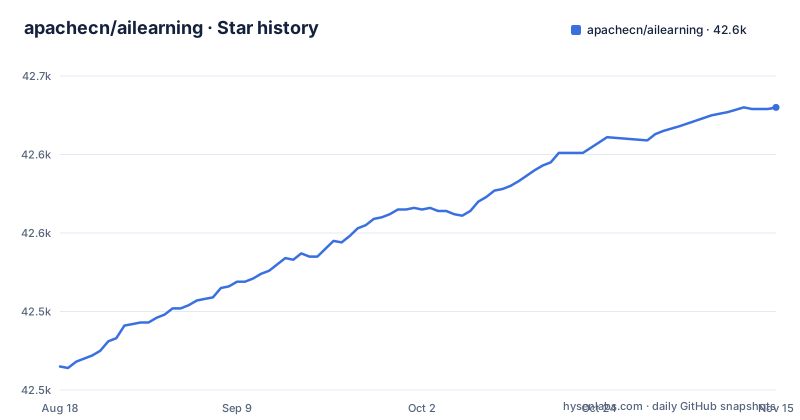
Star history
- apachecn/ailearning42,630 ★ · +165
| Repository | 2026-08-18 | 2026-11-15 |
|---|---|---|
| apachecn/ailearning | 42.5k | 42.6k |
165 Stars in the last 89 days, measured from the daily GitHub snapshot. Compare with other projects
Editorial analysis
What AiLearning Actually Is
AiLearning is a Chinese-language learning repository, not a software library. It collects personal notes, code, and video links for the book Machine Learning in Action, plus separate sections for deep learning topics such as backpropagation, CNN, RNN, and LSTM. The README positions it as a route for programmers who find theoretical courses like Andrew Ng's too abstract. The author's own words in the README say that for them, the book turned "high-sounding theory and derivation" into "addition, subtraction, multiplication, division, and loops." That is the core promise: a coding-first path into machine learning for people who already debug code comfortably. The target reader is a programmer with some Python background who wants to see algorithms implemented rather than derived. The project also bundles a roadmap: step 1, 2, 3 for beginners, with supplementary links to interview questions and algorithm practice.
The Mechanism: Chapter Notes, Code, and Video Combo
The repository's structure is a set of Markdown documents under docs/ml and docs/dl. Each chapter of Machine Learning in Action gets a numbered file, from KNN in chapter 2 through MapReduce in chapter 15. The README lists a responsible person for each chapter, which suggests a community translation effort. The learning flow is not a single pipeline but a mix: read the chapter notes, watch the corresponding video on Bilibili or AcFun, and run the code yourself. The videos come in two flavors: a teaching version and a discussion version. The teaching version covers theory, while the discussion version goes through code line by line. The README explicitly says the discussion version has "too much nonsense" but is good for code explanation. This is a practical split, but it means the learning experience depends on which video you choose. The project also links to a separate data repository, apachecn/data, which holds datasets and books in Baidu cloud packages.
Getting It Running: Python Version Matters
There is no installation script or package to install. You clone the repository and read the Markdown files. The critical constraint is the Python version. The README includes a support table: for the machine learning section, Python 2.7.x is supported, while 3.6.x is marked as not supported, with a note saying "only learning, use python 2.7.x" and that 3.6.x only has some modifications. For the deep learning section, the table is reversed: 3.6.x is supported, 2.7.x is not. This split means you need two different Python environments if you want to go through both parts. The deep learning section also lists an installation guide under docs/TensorFlow2.x/安装指南.md, which suggests TensorFlow 2.x installation instructions, but the section header says "待更新" (to be updated). The code examples are meant to be run in a Python interpreter, but the repository does not provide a requirements.txt or a setup.py. You are expected to have your own Python environment and the necessary packages.
The Deep Learning Sections Are Incomplete
The deep learning part of the repository is thin. The README lists four principle documents: backpropagation, CNN, RNN, and LSTM, each linking to external blog posts. The PyTorch tutorial section is marked "待更新" (to be updated), and the TensorFlow 2.0 tutorial section is also marked "待更新." The actual TensorFlow 2.x documents that exist are an installation guide, a Keras quickstart, and two practical projects: movie sentiment classification and car fuel efficiency. The description of the repository mentions PyTorch and NLTK and TF2 in the title, but the material for these is minimal. This is a significant gap. If you are looking for current deep learning coverage, this repository will not deliver it. The deep learning field has moved far beyond what is documented here. The practical projects that do exist are from the TensorFlow 2.x era, but they are likely not updated to the latest versions of TensorFlow or Keras.
A Real Limitation: The Python 2.7 Anchor
The most concrete limitation is the Python 2.7 requirement for the machine learning chapters. Python 2.7 reached end-of-life in January 2020, and most modern libraries no longer support it. The README's note that 3.6.x is not supported for the ML chapters means you cannot simply run the code in a current Python environment without significant modifications. If you are a beginner, this is a trap: you might follow the tutorial and then hit syntax errors or import errors. The project is not wrong for its time, but it is a time capsule. For a learner today, this is a real cost. You have to either set up a legacy Python 2.7 environment or rewrite the code as you go. The README does not offer any migration guide.
The Alternative: Modern Code-First Courses
The obvious alternative is to use a current code-first course that targets Python 3. For example, fast.ai's Practical Deep Learning for Coders takes a similar top-down approach: you train models from the first lesson and fill in theory later. The difference in approach is that fast.ai is built around modern libraries like PyTorch and is actively maintained, with updated lessons each year. Another alternative is the classic Andrew Ng Machine Learning course, which AiLearning itself recommends for theory, but that course uses Octave or MATLAB, not Python. If you want a Python-based, code-first path with current practices, fast.ai or even the scikit-learn documentation's own tutorials are more reliable. AiLearning's unique value is that it is in Chinese and it walks through the exact code from Machine Learning in Action, which is a book many programmers already own. But the alternative is not just a different course; it is a different era of tooling. The code in AiLearning reflects 2017's libraries and APIs, so you would be learning patterns that are now outdated.
Maintenance, License, and Upgrade Cost
The last push was on 2024-11-12, and the most recent release, v2.0 (the teaching version), was tagged on 2017-10-09. No release has followed it, and the PyTorch and TensorFlow tutorial sections are still marked as pending update. The license is listed as NOASSERTION in the metadata, but the README states a CC BY-NC-SA 4.0 license. That is a Creative Commons license that allows sharing and adaptation with attribution, but only for non-commercial purposes, and any derivative work must be shared under the same license. This has practical implications: you can use the material for personal learning, but you cannot republish it commercially without permission. The upgrade cost is high. If you want to use the code in a modern environment, you must rewrite the Python 2 code to Python 3, update the library imports, and replace any deprecated APIs. The deep learning sections, being mostly links to external posts, are even less maintainable because those links may rot. The project is a static snapshot, not a living resource.
Editorial conclusion
Adopt AiLearning if you are a Chinese-speaking beginner who wants a code-centric introduction to classic machine learning algorithms and you are willing to work in Python 2.7. Do not use it if you need current deep learning coverage, Python 3 compatibility for the ML chapters, or production-grade code. Before starting, verify that your environment can run Python 2.7 and that the linked data files in the apachecn/data repository are still accessible. The project is a snapshot of 2017 teaching practice, not a maintained library.
Frequently asked questions
What is ApacheCN AiLearning and what does it contain?
It is a Chinese study site built around 16 chapters of Machine Learning in Action, annotated as personal notes and published as markdown files under `/docs/ml/` plus a website at http://ailearning.apachecn.org. A deep learning section sits alongside the machine learning one, and the description also names data analysis, linear algebra, PyTorch, NLTK and TensorFlow 2.
Which Python version does AiLearning support?
The tables disagree. The machine learning section marks 2.7.x as supported and 3.6.x as unsupported, with a note telling you to use Python 2.7.x because 3.6.x was only partially modified, while the deep learning section marks 3.6.x as supported and 2.7.x as not.
Where do I get the data for the AiLearning examples?
Not from this repository. The README sends every dataset to the separate apachecn/data repository, with paths for the book files, the machine learning material, the deep learning material and the recommender system material, plus a Baidu Cloud bundle offered through that repository's issue 3.
How do I run the AiLearning examples?
There is no install command, because the project is notes rather than a package. The repository's only container is an Apache httpd image that copies the files into the document root, so it serves the site and cannot execute a chapter.
Is ApacheCN AiLearning still being worked on?
The repository is not archived and the last commit was on 2024-11-12. The only tagged releases are v1.0 from 2017-04-28 and v2.0 from 2017-10-09, and the PyTorch and TensorFlow tutorial sections are still marked as pending update.
Official sources
Add this badge to your README
If you maintain this project, the badge below links readers to this analysis and shows its maintenance status from the daily GitHub snapshot. Paste the markdown into your README; add ?metric=license or ?metric=stars to the image URL for a different field.

[](https://hysenlabs.com/projects/apachecn-ailearning)Star history chart for your README
[](https://hysenlabs.com/projects/apachecn-ailearning)Was this useful?