2027-Internships: A Machine-Verified Internship List That Refreshes Every 15 Minutes
2027 SWE internships and product management internships in the U.S. Updated every 15 minutes with verified listings and one-click apply.
At a glance
- What is it?
- ApplyGuy/2027-Internships is a GitHub repository that aggregates U.S. software engineering and product management internships, with listings reverified every 15 minutes. The core value is the automation and freshness, but the human curation and verification claims need scrutiny.
- Who is it for?
- Adopt this repository if you are a U.S.-based student actively applying for summer 2027 software engineering or product management internships and you value a continuously updated, machine-readable feed that removes closed postings automatically. Do not rely on it as your sole source: the 'verified' claim is self-reported, and the list does not include every company or role.
- Can I use it commercially?
- Yes. MIT is a permissive licence: you can use, modify and sell software built on it, as long as you keep its copyright and licence notices.
- Is it still maintained?
- Yes. The repository received new commits within the last day.
- What is it written in?
- GitHub does not report a main language for this repository.
Answers come from the project's GitHub data, last synced on October 21, 2026, and from our analysis. They are not legal advice.
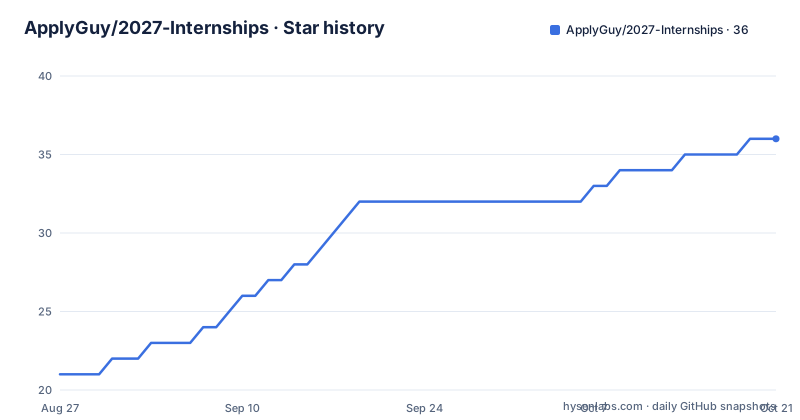
Star history
- ApplyGuy/2027-Internships36 ★ · +15
| Repository | 2026-08-27 | 2026-10-21 |
|---|---|---|
| ApplyGuy/2027-Internships | 21 | 36 |
15 Stars in the last 55 days, measured from the daily GitHub snapshot. Compare with other projects
Editorial analysis
What This Repository Actually Solves
The problem is not a lack of internship listings; it is the time cost of finding ones that are still open. Most students scrape career pages, spreadsheets, and old posts, only to find that half the roles are filled or the posting is for a different year. ApplyGuy/2027-Internships attacks that with a single JSON file, data/internships.json, that claims to be reverified every 15 minutes. The README states that closed and expired internships are removed automatically. That means the list is designed to be a living document, not a static snapshot. The intended user is a U.S.-based student targeting summer 2027 software engineering or product management roles, or a current 2026/2027 co-op. If you are outside the U.S. or looking for non-tech internships, this is not for you.
The Data Feed and the 15-Minute Refresh Claim
The repository's core mechanism is the machine-readable feed at data/internships.json. The README says the last refresh was Aug 29, 2026, at 2:15 AM PDT, and that every listing is still open and reverified every 15 minutes. That is a strong claim. The repository itself does not contain the scraper or verification code, so there is no way to audit the process from the provided material. The refresh timestamp is a concrete data point, but it does not prove the verification is actual. It could be a cron job that re-pings the same URLs and marks them open if the page returns a 200, or it could be a manual update. The README does not specify. As a reader, you have to take the 'verified' label on faith. That is a limitation worth noting, because a broken or stale feed would silently degrade the list's value.
How to Get It Running: Commands and Config Keys
The repository is not a software project you install; it is a data repository. The README does not list any installation commands, dependencies, or configuration keys. To use it, you clone the repository or download data/internships.json directly. For example, you could run: git clone https://github.com/ApplyGuy/2027-Internships.git, then parse the JSON with a script or a tool like jq. You can filter by the 'Season' column, which the README says distinguishes recruiting cycles. The 'Actions' column provides two types of links: orange ones for one-click apply via applyguy.ai, and blue ones that open the employer's career site. No API key is needed. The JSON feed is the only machine-readable interface, and it is public. If you want email alerts, you have to sign up on the applyguy.ai site, not through the repo.
One-Click Apply vs. Direct Application: The Trade-off
The README highlights orange 'Apply Guy' actions that support one-click apply, while blue 'View' actions open the employer's site. That is a meaningful difference. One-click apply likely means you submit your application through ApplyGuy's platform, which may pre-fill your details from a profile. The convenience is real: you skip re-entering your resume and contact info for every company. But the trade-off is that you are routing your application through a third party, which may have data implications. The employer may not see your application in the same format as a direct submission. The README does not explain how the one-click apply works, what data is shared, or whether it is as effective as applying on the employer's site. For a competitive internship, that uncertainty matters. The blue links are the safer, more transparent route, but they cost more time.
The 'Season' Column: A Critical Distinction
The repository lists internships for multiple recruiting cycles: Summer 2027, Summer 2026, Fall 2026, and co-ops. The README explicitly says to use the 'Season' column to distinguish them. That is not a minor detail. If you are a student targeting summer 2027, applying to a Fall 2026 co-op by mistake wastes your time and the employer's. The table examples show entries like 'Software Developer Co-op' with the Season column marked as 'Co-op', and 'Summer Intern 2027 - Software Engineering' marked as 'Summer 2027'. The column is present, but the README does not say whether it is always populated. Some rows show an em dash for Season, which is ambiguous. That could mean the posting does not specify, or the scraper failed to extract it. You should not assume a missing Season means it is open to all cycles.
Limitations and Failure Modes
The most obvious limitation is that the list is limited to U.S. internships, and the README says it covers software engineering and product management roles only. That is a narrow scope. Another failure mode is the reliance on external links. The README says closed internships are removed automatically, but if the verification mechanism breaks, stale links will persist. The repository has no release history and no license issues (MIT), but the absence of any versioning means you cannot track changes to the data format. The JSON feed could change structure without notice, breaking your scripts. Also, the 'verified' claim is self-reported; there is no independent audit. Finally, the list is biased toward companies that use Workday, Ashby, or other ATS systems that are easy to scrape. Smaller companies or those with static career pages may be underrepresented.
Alternatives: The Manual Spreadsheet vs. This Automated Feed
The main alternative is the traditional community-maintained spreadsheet, such as the famous 'Summer 2024 Internships' Google Sheets that circulate on Reddit and GitHub. Those are typically updated by hand, with students adding listings as they find them. The difference in approach is stark: manual lists rely on crowd-sourcing, which means they have broader coverage but suffer from stale entries and duplicate postings. They also do not have a machine-readable JSON feed; you have to parse a web page or a CSV export. ApplyGuy/2027-Internships automates the scraping and the removal of closed postings, which is a genuine improvement in freshness. But the manual lists often include user comments and interview timelines, which this repo does not. Another alternative is to use LinkedIn or Handshake, which have their own algorithms but no open data feed. The trade-off is between automation and human context.
Maintenance and Upgrade Cost
The repository is actively maintained, as indicated by the last push and the refresh timestamp, though the exact date is not given in the material. The README says the list is updated every 15 minutes, which implies a running service behind it. That service is not open source, so you cannot self-host it. The maintenance cost for you as a user is near zero: you just fetch the JSON. But there is an upgrade cost if the JSON schema changes. The MIT license means you can reuse the data, but you cannot modify the underlying scraper because it is not in the repo. If ApplyGuy stops updating the feed, the repository becomes a static snapshot with no value. The lack of release notes or changelog makes it hard to track changes. For a data consumer, the only real cost is monitoring the feed for schema changes.
Editorial conclusion
Adopt this repository if you are a U.S.-based student actively applying for summer 2027 software engineering or product management internships and you value a continuously updated, machine-readable feed that removes closed postings automatically. Do not rely on it as your sole source: the 'verified' claim is self-reported, and the list does not include every company or role. Before applying, cross-check any listing against the employer's official career page, especially the 'Season' column to avoid applying to a 2026 co-op by mistake. Verify the ApplyGuy one-click apply process on a non-critical application first, and be aware that you are trading some data privacy for convenience. The repository is a useful aggregator, but its long-term value depends on whether ApplyGuy maintains the 15-minute refresh cycle and the JSON feed remains accessible.
Frequently asked questions
When should I apply for 2027 internships?
The README's own position is to apply early and enable alerts so you hear about a role when it opens rather than when you happen to look. It states 810 active US internships were posted within the last 30 days and every listing is reverified every 15 minutes, with closed roles removed automatically.
What internships are available for summer 2027?
The software engineering section alone reports 730 open roles, and the Season column distinguishes Summer 2027 postings from spring cycles and co-ops. Visible examples include roles at Northrop Grumman, CACI, Marvell, Muon Space, Amazon and Dow, across software, firmware, flight software and data engineering.
when is winter 2027 internships
No winter cycle is listed in the visible part of the table. The season values that appear are Summer 2027, Spring 2027, Co-op, and a dash where the employer stated no season at all.
Official sources
Add this badge to your README
If you maintain this project, the badge below links readers to this analysis and shows its maintenance status from the daily GitHub snapshot. Paste the markdown into your README; add ?metric=license or ?metric=stars to the image URL for a different field.

[](https://hysenlabs.com/projects/applyguy-2027-internships)Star history chart for your README
[](https://hysenlabs.com/projects/applyguy-2027-internships)