Auxx.ai: A Self-Hosted AI Ticket Desk for Shopify, Not a General n8n Replacement
The Open Source Front / Attio meets N8N Alternative
At a glance
- What is it?
- Auxx.ai is an open-source, AI-assisted email support ticket service aimed at Shopify businesses. It combines Gmail/Outlook ingestion, Shopify context, and workflow automation, but its scope is narrower than the 'Attio meets n8n' tagline suggests.
- Who is it for?
- Adopt Auxx.ai if you run a Shopify store and want a self-hosted AI email support desk that pulls order context and automates responses. Skip it if you need a general-purpose workflow automation platform like n8n, because Auxx.ai is built around tickets, not arbitrary workflows.
- Can I use it commercially?
- Yes, with strict conditions. AGPL-3.0 is a network copyleft licence: if people use a modified version over a network, for example as a hosted service, you must offer them its source code under the same licence.
- Is it still maintained?
- Yes. The repository last received commits 1 day ago.
- What is it written in?
- Mainly TypeScript, according to GitHub's language statistics.
Answers come from the project's GitHub data, last synced on October 21, 2026, and from our analysis. They are not legal advice.
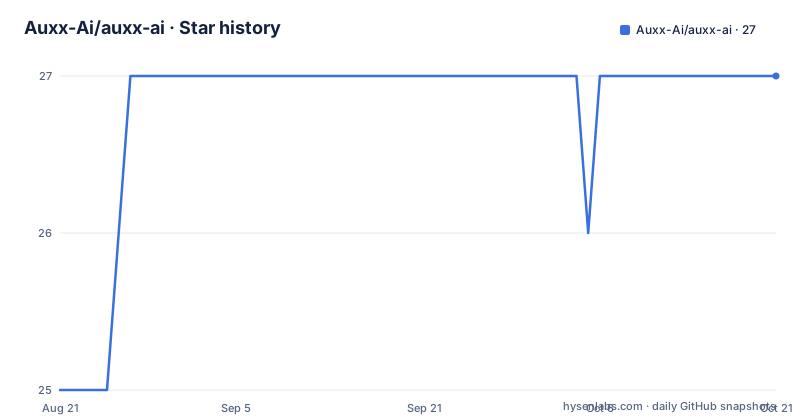
Star history
- Auxx-Ai/auxx-ai27 ★ · +2
| Repository | 2026-08-21 | 2026-10-21 |
|---|---|---|
| Auxx-Ai/auxx-ai | 25 | 27 |
2 Stars in the last 61 days, measured from the daily GitHub snapshot. Compare with other projects
Editorial analysis
What It Actually Does, and Who It Serves
Auxx.ai describes itself as an open-source AI-powered email support ticket service for Shopify businesses. It is not a general CRM like Attio, nor a general automation tool like n8n, despite the README's tagline. The core function is to ingest customer emails from Gmail and Outlook, turn them into tickets, and use AI to generate responses. The Shopify integration provides customer context, such as order history, so the AI can answer with relevant information. The intended user is a Shopify merchant who wants to automate a significant portion of email support without sending customer data to a closed SaaS. The project is written in TypeScript and is licensed under AGPL-3.0, which matters for anyone considering embedding it into a proprietary product.
The Architecture: A Multi-App Monorepo with a Clear Separation of Concerns
The repository is a Turborepo monorepo with multiple apps and packages. The main application is a Next.js 16.1 app using React Server Components. The API server is separate, as is a worker app for background job processing. There is also a dedicated knowledge base app, AWS Lambda functions, a docs site, and a homepage. This separation suggests that the system is designed to handle asynchronous email processing and AI inference outside the main request cycle. The data layer uses PostgreSQL with Drizzle ORM, and Redis is used for caching. Real-time notifications rely on Pusher, which is a third-party service; that is a notable external dependency for a self-hosted product. The worker app likely polls or subscribes to email webhooks, processes them, and updates tickets. The README does not detail the exact data flow, but the structure implies a pipeline: email arrives, a webhook or poll triggers the API, the worker enriches it with Shopify data, AI generates a response, and the result is stored and pushed to the UI in real time.
Getting It Running: One-Line Install, But With a Cloud Twist
The quick start is a single curl command that fetches an install script and runs it. The script checks for Docker, Docker Compose v2, curl, and openssl, then downloads a docker-compose.yml and .env.example, generates secrets, and starts containers. You can pin a version with VERSION=0.1.64. After that, you visit localhost:3000 and go through a setup wizard that creates a super admin and configures your organization. That is the easy part. The environment variables reveal the real complexity: you need Google OAuth credentials for Gmail, Outlook client and webhook settings, Shopify API keys, AI provider keys (OpenAI, Anthropic, Google, Groq), an email provider (Mailgun or SMTP), S3 storage, Stripe for payments, and Pusher for real-time. The Docker setup may handle some of this, but external services like Pusher and Stripe are not self-hosted. So while the install is one command, the operational footprint is closer to a small SaaS than a simple plugin.
The AI and Workflow Engine: Promising, but Underdocumented
The README lists 'AI-powered automated response generation' and 'workflow automation engine' as features, but it does not explain how workflows are defined or executed. There is no workflow DSL, no visual editor mention, and no example of a workflow configuration. This is a gap. For a project that claims to be an n8n alternative, the absence of any workflow documentation is a red flag. The AI response generation is more concrete: it supports multiple providers, so you can choose OpenAI, Anthropic, Google, or Groq. The knowledge base feature is meant to give the AI context beyond the immediate email thread. But how the knowledge base is populated and queried is not described. If you are evaluating this for production, you will need to dig into the source code to understand the workflow engine's capabilities. The tagline oversells the automation side.
A Genuine Limitation: The Third-Party Dependency and the Shopify Focus
The most obvious limitation is that the project is tightly coupled to Shopify. If you are not a Shopify merchant, the 'customer context' feature is irrelevant, and you lose a key differentiator. The email integration relies on Gmail and Outlook webhooks, which require public endpoints and OAuth setup. That is not trivial in a self-hosted environment behind a NAT or firewall. Also, real-time notifications depend on Pusher, a hosted service. If you are self-hosting to avoid external dependencies, Pusher is a contradiction. The README does not mention a self-hosted alternative for real-time events. Another limitation is the lack of documentation on the workflow engine. The project may be powerful, but if the docs do not explain it, adoption will be slow. The release cadence is active, but that also means the API may change between versions.
The Alternative: n8n, and Why It Is a Different Animal
The README explicitly positions Auxx.ai as an 'Attio meets n8n alternative'. n8n is a general-purpose workflow automation tool that connects hundreds of services via nodes. It is not ticket-specific; you build workflows by dragging nodes onto a canvas. Auxx.ai, on the other hand, is a ticket system with a built-in automation engine that is not visually programmable, as far as the documentation shows. If you want to automate arbitrary business processes, n8n is the better fit because it is designed for that. If you want a support desk that happens to automate email responses, Auxx.ai is more focused. The difference is scope: n8n is a platform, Auxx.ai is an application. Choosing one over the other depends on whether you want to build your own support system or use a ready-made one with some automation on top.
Maintenance, Upgrades, and License Implications
The project is under active development, with releases like auxx-v0.1.222 and sdk-v0.0.25 as of late August 2026. That means you should expect frequent updates. The monorepo structure with Turborepo and pnpm suggests a mature build system, but it also means you need to understand the whole stack to upgrade. The database schema is managed with Drizzle, and there are commands for generating and running migrations (pnpm db:generate, pnpm db:migrate). That is a plus for upgrade safety. The AGPL-3.0 license is a double-edged sword: it allows you to use and modify the software, but if you offer it as a network service, you must release your modifications under the same license. That is a serious consideration for any commercial use. The README does not mention a paid support option, so you are on your own for troubleshooting. The presence of a docs app in the repo suggests there is more documentation, but it is not linked in the README.
Editorial conclusion
Adopt Auxx.ai if you run a Shopify store and want a self-hosted AI email support desk that pulls order context and automates responses. Skip it if you need a general-purpose workflow automation platform like n8n, because Auxx.ai is built around tickets, not arbitrary workflows. Before deploying, verify the setup wizard covers your email provider's OAuth and webhook requirements, and confirm you can maintain the multi-service stack (PostgreSQL, Redis, Pusher, S3, Stripe) that the environment variables imply. Also, review the AGPL-3.0 license if you plan to modify and redistribute the code. The project is actively maintained with recent releases, but its real value is in the Shopify-specific ticket flow, not as a generic alternative to Attio or n8n.
Frequently asked questions
What is Auxx.ai?
An open source, AGPL-3.0 licensed email support ticket service for Shopify businesses. It integrates with Gmail and Outlook to handle automated customer support, adds a workflow automation engine, a knowledge base for AI context, real-time notifications and multi-tenant organizations, and is described as an Attio meets n8n alternative.
What do I need installed before running auxx-ai locally?
Node.js 22 or later, pnpm 10.17 or later, a PostgreSQL database and Redis. The one-command installer additionally checks for Docker, Docker Compose v2, curl and openssl before it downloads the compose file and generates your secrets.
Which AI providers does auxx-ai support?
Four, each configured with its own key: OPENAI_API_KEY, ANTHROPIC_API_KEY, GOOGLE_API_KEY and GROQ_API_KEY. They sit in the same environment group, so switching provider is a configuration change rather than a code change.
How does auxx-ai handle real-time updates during development?
With a self-hosted Sockudo container speaking the Pusher protocol at 127.0.0.1:6001 with SSL disabled, since Railway terminates TLS in production but localhost does not. Unauthenticated usage and stats endpoints are disabled by default, and the credential defaults keep the container healthy before setup.sh writes real values.
Official sources
Add this badge to your README
If you maintain this project, the badge below links readers to this analysis and shows its maintenance status from the daily GitHub snapshot. Paste the markdown into your README; add ?metric=license or ?metric=stars to the image URL for a different field.

[](https://hysenlabs.com/projects/auxx-ai-auxx-ai)Star history chart for your README
[](https://hysenlabs.com/projects/auxx-ai-auxx-ai)