backend-br/vagas: a GitHub issue board for Brazilian backend jobs
Espaço para a divulgação de vagas para desenvolvedores backend via issues do Github.
At a glance
- What is it?
- backend-br/vagas is not software you install. It is a recruiting board that runs entirely on GitHub issues, with labels for seniority and contract type, and it is aimed at Brazilian backend developers and the companies hiring them.
- Who is it for?
- Adopt backend-br/vagas if you are a backend developer in Brazil who already lives in GitHub notifications, or a company willing to post a role as a public issue and answer questions in the thread. Do not use it if you need structured, machine-readable postings, applicant tracking, or a private hiring funnel; there is no API beyond what GitHub gives you.
- Can I use it commercially?
- Yes. MIT is a permissive licence: you can use, modify and sell software built on it, as long as you keep its copyright and licence notices.
- Is it still maintained?
- Yes. The repository last received commits 12 days ago.
- What is it written in?
- GitHub does not report a main language for this repository.
Answers come from the project's GitHub data, last synced on November 15, 2026, and from our analysis. They are not legal advice.
Star history
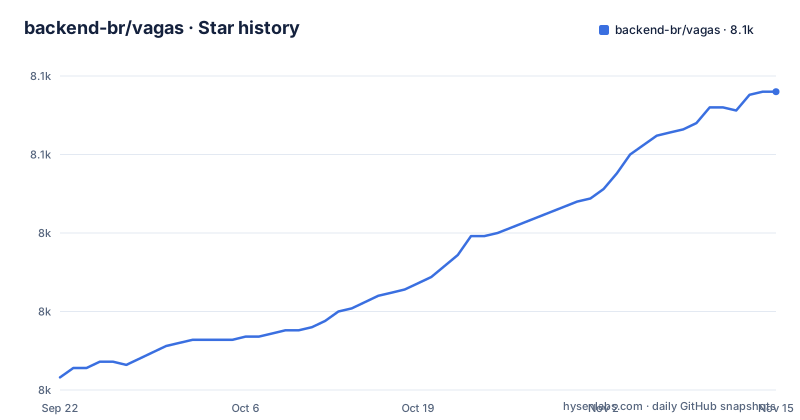
- backend-br/vagas8,070 ★ · +91
| Repository | 2026-09-22 | 2026-11-15 |
|---|---|---|
| backend-br/vagas | 8k | 8.1k |
91 Stars in the last 54 days, measured from the daily GitHub snapshot. Compare with other projects
Editorial analysis
What backend-br/vagas is, and the problem it removes
Most job boards are databases with a web form on top. backend-br/vagas is the opposite: the repository README describes it as "Espaço para a divulgação de vagas para desenvolvedores backend via issues do Github", a space to advertise backend developer openings through GitHub issues. The top level holds .github/, .gitignore, .nvmrc, CODE_OF_CONDUCT.md, CONTRIBUTING.md, LICENSE, README.md, biome.jsonc and a doc/ folder, and the triage rules live in .github/triage/config.json. The postings are not files in the tree. They are issues.
That choice solves a specific annoyance. A recruiter or a developer who wants to publish a role does not need an account on a job site, a paid listing, or a form that asks for the same data twice. They open an issue on a repository they already have access to. A candidate does not need to register anywhere either. They read the issue, and the conversation happens in the same thread, in public.
The audience is narrow on purpose. If you are hiring for frontend, the README points you to frontendbr/vagas instead, and it lists sibling repositories for QA, chat-bot, PHP, .NET, Rust, Kotlin, Vue.js, Android, Flutter, iOS, Go, React, Python and Node.js, plus regional boards for Ceará, Angola and Portugal. This is one node in a family of boards, not a general-purpose product.
How a posting actually works: issues, labels and subscriptions
The mechanism is GitHub's own issue machinery, and the README is explicit about the flow. You open an issue using the form in Portuguese or English. The form is the schema, and every new posting goes through an automatic triage: one job per issue, backend only (or fullstack focused on backend), and AI training, data annotation or model evaluation roles are not accepted.
The labels for level, contract type (regime), work model and technologies are applied from the form, following a taxonomy shared with me-contrata. Approved postings receive the `verificada` label; doubtful ones receive `em-triagem` and are reviewed by a maintainer; rejected ones are closed with a comment explaining why.
Distribution is deliberately passive. The README says you can receive updates by email or through GitHub notifications by clicking Subscribe on the issue you are interested in. The README describes no digest or alerting service, although every `verificada` posting gets a daily-updated comment listing up to 5 matching me-contrata profiles. If you want to hear about a role, you watch that specific issue.
The README also mentions a second way to read the board: searching and filtering Backend BR postings on openings.dev, at the path /communities/backend-br/vagas. According to the README, each result there still links back to the original issue in this repository. So the canonical record is always the issue; openings.dev is a reading layer over it.
Posting your first role: open an issue, then ask for labels
There is nothing to install. The README gives no CLI, no package, no Docker image and no self-hosting instructions, because the project is a repository of issues rather than a running service. The first real use is opening an issue.
Go to the issues page and start a new one. GitHub will offer the project's issue form, in Portuguese or English.
# no install step: the board runs on GitHub issues
# open a new issue at:
# https://github.com/backend-br/vagas/issues
Fill in the form with the role details; the labels for level, contract type, work model and technologies are applied from the form. What you should see afterwards is an open issue that goes through automatic triage and is labelled `verificada` or `em-triagem`, or is closed with a comment explaining the reason.
If you are the candidate rather than the poster, the equivalent first step is to open an issue you care about and click Subscribe, which the README identifies as the way to get updates by email or GitHub notifications. For filtering across many postings, the README's other route is the openings.dev community page for backend-br, where results link back to the original issues.
Before posting anything, read CONTRIBUTING.md. The README points to it as the contribution guidelines, and the triage rules themselves live in .github/triage/config.json.
Where the issue-as-database model breaks
The biggest limitation is that labels are the entire data model. They are applied from the form and the automatic triage checks scope (one backend job per issue), so anyone building a filter on top of this board depends on what posters select in the form.
Lifecycle handling is limited to links. Every day the links of open postings are checked; a link counts as broken only after a 404 or 410 on three consecutive attempts, the posting gets the `link-quebrado` label, and if no application link works again within 3 days the issue is closed. LinkedIn links are not checked because the site blocks robots.
Notifications do not scale. Subscribing is per issue, so a candidate tracking ten openings is managing ten subscriptions. There is no keyword alert or email digest described in the README, only GitHub issue filters such as `label:verificada`. The filtering story lives outside the project, on openings.dev, and the README treats that as a complement rather than a feature of the repository.
Finally, the board is public by construction. Every posting, every question and every reply is visible, and it is indexed like any other GitHub issue. A company that wants to keep salary bands, headcount plans or a confidential search out of public view is using the wrong tool. This is a broadcasting channel, not a hiring pipeline.
How it differs from a conventional job board
The obvious alternative is a dedicated job platform, and the README itself points to one: openings.dev, which mirrors and filters the Backend BR postings. The difference in approach matters. A platform like that owns the data. It ingests postings and presents them in its own interface with its own search, and the README notes that each result still leads back to the original issue, which tells you where the source of truth sits.
Against a generic platform, backend-br/vagas wins on friction and loses on structure. Posting is free and immediate if you have a GitHub account, and the thread doubles as the application channel, so a candidate can ask a question in public and see the answer. What you give up is everything a database gives you: deduplication, an API you can query programmatically, and any guarantee that two postings are described the same way.
Against the sibling boards, the difference is scope rather than mechanism. frontendbr/vagas, pydevbr/vagas, Gommunity/vagas and the rest run the same issue-based model for a different specialism, and backend-pt/vagas and backend-ao/vagas do it for Portugal and Angola. Choosing between them is choosing an audience, not a technology. The README credits frontendbr as the inspiration and states that this page is a fork of theirs, so the pattern is inherited rather than invented here.
Maintenance, licence and the cost of staying listed
The repository is not archived, and the last push was on 2026-11-02, which is recent enough that the board is clearly still receiving activity. That said, the maintenance burden is unusual: there is no package to install and no release to track, because the repository has no GitHub releases. The work is mostly editorial: maintainers review postings labelled `em-triagem`, and the triage and maintenance rules live in .github/triage/config.json.
The licence is MIT, stated in the README and present as a LICENSE file at the top level. For a repository whose content is job postings rather than source code, the practical reading is that the repository's own material is permissively licensed. It says nothing about the terms of any individual job, and it is not a statement about how a company may use the postings. If you plan to republish listings elsewhere, that is a question for the individual posters, not something the MIT text settles. This is a description of what the repository states, not legal advice.
Contribution rules live in CONTRIBUTING.md, which the README links as the guidelines to follow, and behaviour expectations live in CODE_OF_CONDUCT.md. Both are files in the repository rather than sections of the README, so anyone posting should read them directly. Rejected postings are closed with a comment explaining the reason, editing the issue gets it re-evaluated, and when a suggested format is applied the previous text stays in the issue's edit history.
Editorial conclusion
Adopt backend-br/vagas if you are a backend developer in Brazil who already lives in GitHub notifications, or a company willing to post a role as a public issue and answer questions in the thread. Do not use it if you need structured, machine-readable postings, applicant tracking, or a private hiring funnel; there is no API beyond what GitHub gives you. Before relying on it, open the issue form, read CONTRIBUTING.md, and check how the automatic triage labels a posting (`verificada` or `em-triagem`), because those labels and the level, contract and work-model labels from the form are the only filters the board offers.
Frequently asked questions
What is backend-br/vagas?
It is a space for advertising backend developer job openings through GitHub issues, as the README describes it. The postings live as issues rather than files, and the repository also links to sibling boards by area, technology and location.
How do I post a job on backend-br/vagas?
Open an issue using the form in Portuguese or English; the labels for level, contract type, work model and technologies are applied from the form, and the posting goes through an automatic triage. The README points to CONTRIBUTING.md for the contribution guidelines.
How do I get notified about new backend-br/vagas postings?
The README says you can receive updates by email or through GitHub notifications by clicking Subscribe on the issue you are interested in. There is no digest or keyword alert in the repository, so tracking several roles means subscribing to several issues.
Is there a way to search and filter backend-br/vagas postings?
The README mentions searching and filtering Backend BR postings on openings.dev at the path /communities/backend-br/vagas, and states that each result still leads to the original issue in this repository.
Do I need to install anything to use backend-br/vagas?
No. The README gives no install, package or self-hosting steps, because the board runs on GitHub issues. You need a GitHub account to open an issue or to subscribe to one.
What licence does backend-br/vagas use?
The README states that it is licensed under MIT, and a LICENSE file sits at the top level of the repository. That covers the repository's own material, not the terms of any individual job posting.
Official sources
Add this badge to your README
If you maintain this project, the badge below links readers to this analysis and shows its maintenance status from the daily GitHub snapshot. Paste the markdown into your README; add ?metric=license or ?metric=stars to the image URL for a different field.

[](https://hysenlabs.com/projects/backend-br-vagas)Star history chart for your README
[](https://hysenlabs.com/projects/backend-br-vagas)Was this useful?