Get-Started-with-Web3: A Bilingual Curriculum Built to Be Read by Agents
Open-source bilingual AI-native Web3 curriculum: wallets, Bitcoin, Ethereum, DeFi, L2, DAO, smart accounts, llms.txt and MCP
At a glance
- What is it?
- An MIT-licensed Web3 course that ships a REST API, llms.txt, and a read-only MCP server alongside its lessons. The interesting part is the machine-readable surface, not the syllabus.
- Who is it for?
- Adopt it if you want a Chinese-first Web3 syllabus that an agent can query through /api/v1, llms.txt, or the read-only MCP server, and you accept that English coverage is still catching up. Do not adopt it as a production dApp starter kit; the repository states that its labs are educational examples.
- Can I use it commercially?
- Yes. MIT is a permissive licence: you can use, modify and sell software built on it, as long as you keep its copyright and licence notices.
- Is it still maintained?
- Yes. The repository last received commits 6 days ago.
- What is it written in?
- Mainly JavaScript, according to GitHub's language statistics.
Answers come from the project's GitHub data, last synced on November 15, 2026, and from our analysis. They are not legal advice.
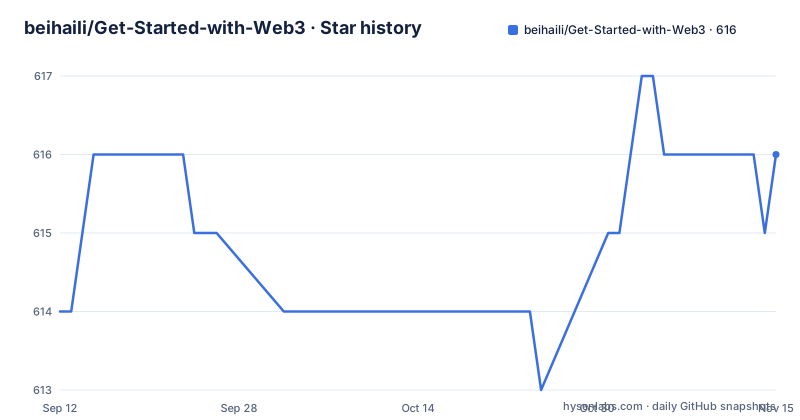
Star history
- beihaili/Get-Started-with-Web3616 ★ · +2
| Repository | 2026-09-12 | 2026-11-15 |
|---|---|---|
| beihaili/Get-Started-with-Web3 | 614 | 616 |
2 Stars in the last 64 days, measured from the daily GitHub snapshot. Compare with other projects
Editorial analysis
The Scattered-Tutorial Problem, Restated as a Data Problem
The README opens with a familiar complaint: beginner tutorials, protocol docs, security warnings, and builder examples live in different places. Most curricula answer that by writing better prose. This one answers by publishing the same content in formats a program can consume. The repository describes itself as "a curriculum and AI-readable knowledge layer first," and the ordering of those two nouns is the honest part. The human-facing course exists, but the agent-facing surface (a versioned REST API, an llms.txt file, an AI manifest, a content index, and a read-only MCP server) is what distinguishes this from a static tutorial site. The stated audiences are beginners, builders, researchers, AI agents, and sponsors. The last two are unusual for a course repository and explain most of the design choices that follow.
Eleven Modules, Sixty-Two Lessons, and a Separate Index of 124 Entries
The README lists 11 modules and 62 lessons in what it calls the React course map. Coverage runs from a seven-lesson Web3 quick start through three Bitcoin modules (cryptography and data layer, network and consensus, application layer), then DeFi, cross-chain and Layer 2, DAO governance, and a three-lesson module on Ethereum and smart accounts that references post-Pectra/Fusaka changes and account abstraction. A builder lab covers ERC-20 deployment, a first DApp, block explorer reading, contract security, and wallet plus SIWE labs. Note the gap between 62 lessons and the 124 indexed bilingual entries in the AI-native index. That index is not a copy of the course map; it is a larger set of bilingual records, and the README does not explain the mapping. Anyone integrating against the API should treat the index as the authoritative list of what is queryable, not the lesson count.
How the Agent Surfaces Fit Together
There are four machine entrypoints, and they serve different purposes. The REST API is versioned at /api/v1 and is documented in docs/api.md, with a production OpenAPI 3.1 document at the /api/v1/openapi.json path on the Vercel deployment. The llms.txt file sits on the GitHub Pages site and is the conventional pointer file for language models. The AI manifest and content index are JSON artifacts under /ai/. The MCP server is described as read-only, which is the correct default for a knowledge source: an agent can retrieve curriculum context without any write path into the repository. The README also mentions JSON artifacts as a separate surface, so an integrator has a choice between live API calls and static file fetches. For a course that changes slowly, the static artifacts are often the cheaper option, and the repository does not push you toward one.
Running It Locally and Hitting the API
What it does give are the hosted endpoints. The live site is at beihaili.github.io/Get-Started-with-Web3/, the REST API documentation is at docs/api.md in the repository, and the production API base is https://get-started-with-web3.vercel.app/api/v1. The OpenAPI document is at https://get-started-with-web3.vercel.app/api/v1/openapi.json. The static agent files are https://beihaili.github.io/Get-Started-with-Web3/llms.txt, /ai/manifest.json, and /ai/content-index.json. Start with the OpenAPI document rather than the prose docs: it is the only artifact here that states the actual request and response shapes. The deploy workflow is visible as a GitHub Actions badge pointing at .github/workflows/deploy.yml, which tells you the site is built and published through Actions.
Where the Curriculum Is Thinner Than the Framing Suggests
The README states the language position plainly: Chinese first, English in progress. One of the two recent releases is titled "Layer 2 English Coverage + AI-Native Index Update," which confirms that English coverage is being filled in incrementally rather than being complete. For an English-speaking learner, that means the 124 bilingual index entries may not all have usable English text, and the README does not give a per-lesson status. There is a second boundary worth taking at face value: the repository says its labs are educational examples, not a production dApp starter kit. If you arrive expecting deployable contract templates or a scaffolded frontend, the project is telling you in advance that this is the wrong tool. A third gap is the monetization section, which lists donations, affiliate disclosure, a sponsor kit, and "future x402-ready tool metadata." The word future is doing real work there, and the README's own boundaries section says wallet, SIWE, x402, certificate, and sponsor materials must be labeled as demos, metadata, drafts, or future plans until production systems are live and verified. Treat those areas as unbuilt.
Compared with a Plain Docs Site or an Open Courseware Repository
The obvious alternative is a conventional Web3 documentation site or an open courseware repository: Markdown files, a static site generator, and a sitemap. That approach is simpler to maintain and has no API to keep in sync. The difference in approach here is that the content is exposed as structured, versioned records with an OpenAPI contract and an MCP endpoint, so an agent can retrieve a specific lesson rather than scraping a rendered page. The cost of that choice is a second thing to maintain: every content change has to flow through the index and the API, and the versioned path /api/v1 implies a migration burden when the shape changes. A plain docs site has no such coupling. If your use case is a human reading lessons in a browser, the docs-site approach wins on maintenance cost. If your use case is an agent citing curriculum context inside another tool, the API and MCP surfaces are the reason to pick this repository over a Markdown dump.
Maintenance, Releases, and What the MIT Licence Covers
The repository is not archived and the last push recorded is 2026-09-07. Two releases are listed: interactive-learning-2026-05-18, which the release title associates with a Merkle Builder and a Gas Fee Calculator, and l2-english-ai-index-2026-05-20, which pairs Layer 2 English coverage with an AI-native index update. The release naming convention embeds a date, which makes it easy to see how often content and index move together. The licence is MIT, which permits reuse and modification provided the copyright notice and permission notice are included; this is a summary, not legal advice, and anyone redistributing the content commercially should read the LICENSE file directly. Because the curriculum is bilingual and the English side is described as in progress, a fork that depends on English text inherits an upgrade cost: when upstream fills in translations, your fork diverges unless you track the index. There is no stated API deprecation policy beyond the /api/v1 version segment.
The Verdict Depends on Which Surface You Need
The repository is two products sharing one codebase: a Chinese-first Web3 course and a machine-readable knowledge layer. The course is broad but uneven in language coverage. The knowledge layer is the more finished artifact, with a versioned API, an OpenAPI 3.1 document, static JSON, and a read-only MCP server. Pick it for the second product if you are wiring Web3 context into an agent and want a licence that permits reuse. Skip it if you need a production dApp scaffold or a fully English curriculum today. The one thing to verify before you build on it is the content index: fetch /ai/content-index.json and count how many entries actually carry English text, because the README's "English in progress" note is the single constraint most likely to change your integration plan.
Editorial conclusion
Adopt it if you want a Chinese-first Web3 syllabus that an agent can query through /api/v1, llms.txt, or the read-only MCP server, and you accept that English coverage is still catching up. Do not adopt it as a production dApp starter kit; the repository states that its labs are educational examples. Before committing, fetch the OpenAPI document, confirm which lessons have English entries in the AI content index, and check the licence file for attribution terms.
Frequently asked questions
Where can I learn Web3 for free?
This project is an open-source bilingual Web3 curriculum of 11 modules and 62 lessons, hosted for free on GitHub Pages. Chinese was written first and English is still in progress, so the two editions are not at the same level of completeness.
how to get started with web3
The first module, Web3 Quick Start, covers 7 lessons on wallets, a first transaction, DApp interaction, useful tools, token launch, security and CEX basics. To read the course locally instead, clone the repository, run npm install and npm run dev, and the site starts at localhost:5173.
How many modules and lessons does the Web3 curriculum have?
11 modules and 62 lessons in the React course map, alongside an AI-native index of 124 indexed bilingual lesson entries and a glossary of 63 Web3 terms. Bitcoin takes three modules and 21 of those lessons.
What agent-facing surfaces does Get Started with Web3 expose?
A public REST API under /api/v1 with an OpenAPI 3.1 document, an llms.txt file, an AI manifest in JSON, a JSON content index, and a read-only MCP server that can be started with npm run mcp:web3.
What does the Web3 AI Tutor need to run?
A Gemini API key, supplied as VITE_GEMINI_API_KEY in a .env.local copied from .env.example, taken from the Google AI Studio key page. The remaining variables, covering the GitHub username, repository, branch, app title and description, all have defaults already filled in.
Is Get Started with Web3 a dApp starter kit?
No. The project states it is a curriculum and AI-readable knowledge layer first, and that any labs it adds are educational examples rather than a production dApp starter kit. It also says it is not investment advice, token promotion, exchange onboarding or a virtual-currency business service.
Official sources
Add this badge to your README
If you maintain this project, the badge below links readers to this analysis and shows its maintenance status from the daily GitHub snapshot. Paste the markdown into your README; add ?metric=license or ?metric=stars to the image URL for a different field.

[](https://hysenlabs.com/projects/beihaili-get-started-with-web3)Star history chart for your README
[](https://hysenlabs.com/projects/beihaili-get-started-with-web3)Was this useful?