ClawRouter: An LLM Router That Lets Agents Pay Their Own Way
The agent-native LLM router for autonomous agents. Every frontier model behind one wallet, <1ms local routing, USDC payments on Base & Solana via x402.
At a glance
- What is it?
- ClawRouter is an open-source TypeScript router that sends each LLM request to the cheapest capable model in under a millisecond, and it is built so autonomous agents can pay with a USDC wallet signature instead of a credit card.
- Who is it for?
- ClawRouter is for developers building autonomous agents that need to operate without human billing: if your agent can sign a transaction, it can pay for LLM calls with USDC on Base or Solana, or you can use a credit-card-funded API key from user.blockrun.ai. It is also for teams that want local, sub-millisecond routing across many models to cut costs.
- Can I use it commercially?
- Yes. MIT is a permissive licence: you can use, modify and sell software built on it, as long as you keep its copyright and licence notices.
- Is it still maintained?
- Yes. The repository last received commits 1 day ago.
- What is it written in?
- Mainly TypeScript, according to GitHub's language statistics.
Answers come from the project's GitHub data, last synced on November 14, 2026, and from our analysis. They are not legal advice.
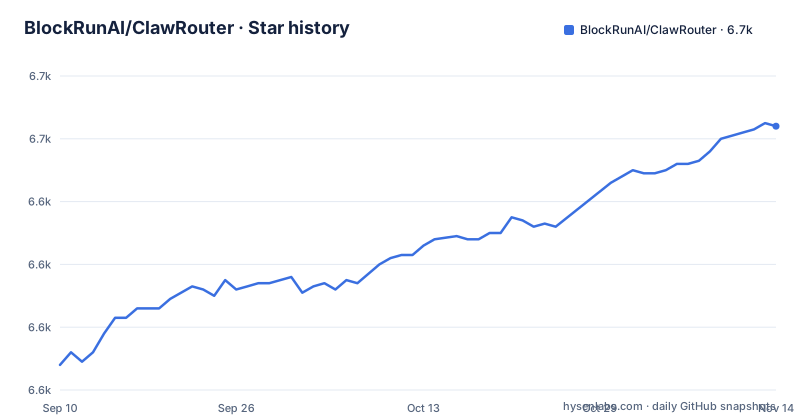
Star history
- BlockRunAI/ClawRouter6,664 ★ · +76
| Repository | 2026-09-10 | 2026-11-14 |
|---|---|---|
| BlockRunAI/ClawRouter | 6.6k | 6.7k |
76 Stars in the last 65 days, measured from the daily GitHub snapshot. Compare with other projects
Editorial analysis
The Problem ClawRouter Solves
Autonomous agents cannot sign up for accounts or enter credit card numbers. They can only sign transactions. That is the core problem ClawRouter addresses, according to its README. Most LLM routers were built for human developers who have API keys and billing dashboards. ClawRouter is designed so that an agent itself can pay for each request using a wallet signature. The target user is a developer building an agent that needs to call many different models without a human in the loop for every purchase. The README claims it reduces AI API costs by up to 84% compared to pinning a single expensive model like Claude Opus 5 on the same traffic. That number is computed from a published workload mix, and it sets the expectation that cost optimization is a primary goal.
How Routing Works: 15 Dimensions, Local Decision
ClawRouter analyzes each request across 15 dimensions and routes to the cheapest capable model in under 1ms, entirely locally. The concept is that the router inspects the request characteristics and matches them to model capabilities. It runs on your machine, not on a remote server, which keeps the routing latency low. The routing decision is separate from the payment and gateway functions. BlockRun is the gateway and billing layer, while ClawRouter is the local decision engine. The router supports 90 chat models across 9 providers, including OpenAI, Anthropic, Google, xAI, and DeepSeek. It also covers image, video, music, speech, and even outbound phone calls that return transcripts, according to the README's feature table. That breadth means the router is not just for text completions; it handles multimodal requests too.
Payment Mechanism: x402 and USDC Micropayments
The payment model is the distinctive part. ClawRouter uses the x402 protocol for USDC micropayments on Base and Solana. The README states that a wallet signature is the account, and USDC micropayments are the billing. This means an agent with a wallet can pay per request without any pre-existing account. For human developers, there is also a credit card option: sign up at user.blockrun.ai, top up a balance, and mint an API key that works with the same router. The README also mentions that seven models are free, with no signup, key, or wallet required. That free tier lowers the barrier for trying the router. The x402 protocol is referenced as the micropayment standard.
Getting Started: Installation and Configuration
The project is published on npm as @blockrun/clawrouter, and package.json exposes a clawrouter command. The repository is written in TypeScript, so a Node.js environment is expected. For configuration, the README refers to user.blockrun.ai for credit-card-based API keys.
Limitations and Failure Modes
Another limitation is that the 84% cost savings figure is based on a published workload mix, not on your specific traffic. If your workload differs, the savings could be smaller. The router requires a local deployment, which means you need to maintain the software and update it frequently. The release history shows many version bumps, with v0.12.304, v0.12.305 and v0.12.306 all published on 2026-11-03, indicating a fast-moving project. That could be a maintenance burden. Also, the payment infrastructure depends on BlockRun's gateway, so if that service goes down, your agent cannot pay for requests, even though the router itself is local.
Alternatives and How They Differ
A typical alternative is using a direct model provider API, like OpenAI or Anthropic, where you pay per token with a credit card on file. That approach requires a human to set up the account and manage billing, which is exactly what ClawRouter avoids. Another alternative is a hosted LLM gateway like LiteLLM or OpenRouter, which provide a unified API for many models but still require an API key and a billing account. ClawRouter differs by making the wallet signature the account, so an agent can self-serve. The key difference is the payment layer: ClawRouter is built for machine-to-machine payments, not human-managed subscriptions.
Maintenance and License Implications
ClawRouter is MIT licensed, which means you can use, modify, and distribute it freely, including in commercial products, without paying royalties. That is a permissive license, but it does not cover the BlockRun gateway service, which is separate. The README does not specify the license for the gateway or the API, so you would need to check the terms of service at user.blockrun.ai. The project is actively maintained, with the last push on 2026-11-02 and three releases on 2026-11-03. Recent release titles cover a dependency security sweep, Solana batch payment fixes and an SSRF guard change, which means you need to track updates. Upgrading from one version to another appears to be routine, but the high frequency could require regular attention.
Editorial conclusion
ClawRouter is for developers building autonomous agents that need to operate without human billing: if your agent can sign a transaction, it can pay for LLM calls with USDC on Base or Solana, or you can use a credit-card-funded API key from user.blockrun.ai. It is also for teams that want local, sub-millisecond routing across many models to cut costs. It is not for you if you need a hosted router with a management UI, or if your traffic is simple enough that a single model endpoint suffices. Before adopting, verify the routing dimensions against your actual workload, confirm the free model list meets your needs, and check that the x402 payment flow works on your target chain. The project is MIT licensed, so you can fork it, but the gateway and billing are tied to BlockRun's infrastructure, so understand that dependency. The release cadence is high, with frequent version bumps, so plan for ongoing updates.
Frequently asked questions
What is ClawRouter?
It is an MIT licensed LLM router that runs on your machine, analyses each request across 15 dimensions and sends it to the cheapest capable model in under a millisecond, entirely locally. It also settles the bill, either as USDC micropayments over x402 or against a credit card funded API key.
How do I use ClawRouter?
The package is @blockrun/clawrouter on npm and its command is clawrouter. For the credit card route you sign up at user.blockrun.ai, top up, mint an API key and run clawrouter login with that key; for the agent route a wallet is generated locally with no signup and pays per request in USDC over x402.
Is ClawRouter free?
Partly. Seven open-weight models are free forever with no signup, no key and no wallet, including a 1M-context reasoner and two sub-second coders. The README notes that image turns route to paid models, and the rest of the catalogue of 90 chat models across 9 providers is paid.
Official sources
Add this badge to your README
If you maintain this project, the badge below links readers to this analysis and shows its maintenance status from the daily GitHub snapshot. Paste the markdown into your README; add ?metric=license or ?metric=stars to the image URL for a different field.

[](https://hysenlabs.com/projects/blockrunai-clawrouter)Star history chart for your README
[](https://hysenlabs.com/projects/blockrunai-clawrouter)Was this useful?