Kelivo: A Flutter LLM Client That Pushes Cross-Platform Limits
A Flutter LLM Chat Client. Support Mobile & Desktop.
At a glance
- What is it?
- Kelivo is an open-source Flutter chat client for LLMs that targets mobile, desktop, and even HarmonyOS. Its broad platform list and feature set are ambitious, but the AGPL license deserves scrutiny.
- Who is it for?
- Adopt Kelivo if you need a single Flutter codebase for LLM chat across Android, iOS and desktop, with HarmonyOS in a separate repository, and you are comfortable with the AGPL-3.0 license and a project that is still evolving. Do not adopt it if you require a stable enterprise-grade solution or cannot accept the viral licensing terms for your distribution model.
- Can I use it commercially?
- Yes, with strict conditions. AGPL-3.0 is a network copyleft licence: if people use a modified version over a network, for example as a hosted service, you must offer them its source code under the same licence.
- Is it still maintained?
- Yes. The repository received new commits within the last day.
- What is it written in?
- Mainly Dart, according to GitHub's language statistics.
Answers come from the project's GitHub data, last synced on November 15, 2026, and from our analysis. They are not legal advice.
Star history
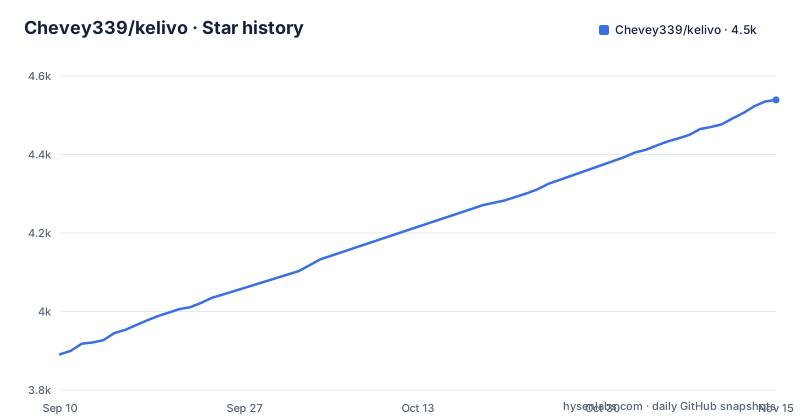
- Chevey339/kelivo4,539 ★ · +648
| Repository | 2026-09-10 | 2026-11-15 |
|---|---|---|
| Chevey339/kelivo | 3.9k | 4.5k |
648 Stars in the last 66 days, measured from the daily GitHub snapshot. Compare with other projects
Editorial analysis
What Kelivo Actually Solves
Kelivo addresses a practical pain: users who want a unified chat interface for multiple LLM providers without juggling several native apps. It is a Flutter application, so it targets Android, iOS, Windows, macOS, Linux, and HarmonyOS (the latter via a separate repository, kelivo-ohos). The README lists native protocols for OpenAI, Google Gemini and Vertex AI, and Anthropic Claude, plus built-in presets for DeepSeek, OpenRouter, SiliconFlow, Alibaba Cloud, Zhipu AI, xAI, ByteDance and more. This makes it a candidate for power users who switch between models and want a local client rather than a web interface. It also includes features that go beyond basic chat, such as MCP (Model Context Protocol) tool integration and web search. The intended audience is clear: developers and tech-savvy users who want control over their LLM interactions and are willing to configure providers manually.
Architecture and Core Mechanisms
The repository is a standard Flutter app, with Dart as the primary language. The README does not describe the internal architecture, but the feature list implies a modular design: providers are abstracted, assistants are customizable, and tools are integrated via MCP. The README says models can call MCP servers and search the web. The design appears to be a client-side aggregator: it handles API calls, renders markdown, manages conversation history, and exposes configuration options for providers and tools.
Getting Started: Installation and Configuration
To run Kelivo, you download the latest release from the GitHub releases page or, for iOS, from the App Store (the README links to an App Store page). There is also a TestFlight link for beta testing. Since it is a Flutter project, to build from source you would typically clone the repository and run `flutter run` after setting up the Flutter SDK. The README's Getting Started section says to open Settings → Providers, enter an API key for a preset provider or add your own endpoint, then fetch its model list; provider configurations can also be shared or imported as a QR code or text. Custom HTTP headers and bodies are supported, which is useful for providers that require extra authentication. For HarmonyOS, you must use the separate kelivo-ohos repository, not this one. The README also links a Chinese User Guide, and community support is on Discord and QQ.
Limitations and Failure Modes
Kelivo has several genuine limitations. First, provider support beyond the built-in presets depends on an OpenAI-compatible endpoint, which the README says includes self-hosted models. Second, the project is licensed under AGPL-3.0, which is a strong copyleft license; if you integrate or modify the code and distribute it, you must release your changes under the same license. This is a deal-breaker for proprietary or closed-source projects. Third, the HarmonyOS support is not in this repository but in a separate project (kelivo-ohos), which may lag behind the main repo. Finally, the project is relatively young, with the latest release at v1.3.4 as of November 2026, so it may still have rough edges and breaking changes.
Alternatives and How They Differ
The most direct alternative is a provider-specific app, such as the official ChatGPT app or the Claude app, but those lock you into one vendor. Another alternative is a self-hosted web client like Open WebUI, which runs on a server and requires a browser, but offers a different deployment model: you host it centrally, and it can be accessed from any device without installing anything. In contrast, Kelivo is a native client that runs on your device, which gives offline access to your settings and chat history, but it requires maintenance on each device. Another category is desktop-only clients like GPT4All, which focuses on local models, whereas Kelivo is cloud-oriented. The key difference is that Kelivo aims for a single codebase across Android, iOS, macOS, Windows and Linux, with HarmonyOS maintained in a separate repository. If you need only one platform, a simpler client might suffice, but for multi-device users, Kelivo's breadth is its main draw.
Maintenance and Upgrade Cost
The project shows active development: releases v1.3.2, v1.3.3, and v1.3.4 were published between late October and early November 2026, with the last push on November 2, 2026. This indicates a regular release cadence, but it also means users must keep up with updates to get fixes and new features. The reliance on third-party sponsors for free models (e.g., siliconflow.cn) suggests that some features depend on external services, which could change or disappear. The AGPL license means that if you redistribute modified versions, you must provide source code, which adds compliance overhead. For personal use, the upgrade cost is low: download the latest release and reinstall. For developers who fork the project, the cost is higher because they must track upstream changes and ensure their modifications remain compliant with the license.
Editorial conclusion
Adopt Kelivo if you need a single Flutter codebase for LLM chat across Android, iOS and desktop, with HarmonyOS in a separate repository, and you are comfortable with the AGPL-3.0 license and a project that is still evolving. Do not adopt it if you require a stable enterprise-grade solution or cannot accept the viral licensing terms for your distribution model. Before committing, verify the current state of the HarmonyOS port (since it lives in a separate repository), test your preferred providers and MCP servers against the latest release, and check the project's issue tracker for unresolved platform-specific bugs. Kelivo is a promising but young project; its value depends on your willingness to engage with its community and adapt to rapid changes.
Frequently asked questions
What platforms does Kelivo run on?
Android, iOS, macOS, Windows and Linux from one Flutter codebase, with HarmonyOS maintained in a separate repository. Requirements are iOS 15.0 or later, Android 7.0 or later, macOS 12.0 or later on Apple silicon or Intel, Windows 10 or 11, and Linux x86_64 as AppImage, DEB, RPM or tar.gz.
Does Kelivo require an account?
No. Kelivo has no account system of its own. You connect your own API keys or sign in with a supported subscription, and conversations, settings and files are stored locally, with backup to WebDAV or S3-compatible storage whenever you choose.
What can a Kelivo workspace do?
Binding a conversation to a workspace gives the model eight tools: shell, read_file, view_image, write_file, edit_file, list_dir, glob and grep. Command output streams live, file edits appear as diffs, and file access outside authorized folders and desktop commands ask for approval, unless a conversation explicitly enables Full access.
Does Kelivo work on a phone without a computer?
Yes. A workspace can run inside a Linux sandbox on the phone: Android runs Ubuntu, Debian or Alpine through PRoot or a rootfs image you import, while iOS bundles Alpine Linux based on iSH so nothing has to be downloaded.
Which model providers does Kelivo support?
Native protocols cover OpenAI Chat Completions and Responses API, Google Gemini and Vertex AI, and Anthropic Claude, plus any OpenAI-compatible endpoint including self-hosted models. Built-in presets cover OpenAI, Gemini, Claude, DeepSeek, OpenRouter, SiliconFlow, Alibaba Cloud, Zhipu AI, xAI and ByteDance.
Is Kelivo open source?
Yes, under the GNU Affero General Public License v3.0. The source, releases and issue tracker are on GitHub, with a project website, a Chinese user guide, a Discord server and a QQ group.
Official sources
Where developers are discussing it
Posts on Hacker News, dev.to and Lobsters that link to this repository, found by our scan of those communities. 0 in the last 30 days; newest first.
- Kelivo: A Flutter LLM Chat Client. Support Mobile and DesktopHacker News · Sep 10, 2026 · 2 points · 0 comments
Add this badge to your README
If you maintain this project, the badge below links readers to this analysis and shows its maintenance status from the daily GitHub snapshot. Paste the markdown into your README; add ?metric=license or ?metric=stars to the image URL for a different field.

[](https://hysenlabs.com/projects/chevey339-kelivo)Star history chart for your README
[](https://hysenlabs.com/projects/chevey339-kelivo)Was this useful?