ArtifactFS: mounting a git repository without waiting for the clone
ArtifactFS is a filesystem driver designed to mount large git repos as quickly as possible, hydrating file contents on-the-fly instead of blocking on the initial clone. It's ideal for agents, sandboxes, containers and other use-cases where startup time is critical.
At a glance
- What is it?
- ArtifactFS is a Go FUSE driver from Cloudflare that exposes a git repository as a working tree immediately and fetches blob contents on demand, prioritising manifests and source over large binaries. It suits sandboxes, agents and CI jobs where startup time dominates, and it is the wrong tool for a workstation that simply needs the files.
- Who is it for?
- ArtifactFS is a good fit for short-lived environments, agent sandboxes and CI steps that need a repository tree almost immediately, because the mount replaces a blocking clone with a background hydration that only stalls on the specific file being read. It is not a fit for a developer workstation, since the tree is assembled from a git remote plus an overlay and the README does not describe a workflow for committing local changes back.
- Can I use it commercially?
- Yes. Apache-2.0 is a permissive licence: you can use, modify and sell software built on it, as long as you keep its copyright and licence notices.
- Is it still maintained?
- Yes. The repository last received commits 7 days ago.
- What is it written in?
- Mainly Go, according to GitHub's language statistics.
Answers come from the project's GitHub data, last synced on November 6, 2026, and from our analysis. They are not legal advice.
Star history
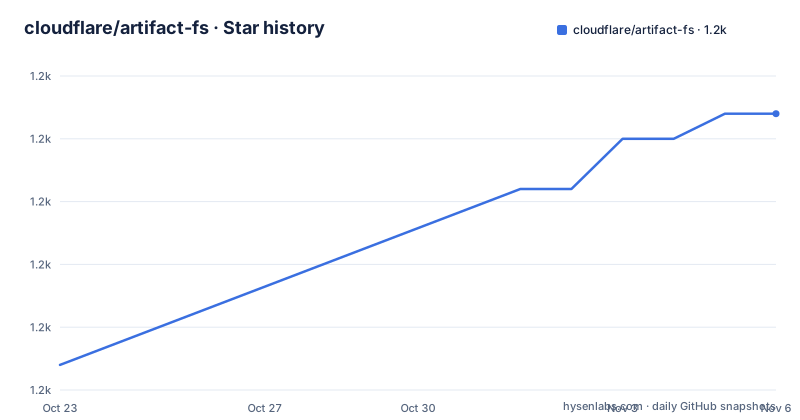
- cloudflare/artifact-fs1,211 ★ · +10
| Repository | 2026-10-23 | 2026-11-06 |
|---|---|---|
| cloudflare/artifact-fs | 1.2k | 1.2k |
10 Stars in the last 14 days, measured from the daily GitHub snapshot. Compare with other projects
Editorial analysis
The tree appears before the blobs do
ArtifactFS is a filesystem daemon written in Go that mounts a git repository as an ordinary working tree, and the point of the design is that the two halves of a clone are separated. The operating system sees the full tree almost immediately, while the FUSE driver fetches file contents in the background. A read blocks only until the blob it needs has arrived. For the environments the project targets, which the README names as sandboxes, agents and other short-lived contexts where a full clone is too slow, that reordering is the whole value. The project describes itself as a beta release and warns that your mileage may vary, which is the appropriate frame for a driver that intercepts filesystem calls on behalf of a build tool.
Manifests and source are fetched before large binaries
Hydration is not a blind queue. The daemon prioritises code and manifests, with the README naming package.json, go.mod and README.md as examples, ahead of binary files. That ordering reflects how a toolchain actually uses a repository: a build needs the manifest to decide what to do, and only then reaches for the artefacts. It also means the worst case for a slow operation is a large binary, not the whole tree. The number of parallel blob-fetch workers is tunable through a --hydration-concurrency flag that defaults to 4, and each worker keeps a persistent git cat-file --batch process open, so raising the number trades memory for throughput. For a repository dominated by binaries the prioritisation buys less, and the flag becomes the only lever you have.
The daemon mounts, blocks and reports its own state
The CLI has three working parts. add-repo registers a remote, clones it and builds the initial snapshot, writing the result under a root directory. The daemon then starts, mounts through FUSE and blocks until it is killed. Third, status reports the condition of a mounted repository as a single line of key and value pairs, and the README documents each field.
export ARTIFACT_FS_ROOT=/tmp/artifact-fs-test

./artifact-fs add-repo \
  --name workers-sdk \
  --remote https://github.com/cloudflare/workers-sdk.git \
  --ref refs/heads/main \
  --mount-root /tmp

./artifact-fs daemon --root /tmp &
DAEMON_PID=$!

ls /tmp/workers-sdk/
cat /tmp/workers-sdk/README.md
git -C /tmp/workers-sdk log --oneline -5

kill $DAEMON_PID
Because the mount happens under the mount root, the repository path is the name you gave it, which is why the example reads files at /tmp/workers-sdk. The status output distinguishes states of mounted, unmounted, preparing and failed, and tracks hydrated_blobs and hydrated_bytes so you can see how much of the repository has actually landed.
An overlay holds local changes, and a dirty flag tells you they exist
The status fields describe two generations of content. base_commit is the commit backing the currently published filesystem generation, while head and ref are described as backward-compatible aliases for the current base commit and the Git HEAD ref. On top of that sits an overlay, and overlay_dirty is true when the overlay contains created or modified files. The README adds a precise caveat: delete-only overlays are not counted, so a clean flag does not strictly mean nothing was changed locally. A reader building a workflow on top of this needs to read that field carefully, because a mount that only removed files reports as clean.
Preparation is bounded by a timeout and a retry policy
The daemon does not wait forever. Preparation has a 30-minute timeout, and clone and fetch operations retry known transient transport failures up to three total attempts. Caller cancellation stops the active git command and the retry backoff, with synchronous preparation recording a redacted prepare canceled status, while daemon shutdown leaves asynchronous preparation queued for restart. Those two cancellation paths behave differently on purpose, and the difference matters if you script around the CLI. For an existing clone, the asynchronous path reports remote configuration, fetch and branch update as separate phases called configure_remote, fetch and update_branch, so a failure can be attributed to a step rather than to preparation as a whole.
Logs are newline-delimited JSON with a fixed shape
Everything the daemon emits goes to stderr as newline-delimited JSON, and the README shows representative lines for a successful preparation, a transient failure that recovers, and a timeout. The fields are stable enough to parse: time, level, msg, repo, mode, source, attempt, phase, state, duration_ms, deadline_set and timeout_ms appear on preparation lines, while failure lines add max_attempts, retryable, timed_out and canceled, and a recovery line reports the number of attempts and the total duration. The timeout line is truncated in the README itself, so the full shape of a failure record beyond the visible prefix is not documented there, though the accompanying table of status fields is complete.
Building it needs Go 1.26 and a FUSE implementation on the host
The build requirements are specific. Go 1.26 or newer is required, and the host needs a FUSE implementation: macFUSE on macOS, and fuse3 on Linux, which the README gives as apt install fuse3 on Debian and Ubuntu and dnf install fuse3 on Fedora. The CLI installs from the module path.
go install github.com/cloudflare/artifact-fs/cmd/artifact-fs@latestOr you can build the binary directly from the same module path.
go build -o artifact-fs github.com/cloudflare/artifact-fs/cmd/artifact-fsThe go.mod file confirms the small dependency surface: the jacobsa/fuse binding, urfave/cli for the command line, golang.org/x/sys and modernc.org/sqlite, which is a pure Go SQLite build and avoids a cgo toolchain requirement. The repository root shows the testing posture as well, with separate end-to-end files for async preparation, git operations, benchmarks and per-platform setup for Darwin and Linux.
Apache-2.0, release-candidate tags, and an example Docker image
The project is Apache-2.0 licensed, so it can be used in commercial and closed-source products with attribution, and it is published by Cloudflare as part of Cloudflare Artifacts, a versioned filesystem that speaks git, which the product page describes as built for agent toolchains, sandboxes and CI/CD systems. The releases are still labelled release candidates, with 1.0.0-rc.10 on 2026-08-12, 1.0.0-rc.9 on 2026-07-27 and 1.0.0-rc.8 on 2026-07-26, and the last push was on 2026-09-11. The repository ships an examples directory with a Dockerfile, an entrypoint script and a cloudflare-sandbox-sdk folder, which is the closest thing in the tree to a deployment recipe for the sandboxes the tool is designed for.
Editorial conclusion
ArtifactFS is a good fit for short-lived environments, agent sandboxes and CI steps that need a repository tree almost immediately, because the mount replaces a blocking clone with a background hydration that only stalls on the specific file being read. It is not a fit for a developer workstation, since the tree is assembled from a git remote plus an overlay and the README does not describe a workflow for committing local changes back. Verify first that your environment has a FUSE implementation available, macFUSE on macOS or fuse3 on Linux, and that the machine running the daemon can reach your git remote, since a failed fetch surfaces as a prepare_error in the status output rather than at mount time.
Frequently asked questions
What does ArtifactFS need to run?
Go 1.26 or newer to build it, and a FUSE implementation on the host: macFUSE on macOS, or fuse3 on Linux via apt install fuse3 on Debian and Ubuntu and dnf install fuse3 on Fedora.
Does ArtifactFS support Cloudflare Artifacts or only git repositories?
Both. The README states it is part of Cloudflare Artifacts, a versioned filesystem that speaks git, and that it also works with any git repo, which is what the quick start demonstrates with a public GitHub repository.
How does ArtifactFS handle files that have not been downloaded yet?
Reads block only until the requested blob is fetched, and the daemon prioritises code and manifests such as package.json, go.mod and README.md over binary files. The --hydration-concurrency flag, default 4, controls how many blob-fetch workers run in parallel.
Is ArtifactFS a stable release?
The README describes it as a beta release and warns that your mileage may vary, and the published tags are release candidates, with 1.0.0-rc.10 being the most recent.
Official sources
Add this badge to your README
If you maintain this project, the badge below links readers to this analysis and shows its maintenance status from the daily GitHub snapshot. Paste the markdown into your README; add ?metric=license or ?metric=stars to the image URL for a different field.

[](https://hysenlabs.com/projects/cloudflare-artifact-fs)Star history chart for your README
[](https://hysenlabs.com/projects/cloudflare-artifact-fs)Was this useful?