Entity Framework 6: .NET data access with a stability-first lifecycle
This is the codebase for Entity Framework 6 (previously maintained at https://entityframework.codeplex.com). Entity Framework Core is maintained at https://github.com/dotnet/efcore.
At a glance
- What is it?
- Entity Framework 6 is an object-relational mapper for .NET that removes much routine data-access code from applications. Its repository remains available and the last push was on 2026-10-12, but Microsoft states that EF6 is supported without active feature development.
- Who is it for?
- Organizations with established EF6 applications that must remain on their current .NET stack may continue using EF6 after checking the Microsoft support policy and dependency compatibility. New applications and teams intending to move to modern .NET should first assess EF Core.
- Can I use it commercially?
- Yes. MIT is a permissive licence: you can use, modify and sell software built on it, as long as you keep its copyright and licence notices.
- Is it still maintained?
- Yes. The repository last received commits 6 days ago.
- What is it written in?
- Mainly C#, according to GitHub's language statistics.
Answers come from the project's GitHub data, last synced on November 7, 2026, and from our analysis. They are not legal advice.
Star history
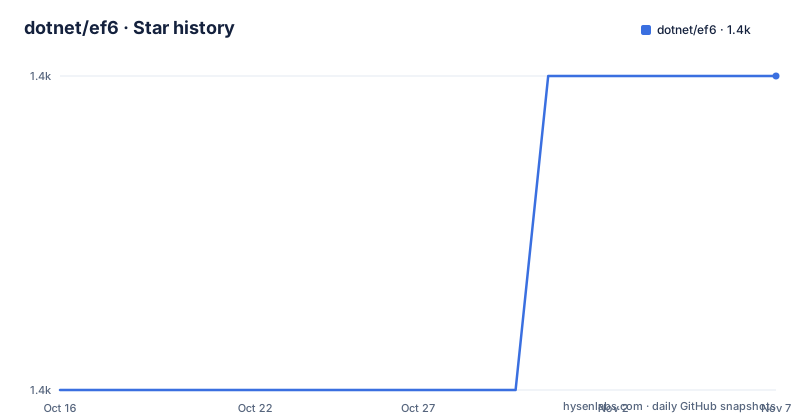
- dotnet/ef61,449 ★ · +1
| Repository | 2026-10-16 | 2026-11-07 |
|---|---|---|
| dotnet/ef6 | 1.4k | 1.4k |
1 Stars in the last 22 days, measured from the daily GitHub snapshot. Compare with other projects
Editorial analysis
Entity Framework 6 data access scope and intended users
Entity Framework 6 addresses the code that connects .NET application objects to relational data. Its README describes it as an object-relational mapper and says it eliminates most of the data-access code developers would normally write. The practical target is an application whose entities, queries, and persistence operations are already expressed in .NET and backed by a relational database. EF6 can reduce repetitive persistence plumbing, but the README does not define its internal query pipeline, provider abstraction, connection management, or transaction implementation, so this review does not infer those details.
The clearest audience is a team maintaining an existing EF6 solution. The repository's continued availability, the link to EF6 documentation, and references to porting existing projects all point toward an established-codebase role. The README also identifies Microsoft Support as an option that may incur a fee. That is relevant to organizations that cannot use community support channels, although the repository does not provide a support package or fixed response time.
EF6 is not positioned as the default choice for a new modern .NET system. The README says the EF team focuses on EF Core, and it describes EF Core as the version actively developed for modern .NET. The distinction is architectural and platform-related, not merely a preference between two package names. EF6 is a reasonable subject for an adoption review when compatibility outweighs access to new features. A greenfield project would need more evidence before accepting that constraint.
Repository boundaries, build layout, and external tooling
The repository is the Entity Framework 6 codebase rather than a complete application template. Its top-level solution is `EntityFramework.sln`, while `src/` contains the product source and `test/` contains the associated test tree. Build and restore entry points include `restore.cmd`, `restore.sh`, `build.cmd`, `build.sh`, `test.cmd`, and `test.sh`. Those file names show that the repository supports Windows-style command workflows alongside shell scripts, but the README does not document their prerequisites or arguments. The repository therefore supports source-level inspection, not a reproducible consumer installation tutorial.
Two related tools live outside this repository. The EF6 Tools for Visual Studio, including the visual designer, are in the separate `dotnet/ef6tools` repository. EF6 PowerTools is maintained as a community-driven project in the `ErikEJ/EntityFramework6PowerTools` repository. This boundary matters when evaluating tooling: obtaining the main EF6 repository does not place every visual design utility into the same codebase.
The repository also contains package, build, pipeline, and metadata configuration, including `.nuget/`, `Directory.Build.props`, `Directory.Build.targets`, `global.json`, and Azure Pipelines files. These entries indicate a structured build and release process. They do not reveal supported database providers or exact .NET targets in the README. An engineer considering direct repository builds would therefore need to inspect those files rather than infer requirements from the product description.
EF6 installation documentation and the first-use boundary
The README directs users to the Entity Framework documentation site for installation, documentation, tutorials, samples, and related guidance. It also warns that this documentation is no longer being updated. No package name, installation command, code-first connection example, or application configuration snippet appears in the repository information.
A new user's first supported route is therefore the linked EF6 documentation at `https://docs.microsoft.com/ef/ef6/`. From there, the relevant setup depends on the application model and database provider, neither of which is specified in the repository description. The README does not say which Visual Studio template to select, which NuGet packages to add, or what connection settings a first model requires. It also does not document a command-line installer.
For an existing EF6 application, a more concrete first verification is to inspect whether the solution already references the intended EF6 and provider packages, then confirm that it restores and builds with that application's existing toolchain. The repository's `restore.cmd` and `build.cmd` are visible files, but the README does not claim they are the documented installation procedure for consumers. No runnable command is included here because the repository documentation does not establish its working directory, required SDK, or expected result. Microsoft Support or Stack Overflow are the documented support paths, with the former potentially chargeable.
EDMX and visual design constraints when comparing EF Core
The clearest documented architectural difference is EF6's relationship with designer-based development. The README states that EF Core has a different architecture and does not support a visual designer or EDMX files. That makes the distinction concrete for teams whose EF6 design is stored in EDMX or depends on the Visual Studio designer. A port is described as possible for most EF6 projects, but it requires work and is not presented as a mechanical conversion.
This limitation also changes where tooling responsibility sits. EF6's visual designer belongs to the separate `dotnet/ef6tools` repository. EF6 PowerTools is another separate, community-driven project. Teams adopting EF6 therefore need to account for these companion components when they rely on model design or related utilities. The README does not claim that the main EF6 package includes the designer.
For EF Core, the repository points to `dotnet/efcore` and describes it as lightweight and extensible, actively developed, and exclusive to modern .NET. It links to a dedicated porting guide but does not claim automatic preservation of every provider, query, extension, or migration. That omission matters. An upgrade decision should begin by inventorying EDMX artifacts and visual-designer workflows, because those are areas where EF Core explicitly differs rather than merely offering a newer package.
Support scope, maintenance boundaries, and upgrade pressure
Microsoft's status statement is more restrictive than the repository's recent push date alone might suggest. The last push was on 2026-10-12, and the repository is not archived. However, the README explicitly says EF6 is no longer being actively developed. It defines the remaining scope as security fixes, possible high-impact bug fixes, no new features, and no general bug fixes. Community pull requests are not being accepted because Microsoft prioritizes stability and compatibility.
This creates a predictable upgrade cost for an adopting team. Existing behavior should receive less intervention than in an actively evolving codebase, which can reduce regression exposure but limits access to new capabilities. A team cannot assume that a missing feature will be added to EF6 or that an ordinary defect will qualify for a fix. The README points to the Entity Framework Support Policies for the authoritative support terms.
The recent release list includes `v6.5.2` on 2026-04-28, `v6.6.0-preview1` on 2026-04-28, and `v6.5.1` on 2024-06-17. The presence of a preview does not reverse the stated lack of feature development, and the README does not describe what the preview contains. Version planning should distinguish security and compatibility fixes from the possibility that a preview is unsuitable for production. Microsoft Support may be relevant when a high-impact issue needs assessment under its published policy.
MIT licensing and the practical alternative in EF Core
The repository identifies its license as MIT and includes `LICENSE.txt`. The README does not add separate licensing terms for consumers, providers, database engines, or the separately hosted EF6 tools, so an adoption review should distinguish the main repository's declared license from the terms of every companion component and application dependency. This is a licensing boundary, not legal advice.
EF Core is the documented alternative, but it is not a drop-in replacement. It targets modern .NET and does not run on .NET Framework. It also lacks EF6's visual designer and EDMX support. Existing projects can often be ported according to the linked migration guide, although Microsoft does not promise that most means automatic or effort-free. EF6 therefore serves a different near-term need: retaining established applications and their conventions, rather than adopting the actively developed ORM for new modern .NET work.
That difference is especially significant for platform planning. An EF6 application may remain the lower-disruption choice while its .NET dependencies remain compatible, but choosing it for a new service can introduce a future port and redesign. Choosing EF Core instead can avoid carrying EDMX and designer dependencies, but it requires accepting its architecture and modern .NET requirement. The correct comparison starts with the application's runtime and model representation, not with a feature checklist copied from either README.
Editorial conclusion
Organizations with established EF6 applications that must remain on their current .NET stack may continue using EF6 after checking the Microsoft support policy and dependency compatibility. New applications and teams intending to move to modern .NET should first assess EF Core. Before adoption, verify provider support, the impact of the absence of new EF6 features, and the effort required to move EDMX or designer-based models if migration to EF Core is possible.
Frequently asked questions
Is Entity Framework 6 still supported?
The README says EF6 is still supported by Microsoft and links to the Entity Framework Support Policies for details. Security issues will be fixed, selected high-impact bugs may be fixed, and new features will not be implemented.
Is Entity Framework 6 actively developed?
No. Microsoft explicitly states that EF6 is no longer being actively developed and is not accepting community pull requests. The repository was not archived, and its last push was on 2026-10-12, but those facts do not change the stated development policy.
Should a new .NET project choose EF6 or EF Core?
The documented direction for modern .NET is EF Core, which is actively developed and does not run on .NET Framework. EF6 is more relevant to an established application that must retain its current stack and can work within the restricted support policy.
Official sources
Add this badge to your README
If you maintain this project, the badge below links readers to this analysis and shows its maintenance status from the daily GitHub snapshot. Paste the markdown into your README; add ?metric=license or ?metric=stars to the image URL for a different field.

[](https://hysenlabs.com/projects/dotnet-ef6)Star history chart for your README
[](https://hysenlabs.com/projects/dotnet-ef6)Was this useful?