dpangestuw/Free-Proxy: A Raw Text Feed of Freshly Scraped Proxies
Free Proxy List 🔄 Update Every 5 Minutes
At a glance
- What is it?
- dpangestuw/Free-Proxy is a GitHub repository that publishes scraped HTTP, HTTPS, SOCKS4, and SOCKS5 proxy lists as plain text files, updated every five minutes. It is a raw data feed, not a tool, and its value depends entirely on how you consume it.
- Who is it for?
- Adopt dpangestuw/Free-Proxy if you need a quick, no-frills source of many proxy addresses for testing, web scraping, or privacy experiments, and you can tolerate the churn of free proxies. Do not use it for production systems that require stable, authenticated, or geographically controlled proxies, because the list is unauthenticated, unvetted beyond basic validation, and changes every five minutes.
- Can I use it commercially?
- Not without permission. GitHub finds no licence file in the repository, and without a licence all rights are reserved by default: you may read the code but not reuse it. Check the README, or ask the authors, before using it.
- Is it still maintained?
- Yes. The repository received new commits within the last day.
- What is it written in?
- GitHub does not report a main language for this repository.
Answers come from the project's GitHub data, last synced on October 22, 2026, and from our analysis. They are not legal advice.
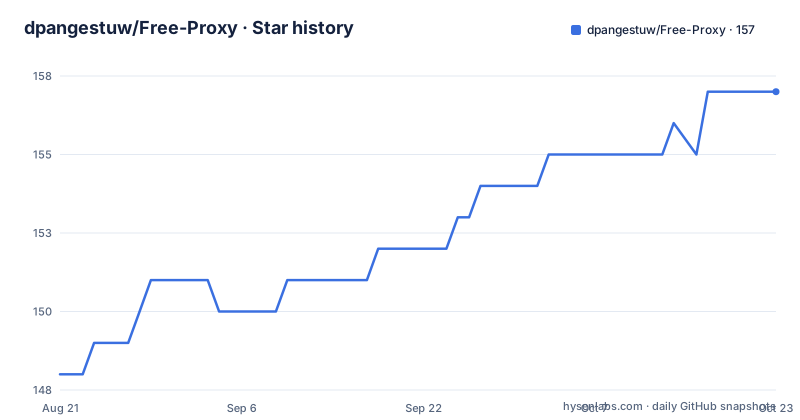
Star history
- dpangestuw/Free-Proxy157 ★ · +9
| Repository | 2026-08-21 | 2026-10-22 |
|---|---|---|
| dpangestuw/Free-Proxy | 148 | 157 |
9 Stars in the last 62 days, measured from the daily GitHub snapshot. Compare with other projects
Editorial analysis
What This Repository Actually Provides
dpangestuw/Free-Proxy is not a proxy server or a client tool. It is a scraped list of proxy addresses published as plain text files on GitHub. The README states that it fetches fresh proxies from around the web, including HTTP, HTTPS, SOCKS4, and SOCKS5, and that the latest update contained 8,778 proxies. The output is four .txt files: All_proxies.txt, http_proxies.txt, socks4_proxies.txt, and socks5_proxies.txt. Each file is a raw list of IP:port entries, one per line, as is typical for proxy lists. The intended consumer is a developer or data gatherer who needs a bulk supply of addresses to filter, test, and rotate. There is no API, no authentication, no filtering by country or speed. The repository is a feed, and the only interaction is downloading the files.
The Five-Minute Update Cycle and What It Means
The description says the list updates every five minutes. That is a fast cadence for a free proxy source, and it suggests the scraper is continuously running, likely on a scheduled job, and pushing new commits to the main branch. The README shows a badge with the count of fresh proxies found in the latest update, which is the only freshness indicator. Fast updates are useful because free proxies die quickly. A proxy that works at 10:00 may be dead by 10:05, so a five-minute refresh gives you a chance to grab addresses before they vanish. However, the speed also means the list is volatile. If you download once and use it for an hour, a large fraction of the entries may already be stale. The repository does not promise uptime, latency, or geographic distribution. You get what the scraper found in the last five minutes, nothing more.
How to Fetch the Lists: Commands and URLs
The README gives direct raw URLs for each list. For all proxies, use https://raw.githubusercontent.com/dpangestuw/Free-Proxy/refs/heads/main/All_proxies.txt. For HTTP only, use http_proxies.txt; for SOCKS4, socks4_proxies.txt; for SOCKS5, socks5_proxies.txt. These are plain text files, so you can fetch them with curl, wget, or any HTTP client. For example, a shell command like curl -O https://raw.githubusercontent.com/dpangestuw/Free-Proxy/refs/heads/main/http_proxies.txt will save the file. There is no authentication, no rate limit mentioned, and no need to clone the repository. The raw URLs work directly. This simplicity is the project's main strength. You do not need to install anything or write code to get the data. However, the URLs include refs/heads/main, which is a branch reference. If the maintainer changes the branch or deletes the files, the URLs break. The README does not mention any backup or mirror.
Validation and Sorting: What the README Claims
The feature list says the proxies are validated, extremely fast, and sorted into HTTP, HTTPS, SOCKS4, and SOCKS5. Sorted here likely means separated into category files, not ordered by any metric. The validation claim is vague. It does not say what validation method is used, how often it runs, or what percentage of the list passes. In free proxy lists, validation usually means a quick connectivity check, not a guarantee of anonymity or speed. The README also does not specify whether HTTPS proxies are included in http_proxies.txt or in a separate file. The only files are http, socks4, socks5, and all, so HTTPS may be merged into HTTP or into All. That ambiguity is a limitation. If you need HTTPS proxies specifically, you cannot tell from the repository layout whether they are isolated. The count of 8,778 proxies is a snapshot, not a constant. It changes with every update.
The Core Limitation: No Context, No Guarantees
The biggest weakness is the absence of any metadata. The list gives you IP:port pairs and nothing else. No country, no anonymity level, no response time, no protocol version for SOCKS. For many use cases, that is a dealbreaker. If you need a proxy in a specific country for geo-restricted content, you cannot filter this list without testing each address yourself. If you need a high-anonymity proxy for privacy, you have no way to know if the proxy leaks your IP. The repository also has no license file, which is a legal ambiguity. The README does not state a license, so the default copyright rules apply. You can read the data, but redistribution or commercial use may be restricted. The project is also not archived, but there are no recent releases or tags. The last push is unknown, so the update cycle might have stopped. A five-minute cadence means nothing if the last push was months ago. You should check the repository's commit history before relying on it.
Alternatives: Comparing to Other Free Proxy Sources
The main alternative is a curated proxy list service like ProxyScrape or Free Proxy List from various websites. These services often provide an API with filters for country, protocol, and uptime, and they offer structured data like JSON or CSV. For example, ProxyScrape's API lets you request proxies with parameters like country=US and protocol=http, which is impossible with dpangestuw/Free-Proxy. Another alternative is to run your own proxy scraper and validator using tools like Scrapy or a custom script, which gives you full control over validation and metadata. The difference is clear: dpangestuw/Free-Proxy is a raw dump, while these alternatives offer structured, queryable data. If you need a quick, bulk list without any setup, this repository works. If you need filtering or reliability, you will spend more time writing validation code than you would with a service that provides it.
Maintenance and Upgrade Costs
The maintenance cost is on you, the consumer. Since the repository only provides raw lists, you must build a validation and rotation system. Free proxies fail often, so you need to test each address before use. A simple script can check connectivity by attempting an HTTP request through the proxy, but that is extra work. The update cycle means you should re-fetch frequently, perhaps every five minutes, which can be a lot of requests to raw.githubusercontent.com. There is no versioning or changelog, so you cannot track changes. The lack of a license is a legal risk. Without a license, you cannot assume you have permission to use the data in commercial products. The project may also disappear at any time, as it is a personal repository with no corporate backing. The upgrade cost is zero in terms of features, but high in terms of operational overhead. You are not adopting a tool; you are adopting a data source that requires constant care.
Editorial conclusion
Adopt dpangestuw/Free-Proxy if you need a quick, no-frills source of many proxy addresses for testing, web scraping, or privacy experiments, and you can tolerate the churn of free proxies. Do not use it for production systems that require stable, authenticated, or geographically controlled proxies, because the list is unauthenticated, unvetted beyond basic validation, and changes every five minutes. Before relying on it, verify the current freshness by checking the latest update count in the README and test a sample of addresses against your target service, since free proxies often fail or are blocked. The project is a data source, not a managed service, so your own validation and rotation logic is mandatory.
Frequently asked questions
How do I get a free proxy from dpangestuw/Free-Proxy?
Fetch one of the four plain text files from the main branch with curl or a client subscription field. The combined list is All_proxies.txt, and the per protocol slices are http_proxies.txt, socks4_proxies.txt and socks5_proxies.txt. There is nothing to install.
How do I use the Free-Proxy list?
Paste the raw URL of All_proxies.txt or of one protocol file into your client's proxy or subscription setting and refresh it often, since the addresses are branch-pinned to main and the body changes without notice. The README gives no line format, so the client has to accept a bare host and port list.
Does dpangestuw/Free-Proxy ship a separate HTTPS proxy file?
No. The README says the list is sorted into HTTP, HTTPS, SOCKS4 and SOCKS5, but the repository root holds only All_proxies.txt, http_proxies.txt, socks4_proxies.txt and socks5_proxies.txt, and the download section gives no address for an HTTPS file. Whether HTTPS entries sit inside http_proxies.txt is not stated.
How does dpangestuw/Free-Proxy validate the proxies it publishes?
The feature list says Validated and the count line calls the entries fresh proxies, but no check is described. The README does not say what a validation step consists of, what a passing response looks like, or how often an entry is retested.
Can I run dpangestuw/Free-Proxy myself to generate the proxy lists?
Not from what the repository publishes. The top level holds four text files and a README, with no source directory, no script, no workflow file and no detected language, and no release has ever been published. The collection process is not documented.
Official sources
Add this badge to your README
If you maintain this project, the badge below links readers to this analysis and shows its maintenance status from the daily GitHub snapshot. Paste the markdown into your README; add ?metric=license or ?metric=stars to the image URL for a different field.

[](https://hysenlabs.com/projects/dpangestuw-free-proxy)Star history chart for your README
[](https://hysenlabs.com/projects/dpangestuw-free-proxy)