SkyEye: a Java platform whose open repository is not the whole product
智能办公OA系统[SpringBoot2-快速开发平台],适用于医院,学校,中小型企业等机构的管理。Activiti5.22+动态表单实现零java代码即可做到复杂业务的流程实施,同时包含文件在线操作、日志、考勤、CRM、ERP进销存、项目、拖拽式生成问卷、日程、笔记、计划、行政等多种复杂业务功能。同时,可进行授权二开。
At a glance
- What is it?
- dromara/skyeye is a Spring Cloud Alibaba based Java platform for CRM, ERP, MES, WMS, OA, EHR and workflow, with a zero-code designer and a uni-app mobile client. The important caveat is stated in its own documentation: the open repository does not contain all the code, and the full business source is available only to paying members.
- Who is it for?
- Adopt SkyEye if you want a working Chinese-language OA and ERP base to deploy and evaluate, and if paying for the member source is acceptable to you. Do not adopt it expecting a complete MIT-licensed codebase, because the project states the open repository excludes some of the code.
- Can I use it commercially?
- Yes. MIT is a permissive licence: you can use, modify and sell software built on it, as long as you keep its copyright and licence notices.
- Is it still maintained?
- Yes. The repository last received commits 3 days ago.
- What is it written in?
- Mainly Java, according to GitHub's language statistics.
Answers come from the project's GitHub data, last synced on November 7, 2026, and from our analysis. They are not legal advice.
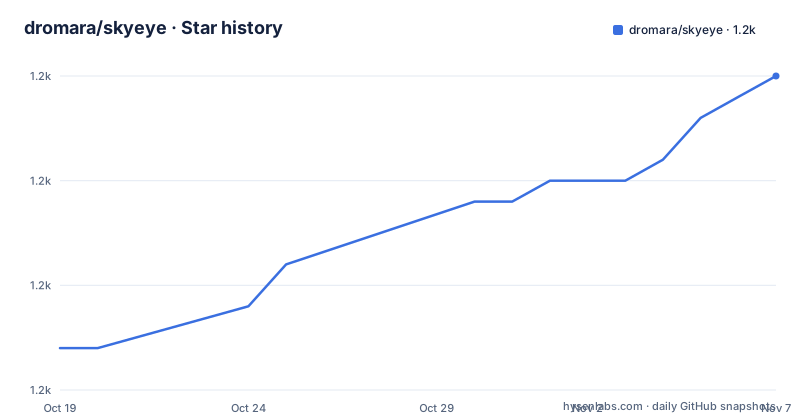
Star history
- dromara/skyeye1,245 ★ · +13
| Repository | 2026-10-19 | 2026-11-07 |
|---|---|---|
| dromara/skyeye | 1.2k | 1.2k |
13 Stars in the last 19 days, measured from the daily GitHub snapshot. Compare with other projects
Editorial analysis
What the platform claims to cover
SkyEye is described as an enterprise platform for the intelligent manufacturing sector, an AI plus zero-code, SaaS-shaped, full-chain management product built on a Spring Cloud Alibaba microservices base with Vue3, Ant Design Vue, and uni-app. The scope claim is large. The built-in modules listed in the project description include CRM customer management, ERP inventory and purchasing, MES production, WMS warehousing, OA office administration, EHR personnel and payroll, project management, a storefront, finance, after-sales work orders, a workflow engine, and business reporting, described as over a hundred business modules.
Underneath that is a self-developed zero-code designer, so forms, processes, and print templates are assembled by dragging rather than by writing native CRUD code, with the same source published to a PC client and to mobile clients as a mini program, an H5 app, and a native app.
The project belongs to the Dromara open source community, and the README says the open source trunk is iterated continuously while a commercial complete-source membership service is also offered. It is MIT licensed by the repository metadata, it is written in Java, and its default branch is company_server rather than main. The last push to the repository was on 2026-10-18, and there are no GitHub releases.
The repository does not contain all the code
This is the fact to read first, and the project states it plainly in the source and commercial versions section. The open source repository does not contain all the code, and the full business source must be obtained by becoming a SkyEye member. Member source is described as supporting learning and research, graduation projects, and enterprise commercial secondary development, and the project supports local private deployment with no functional restrictions once you have it.
That changes how you should evaluate the project. The MIT licence in the repository metadata applies to what is in the repository, and the parts that are not in the repository are distributed under the membership terms instead. A team that reads MIT in the licence file and concludes it has a complete MIT-licensed OA and ERP is going to be surprised.
The pricing and the member portal live outside the repository, on a separate pricing page and portal, and there is a paid trial as well, described as one person one account at 50 yuan per slot, with contact through the QQ or WeChat handles in the README. The second-development documentation, the product architecture flow diagram, and a set of Bilibili video collections for both secondary development and operation are also linked from the project page rather than shipped in the repository.
None of this makes the project bad. It is a common model for Chinese enterprise platforms, where the open repository is a working shell and the commercially interesting modules are paid. It does mean the adoption decision has a budget line in it, and it means you cannot audit the code you are about to deploy.
The service topology and its ports
The dependency table is concrete about what has to run for this to work. The base runtime is JDK 1.8, and the supporting services are MySQL on port 3308 by default, Redis on 6379, Nacos on 8848, and RocketMQ on 9876. The version requirements are MySQL 5.7 or higher, Redis 5.0 or 6.0, Nacos 2.3.0, and RocketMQ 4.9.2.
The backend stack table names the role of each piece. Spring Cloud Alibaba 2.1.0.RELEASE is the microservice base, Nacos 2.3.0 is the registry and configuration centre, RocketMQ 4.9.2 is the distributed message queue, Sentinel 2.1.0.RELEASE handles traffic circuit breaking and service fault tolerance, XXL-Job 2.3.0 runs distributed scheduled tasks, and Activiti 6.8.0 is the workflow engine. Mybatis-Plus 3.5.7 is the ORM, Druid 1.2.23 is the connection pool, Redis is the cache middleware, MySQL is the business database, and Hutool and Lombok handle utilities and code simplification.
The front end is split in two. The PC client is Vue3 with Vite5 and Ant Design Vue4, and the mobile client is uni-app on Vue3, where the same code compiles to Android, iOS, mini program, and H5.
Note the version spread. Spring Cloud Alibaba 2.1.0.RELEASE and JDK 1.8 are both firmly in the past, which tells you this codebase is built on a long-established Java stack rather than a current one. That is not a criticism, since it is the stack many Chinese enterprise deployments still run, but it does mean you are adopting an older baseline of dependencies along with the platform.
The module list in the repository tells you what is really there
The top level directory listing is the most reliable description of the codebase, and it reads as a set of independently deployable services rather than a monolith. The names cover skyeye-adm, skyeye-auto, skyeye-base-images, skyeye-choose-topic, skyeye-crm, skyeye-doc, skyeye-erp, skyeye-flowable, skyeye-monitor, skyeye-portal, skyeye-project, skyeye-promote, skyeye-report, skyeye-school, skyeye-seal-service, skyeye-seata, skyeye-shop, skyeye-tms, skyeye-wall, skyeye-zuul, and a vendored xxl-job-2.3.0 directory.
Several of those names carry architectural information. skyeye-zuul points to the API gateway, skyeye-flowable points to the flowable process engine, skyeye-seata points to distributed transaction handling, skyeye-tms to a transport management module, skyeye-monitor to monitoring, and skyeye-seal-service to electronic sealing, which in Chinese enterprise systems is the digital seal on contracts and official documents. The xxl-job directory is the scheduler's own code rather than a dependency, which tells you the project vendors and builds that component itself.
The feature tree that the README prints for the open source ERP core is worth reading in the same way. It is a hierarchy of administrative functions, and it opens at the homepage with a dashboard designer, then the default desktop with system settings containing resource icons, system base settings, platform information settings, app menu management, database backup and restore, team templates, form components, data templates, background image settings, lock screen background settings, theme background settings, menu management, front-end service configuration, administrative divisions, and business object management.
That business object management node is the interesting one, because it contains property management, layout management, operation management, process management, print template management, state management, lifecycle management, and import and export. That subtree is the metadata model underneath the zero-code designer, and its presence in the open tree is a good sign about where the design effort went.
The rest of the tree covers organisation management with company, department, position, and the enterprise organisation chart, payment management with channels and applications, questionnaire surveys, file management, knowledge review, announcements, light applications, editor assets, forum management with tags, sensitive words, and report review, a 3D editor, and the platform tenant data dictionary with strong isolation. Then there is a whole wisdom store branch for retail, with coupons, template coupons, store management, and store staff assignment.
What the zero-code and AI features actually claim
The platform describes itself as operating in a dual mode, low-code for developers and zero-code for business staff, on a shared base, and the stated purpose is to remove the barrier between technical development and business self-service building. The built-in designers are listed as five: form, layout, workflow, encoding, and print.
The AI scenarios are described per module rather than as one feature. For the office module the claims are one-sentence drafting of leave requests and official documents, automatic organisation of meeting minutes, knowledge base question answering, and a smart summary of to-do items. For the workflow engine the claims are starting a process from a single description, summarising approval opinions, flagging risk points, and suggesting rejections, with forms decoupled from processes and support for multi-organisation, multi-role countersigning.
For ERP the claims are intelligent document creation, interpretation of stock warnings, purchasing replenishment suggestions, statement summaries, and equipment fault reporting by screenshot, with documents flowing by business scenario and support for multiple warehouses and organisations. For MES, the claims are scheduling suggestions, analysis of abnormal causes, screenshot-based quality inspection judgement, and work instruction for process steps.
There is also a built-in intelligent form filling feature, which takes an uploaded document, image, or text, extracts the information, and fills the form, and an AI knowledge base that slices and segments synchronised data for retrieval and question answering within the project. The workflow engine, the knowledge base, the layout designer, and the automated testing platform are the four pieces that are most likely to be interesting to a technical reader, and the automated testing platform is the least conventional of them, with one-sentence requirement document generation, smoke test case generation from requirements and module API directories, defect creation from text and screenshots, and AI-generated assertions written back into test steps.
Treat these as vendor claims rather than as documented behaviour, because the repository contains no benchmark, no test, and no design note about the models behind them.
Against assembling the modules yourself
The alternative is to assemble the equivalent stack from separate open source projects. A Java team that needs approval workflows, CRM, inventory, and a mobile client would typically pick a workflow engine, an ORM and admin scaffold, a front-end admin template, and a low-code form designer, and wire them together itself. The difference in approach is that SkyEye hands you a single integrated product with the workflow, the form designer, the print templates, the permission model, and the multi-tenant isolation already working together.
What you give up in that comparison is the ability to choose each piece. The Activiti workflow engine, Mybatis-Plus, Druid, XXL-Job, and the rest are fixed in the version table, and swapping one means forking the platform rather than changing a dependency. The same applies to the front end, where the admin UI is Ant Design Vue4 and the mobile client is uni-app, and both are coupled to the backend's data conventions.
The other thing you give up is code ownership, and this is where the membership model bites hardest. A self-assembled stack is fully auditable and fully yours. Here, the open repository is a subset, the rest is behind a paywall, and the documentation for secondary development lives on an external site. If your requirement is to understand and modify every line that runs in your organisation, the paid tier is not optional.
On the other hand, the breadth is real. Assembling an OA with CRM, ERP, MES, WMS, EHR, a workflow engine, a print template system, and a mini-program client is many person-months of integration work, and the templates and data models are the part you would otherwise write first and least enjoy.
Editorial conclusion
Adopt SkyEye if you want a working Chinese-language OA and ERP base to deploy and evaluate, and if paying for the member source is acceptable to you. Do not adopt it expecting a complete MIT-licensed codebase, because the project states the open repository excludes some of the code. Verify first which modules your intended deployment actually needs and whether the open tree covers them, since the full business source is behind a membership.
Frequently asked questions
Does the dromara/skyeye repository contain the full source code?
No. The project documentation states that the open source repository does not contain all the code, and that the full business source requires a SkyEye membership. The membership covers learning, graduation projects, and enterprise commercial secondary development, and local private deployment is supported.
What services does SkyEye need to run?
The dependency table lists JDK 1.8, MySQL 5.7 or higher on the default port 3308, Redis 5.0 or 6.0 on 6379, Nacos 2.3.0 on 8848, and RocketMQ 4.9.2 on 9876. The backend is Spring Cloud Alibaba with Sentinel for circuit breaking and XXL-Job for scheduled tasks.
What is the technology stack for the SkyEye clients?
The PC client is Vue3 with Vite5 and Ant Design Vue4. The mobile client is uni-app on Vue3, where one codebase compiles to Android, iOS, mini program, and H5, which is the basis of the project's claim of one development, multi-platform publishing.
Which business modules does SkyEye include?
The project lists CRM, ERP inventory and purchasing, MES production, WMS warehousing, OA office administration, EHR personnel and payroll, project management, a storefront, finance, after-sales work orders, a workflow engine, and business reporting, described as over a hundred business modules on a shared base.
What does the zero-code designer cover?
The README names five visual designers built in: form, layout, workflow, encoding, and print. The open source ERP core tree also shows a business object management node holding property, layout, operation, process, print template, state, and lifecycle management.
Official sources
Add this badge to your README
If you maintain this project, the badge below links readers to this analysis and shows its maintenance status from the daily GitHub snapshot. Paste the markdown into your README; add ?metric=license or ?metric=stars to the image URL for a different field.

[](https://hysenlabs.com/projects/dromara-skyeye)Star history chart for your README
[](https://hysenlabs.com/projects/dromara-skyeye)Was this useful?