Abdal Proxy Hub: A Plain-Text Proxy List That Refreshes Every 10 Minutes
A curated list of free, tested proxies by EbraSha — updated every 10 minutes for maximum availability and freedom. Also on Telegram: https://t.me/AbdalProxyBot
At a glance
- What is it?
- EbraSha's repository serves pre-tested HTTP, HTTPS, SOCKS4, and SOCKS5 proxies as simple ip:port text files, refreshed every 10 minutes. It is a convenience feed for quick testing, not a managed service.
- Who is it for?
- Adopt Abdal Proxy Hub if you need a quick, disposable set of public proxies for low-stakes tasks like scraping a few pages or testing a client's proxy parsing. Skip it if you require authenticated proxies, uptime guarantees, or any legal warranty, since the repository has no license and the lists are anonymous by design.
- Can I use it commercially?
- Not without permission. GitHub finds no licence file in the repository, and without a licence all rights are reserved by default: you may read the code but not reuse it. Check the README, or ask the authors, before using it.
- Is it still maintained?
- Yes. The repository last received commits 5 days ago.
- What is it written in?
- GitHub does not report a main language for this repository.
Answers come from the project's GitHub data, last synced on October 17, 2026, and from our analysis. They are not legal advice.
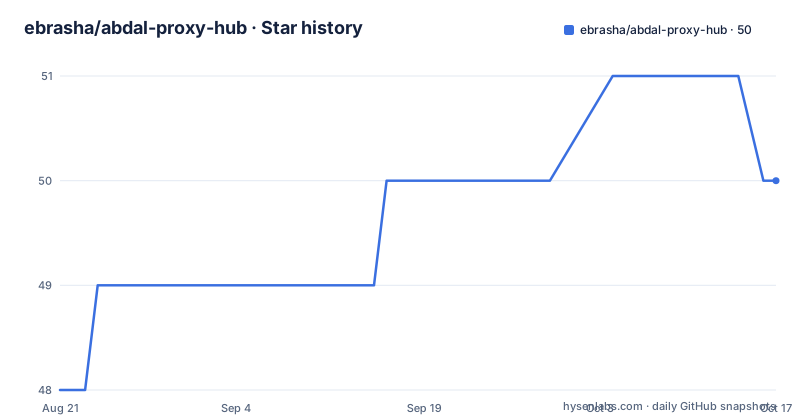
Star history
- ebrasha/abdal-proxy-hub50 ★ · +2
| Repository | 2026-08-21 | 2026-10-17 |
|---|---|---|
| ebrasha/abdal-proxy-hub | 48 | 50 |
2 Stars in the last 57 days, measured from the daily GitHub snapshot. Compare with other projects
Editorial analysis
What This Repository Actually Delivers
Abdal Proxy Hub is a collection of four plain-text files, one per protocol: socks4-proxy-list-by-EbraSha.txt, socks5-proxy-list-by-EbraSha.txt, http-proxy-list-by-EbraSha.txt, and https-proxy-list-by-EbraSha.txt. Each file contains lines of ip:port pairs, with no usernames, passwords, or metadata. The README states the lists are updated every 10 minutes and that invalid or dead proxies are excluded. That is the entire scope. There is no API, no configuration file, no authentication mechanism. The target user is someone who needs a raw list to paste into a tool that accepts proxy input, such as a scraper or a network testing utility. The Telegram bot at https://t.me/AbdalProxyBot is the only other delivery channel, offering the same proxy types directly in chat.
How the Update Mechanism Works, Based on the Evidence
The repository does not include source code, so the exact update pipeline is not visible in the material. What is visible is the claim of a 10-minute refresh cycle and automatic removal of dead proxies. The presence of releases 1.6 and 1.5, with the latest push on 2025-07-20, indicates the maintainer tags versions when the lists change. The mechanism likely runs on a scheduled job, but the README does not describe it. That absence matters. A user cannot verify how proxies are tested, how often the test actually runs, or whether the list is generated by scraping other public lists or by active probing. The only verifiable facts are the file names, the format, and the stated schedule. For a tool that promises freshness, the lack of transparency about the testing method is a real gap.
Getting the Proxies Into Your Tooling
To use the lists, you download the raw text file and feed it to your proxy-aware application. For example, a curl command can fetch the HTTP list: curl -O https://raw.githubusercontent.com/ebrasha/abdal-proxy-hub/main/http-proxy-list-by-EbraSha.txt. Then you read the file line by line, parse each ip:port, and configure your client. The README gives no example commands, so the integration is left entirely to the user. That is both a strength and a weakness. The simplicity means any script can consume the data, but the lack of a JSON or structured format forces you to write your own parser. If you use a tool that expects a specific proxy list format, such as a proxy rotation script, you will need to adapt the plain text to that tool's requirements.
The Telegram Bot as a Distribution Channel
The README points to a Telegram bot as an alternative way to receive the same proxies. The bot, named AbdalProxyBot, is described as providing free and regularly updated proxies for all four protocols. The repository's homepage is the bot's Telegram link, which suggests the bot is the primary interface for many users. This is a notable design choice: instead of a web UI or an API, the maintainer chose a chat interface. For users in regions where Telegram is accessible, this is convenient. For automation, however, it is less practical, because pulling proxies from a chat requires manual interaction or a Telegram client library. The bot's exact commands and response format are not documented in the README, so you would need to open the chat to learn them. That is a documentation gap that could slow down adoption for scripted workflows.
A Genuine Limitation: No Authentication and No Guarantees
The most obvious limitation is that these are free public proxies. They are anonymous, shared, and likely slow. The README does not mention any authentication, so you cannot expect a stable session or a dedicated IP. Free proxies are frequently blocked by target sites, and their reliability varies by the hour. The 10-minute refresh helps, but it does not solve the fundamental issue that public proxies are a shared resource. Another limitation is the lack of a license. The repository metadata shows License: (unknown), so there is no explicit permission for redistribution or commercial use. That is a legal ambiguity you must consider before incorporating these lists into a product. The README also does not state the geographic distribution of the proxies, so you cannot select a specific country. For geo-targeted scraping, this list is the wrong tool.
Comparing With a Managed Proxy Service
A direct alternative is a commercial proxy service that provides authenticated, dedicated or residential proxies through an API. Unlike Abdal Proxy Hub, such services offer credentials, a control panel, and uptime SLAs. They also charge per gigabyte or per IP. The difference in approach is fundamental: this repository is a firehose of anonymous addresses, while a managed service is a curated pool with guarantees. If you need a single stable IP for a long-running session, the free list will not work because the proxy may disappear mid-connection. A managed service would hold the connection. If your task is a one-off request that tolerates retries, the free list is cheaper. The trade-off is reliability versus cost, and Abdal Proxy Hub sits clearly on the cost side.
Maintenance and Upgrade Cost
The maintenance burden for a user is low: you download a file and parse it. The burden for the maintainer is higher, since the 10-minute cycle implies constant probing and list regeneration. The release history shows two versions in a month, which suggests active upkeep. However, the project has no license, so there is no formal framework for contributions or forks. If the maintainer stops pushing updates, the lists will go stale quickly, and the README gives no fallback plan. For a user, the upgrade cost is trivial: you just re-fetch the file. But you must build your own monitoring to detect when the repository stops updating. There is no changelog or migration guide, because there is no software to migrate. The only upgrade path is to watch the last push date, which is visible on the repository page.
Editorial conclusion
Adopt Abdal Proxy Hub if you need a quick, disposable set of public proxies for low-stakes tasks like scraping a few pages or testing a client's proxy parsing. Skip it if you require authenticated proxies, uptime guarantees, or any legal warranty, since the repository has no license and the lists are anonymous by design. Before relying on it, verify the freshness of the files at the moment of use, test each proxy against your target endpoint, and check the repository's recent push history for signs of stalled updates. For production traffic, look elsewhere.
Frequently asked questions
Which proxy protocols does the Abdal Proxy Hub publish?
Four, one file each: socks4-proxy-list-by-EbraSha.txt, socks5-proxy-list-by-EbraSha.txt, http-proxy-list-by-EbraSha.txt and https-proxy-list-by-EbraSha.txt. Each file holds plain ip:port entries with no extra metadata, and the README states there are no usernames or passwords.
How often are the Abdal Proxy Hub lists refreshed?
The README says the lists update every 10 minutes automatically and that invalid or dead proxies are excluded. It does not describe how entries are probed or how many a list holds, and the last release tag is 1.6 from July 2025 while the last commit is dated 29 September 2026.
What licence applies to the Abdal Proxy Hub proxy lists?
None is stated. The repository has no licence file, and the README says the lists can be used freely in tools that support proxy input without naming any terms. A donation link and a contact email are given instead.
Official sources
Add this badge to your README
If you maintain this project, the badge below links readers to this analysis and shows its maintenance status from the daily GitHub snapshot. Paste the markdown into your README; add ?metric=license or ?metric=stars to the image URL for a different field.

[](https://hysenlabs.com/projects/ebrasha-abdal-proxy-hub)Star history chart for your README
[](https://hysenlabs.com/projects/ebrasha-abdal-proxy-hub)