Open-Workflow-Library: 1,700 workflow files and an audit tool that reports zero secrets
Open workflow intelligence for discovering, validating, repairing, and generating automation workflows across frameworks — starting with n8n.
At a glance
- What is it?
- A standard-library Python project that catalogues a large collection of n8n workflow files, redacts anything secret-shaped before writing it to disk, and publishes a status table admitting that behavioural execution, multi-framework export and autonomous improvement are all absent. The value is in that table.
- Who is it for?
- Treat this as a dataset with a scanner attached rather than as a workflow engine, because that is what it says it is. The collection is large and the audit tooling is honest about its limits, including the detail that its quality score is not a correctness score and that duplicate analysis surfaces candidates without removing anything.
- Can I use it commercially?
- Yes. MIT is a permissive licence: you can use, modify and sell software built on it, as long as you keep its copyright and licence notices.
- Is it still maintained?
- Yes. The repository last received commits 175 days ago.
- What is it written in?
- Mainly Python, according to GitHub's language statistics.
Answers come from the project's GitHub data, last synced on November 15, 2026, and from our analysis. They are not legal advice.
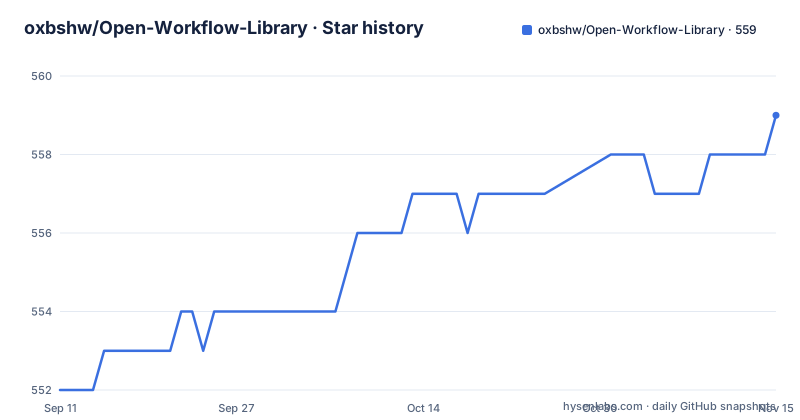
Star history
- oxbshw/Open-Workflow-Library559 ★ · +7
| Repository | 2026-09-11 | 2026-11-15 |
|---|---|---|
| oxbshw/Open-Workflow-Library | 552 | 559 |
7 Stars in the last 65 days, measured from the daily GitHub snapshot. Compare with other projects
Editorial analysis
The status table marks five capabilities as not implemented
The most useful page in this repository is a table titled honest status, and it separates what exists from what does not. Behavioural execution of an n8n workflow is marked not implemented, with the note that no workflow has been imported into n8n by this project at all. Multi-framework export is marked not implemented, meaning Dify, LangGraph, Make and Zapier are documented rather than built. LLM-backed prompt-to-workflow is marked not implemented, because only a deterministic minimum viable version exists. Autonomous self-improvement is marked not in scope, with promotion into the curated wiki requiring human review. And production certification is marked none, described as a developer-grade open-source library. Three more rows are qualified rather than absent: schema validation falls back to a lightweight required-field check when the validation library is unavailable, static n8n validation is structural and not behavioural, and the quality score on catalog entries is explicitly not a correctness score. For an early-stage project that is a better map than a feature list.
Nothing is installed, nothing is published, and no n8n is needed
The quickstart makes a claim about how the tooling is delivered that is worth repeating, because it is unusual for a project of this shape: every tool is standard-library Python 3.12 or newer, nothing is installed globally, nothing is published, and nothing requires n8n on the local machine. Five commands make up the whole surface, and each one is a file you run directly:
python tools/audit_workflows.py
python tools/build_unified_catalog.py
python tools/search_workflows.py --query "lead qualification" --top 5
The first catalogues the collection with a secret scan that redacts findings, the second builds the unified catalog with deterministic quality scores, the third does keyword and filter search over it. There is also a validator for the generated expansion pack of 420 templates, which is structural only. A fifth tool goes from a prompt to an intermediate representation to an n8n workflow and then validates it statically, with no runtime and no language model involved, although the example line for it is cut off mid-sentence in the page.
The scanner redacts before anything reaches the disk
The audit tool's security properties are stated as guarantees rather than intentions. It is read-only: it never modifies, moves or deletes a workflow file, and it never prints real secret values, because anything matching a secret-like pattern is replaced with a redaction marker before a single byte is written. The tool detects code and webhook usage as it goes, and its current run reports zero findings. That last part needs the care this page applies to everything else. A zero-finding report describes the collection as it stands today, not a property of the scanner, and a collection that grows by import will change under you. The mitigation is cheap, since the tool is a file you can run after any addition, and the project separates its security model into its own document. A library that ships other people's automation definitions is exactly the place where this matters, because those definitions can carry credential references that were never meant to be public.
Four schemas hold the shared data model together
The layer above the collection is four JSON schemas, and they describe what the project believes a workflow is. There is a schema for the universal workflow intermediate representation, which is the framework-agnostic form the rest of the system converts into. There is one for catalog metadata, which is what every index entry must satisfy, and it is where the detected integrations, trigger type, credential references, code and webhook presence and a coarse risk level live. A third defines a repair proposal, with the important property that proposals are human-reviewable and are emitted rather than applied. The fourth defines a learning event, which is the evidence the self-improvement loop would consume, and the same rule applies: evidence only, never auto-promoted into the curated wiki. The shape of these files is the actual design work here, and they are the part worth reading if you want to build something similar.
The catalog scores quality, not correctness
The catalog is generated from the audit rather than written by hand, and each entry conforms to the metadata schema. What it indexes today is detected n8n workflows, with cross-framework coverage arriving alongside per-framework importers. The scoring is where the caveat lives: it is described as a deterministic quality score and explicitly not a correctness score. That distinction is doing real work. A deterministic score can be computed from structure, naming and duplication signals, and it will rank a tidy workflow above a messy one without knowing whether either runs. Duplicate analysis follows the same pattern, matching exactly and by title similarity and surfacing candidates with no automatic deduplication. So the catalog is a map of what exists, and the two things it will not do for you are decide which workflow is right and quietly merge two of them.
Repair proposals are emitted, never applied
Three rows in the status table describe the same design choice from different angles. Repair proposals are implemented and emit proposals only, never auto-applying them. Learning events are implemented and carry evidence only, never auto-promoted. The human review queue is implemented and nothing is auto-approved. Then the final row makes the principle explicit by listing autonomous self-improvement as out of scope, because promotion into curated material requires a human. That is an unusual amount of repetition for a project this young, and it reads as a deliberate answer to the obvious criticism of an automated workflow repair tool, namely that a wrong repair silently corrupts a production automation. The cost is that the repair queue is only as fast as whoever reads it. If you adopt this, budget for that person rather than assuming the loop closes itself.
The prompt-to-workflow path is deterministic, and whitelisted
The generator exists in a deliberately limited form. Prompt to intermediate representation is marked as a deterministic minimum viable version driven by keyword rules and not backed by a language model. The export from that representation into an n8n workflow is also an MVP, using a conservative node whitelist and safe placeholders only. Static validation of the result is implemented and structural, meaning it checks that the graph has the shape n8n expects without running it. Taken together, the chain is reproducible and cheap, which is the right property for something that generates configuration you will later deploy, and also means it will not handle the requests that need actual comprehension. The longer plan is described as retrieval-grounded generation using the catalog and the wiki as its knowledge base, which is where the language model is meant to arrive.
The repository carries three directories nobody claims
The top level of the tree holds the expected directories, workflows, automation, catalog, schemas, tools, wiki, docs, reports and scripts, alongside the usual governance files. Three of them sit there without appearing anywhere in the status table or the project description. A keyword rank tracker, a search result analysis directory and a directory named after a search-engine-optimisation writer. That is three marketing tools living inside a repository whose own documentation insists it is a developer-grade library with no production certification. They are harmless as directories, and the separation matters more than the presence: a workflow audit tool and a ranking dashboard reading the same repository is exactly the arrangement that produces an access-control question later. Worth asking about before you contribute to the same tree.
Editorial conclusion
Treat this as a dataset with a scanner attached rather than as a workflow engine, because that is what it says it is. The collection is large and the audit tooling is honest about its limits, including the detail that its quality score is not a correctness score and that duplicate analysis surfaces candidates without removing anything. Two things to check before you use the files. The audit run reports zero secret findings, which is a claim about the current collection rather than a guarantee about the next batch of imported workflows, so re-run it. And nothing here has been executed inside n8n by the project, so treat any workflow as unverified code until you have run it yourself.
Frequently asked questions
What does the Open Workflow Library contain?
A collection of roughly 1,700 n8n workflow files plus about 420 generated templates, four JSON schemas defining the shared data model, a read-only audit tool that catalogues them and redacts secret-like values, a generated catalog, and a wiki directory holding seed content for patterns, repair rules and failure cases.
Do I need n8n installed to use the Open Workflow Library tools?
No. Every tool is standard-library Python 3.12 or newer, nothing is installed globally, nothing is published to a package index, and no tool requires n8n on the local machine. You run the scripts directly, for example `python tools/audit_workflows.py`.
Does the Open Workflow Library execute or repair workflows automatically?
Neither. Behavioural execution of an n8n workflow is marked not implemented, with no workflow imported into n8n by the project. Repair proposals are emitted for human review and never auto-applied, learning events are evidence only, and nothing in the review queue is auto-approved.
How does the Open Workflow Library handle secrets inside workflow files?
The audit tool is read-only and never modifies, moves or deletes a file, and it replaces anything matching a secret-like pattern with a redaction marker before writing reports to disk, so no real secret value is printed. The current run reports zero findings, and the security model is documented separately.
Which frameworks can the Open Workflow Library export to?
Only n8n today. Multi-framework export is marked not implemented, meaning Dify, LangGraph, Make and Zapier are documented rather than built, and the universal intermediate representation is designed to stay framework-agnostic so importers and exporters can be added.
Is the quality score on the Open Workflow Library catalog a correctness measure?
No. It is described as a deterministic quality score and explicitly not a correctness score, so it ranks workflows on structural signals rather than on whether they run. Static validation of generated workflows is likewise structural only and not a behavioural test.
Official sources
Add this badge to your README
If you maintain this project, the badge below links readers to this analysis and shows its maintenance status from the daily GitHub snapshot. Paste the markdown into your README; add ?metric=license or ?metric=stars to the image URL for a different field.

[](https://hysenlabs.com/projects/oxbshw-open-workflow-library)Star history chart for your README
[](https://hysenlabs.com/projects/oxbshw-open-workflow-library)Was this useful?