DolarAPI.com: A Spanish-Language API for Exchange Rates Across Latin America
API desarrollada en EsJS para las diferentes cotizaciones de Dólar en Argentina, Chile, Venezuela, Uruguay, México, Bolivia, Brasil y Colombia
At a glance
- What is it?
- DolarAPI.com is an open source API written in EsJS that scrapes DolarHoy to serve dollar and currency quotes for eight Latin American countries. It is a practical, MIT-licensed tool for developers building currency converters, but its reliance on a single source and its language-specific codebase set clear boundaries.
- Who is it for?
- Adopt DolarAPI.com if you need quick, free, and MIT-licensed exchange rate data for Argentina, Chile, Venezuela, Uruguay, Mexico, Bolivia, Brazil, or Colombia, and if you are comfortable with a Spanish-language codebase and a single-source data pipeline. Do not adopt it if you require guaranteed uptime, historical data, or if you cannot tolerate the risk of DolarHoy changing its HTML structure or blocking requests.
- Can I use it commercially?
- Yes. MIT is a permissive licence: you can use, modify and sell software built on it, as long as you keep its copyright and licence notices.
- Is it still maintained?
- Yes. The repository last received commits 1 day ago.
- What is it written in?
- Mainly JavaScript, according to GitHub's language statistics.
Answers come from the project's GitHub data, last synced on October 21, 2026, and from our analysis. They are not legal advice.
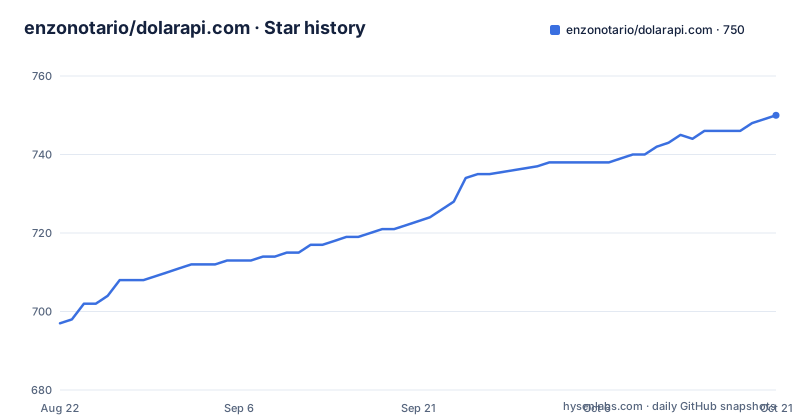
Star history
- enzonotario/dolarapi.com750 ★ · +53
| Repository | 2026-08-22 | 2026-10-21 |
|---|---|---|
| enzonotario/dolarapi.com | 697 | 750 |
53 Stars in the last 60 days, measured from the daily GitHub snapshot. Compare with other projects
Editorial analysis
What DolarAPI.com Actually Solves
DolarAPI.com is a public API that returns exchange rate quotes for the US dollar and other currencies across eight Latin American countries: Argentina, Chile, Venezuela, Uruguay, Mexico, Bolivia, Brazil, and Colombia. The problem it addresses is the fragmentation of exchange rate data in these markets, where official rates, parallel rates, and blue rates can vary significantly and are often published on scattered websites. The project targets developers who need a single HTTP endpoint to fetch these quotes for web apps, browser extensions, mobile apps, or desktop utilities. The README lists a long set of consumer applications, including a Chrome extension, a Discord bot, a macOS menu bar app, and several web converters. That list is evidence of practical adoption, not a measure of quality, but it shows the API fills a real niche for Spanish-speaking developers building currency tools.
How It Works: Scraping DolarHoy as the Data Source
The core mechanism is simple and direct. The README states: 'Consulta la página DolarHoy y determina los valores de las diferentes cotizaciones.' In other words, the API scrapes the DolarHoy website to obtain the current values. There is no mention of an official data feed, a financial institution API, or a database of historical rates. The entire data pipeline is a fetch-and-parse operation against a third-party site. This means the accuracy and freshness of the data depend entirely on DolarHoy's availability and HTML structure. If DolarHoy changes its markup, the API could break until the maintainer updates the scraper. The architecture is a classic web scraper wrapped in a REST API, which is a trade-off between simplicity and resilience. There is no caching layer mentioned, no rate limiting documentation, and no fallback source, so each request likely triggers a live scrape or a cached response that the documentation does not specify.
Getting It Running: Installation and Configuration
The README does not provide explicit installation commands, a Dockerfile, or a list of environment variables. It only points to the official documentation at dolarapi.com for API usage details. From the repository layout, the project is written in EsJS, a Spanish-flavored JavaScript language that compiles to standard JavaScript. To run it locally, you would likely need to install EsJS tooling, but the README does not give those steps. The only concrete command-like action mentioned is for contributing to the README: editing the list of applications and making a pull request. For the API itself, the documentation at dolarapi.com is the authoritative source for endpoint paths, query parameters, and response schemas. As a reviewer, I cannot confirm the exact endpoints, but the homepage suggests there is a documented API with JSON responses. If you plan to self-host, you will need to clone the repository, install dependencies, and run the EsJS build process, but you must consult the external docs or the source code for specifics.
The EsJS Factor: A Language Barrier and a Niche Choice
The project is written in EsJS, a programming language that uses Spanish keywords and syntax, as indicated by the link to es.js.org in the README. This is a deliberate design choice that lowers the barrier for Spanish-speaking developers but creates a significant adoption hurdle for others. If you are an English-only developer, reading the source code, contributing fixes, or debugging the scraper will require learning a new language or at least translating keywords. EsJS is not a mainstream language, so the pool of contributors is small, and the tooling ecosystem is thinner than for standard JavaScript or TypeScript. This is a genuine trade-off: the project sacrifices broader accessibility for a localized developer experience. For a small utility API, that might be acceptable, but for a project that needs long-term maintenance, the language choice could become a liability if the maintainer moves on and no EsJS-literate contributors step up.
Where It Falls Short: Single Source, No Historical Data, and Maintenance Risk
The most obvious limitation is the dependence on DolarHoy as the sole data source. Scraping a third-party site is fragile. If DolarHoy introduces a CAPTCHA, changes its HTML, or blocks the API's IP range, the entire service goes down. There is no mention of a backup source, a fallback mechanism, or a data validation layer. Another limitation is the lack of historical data. The README and the described mechanism only cover current quotes. For applications that need to track rate trends or calculate averages over time, this API is the wrong tool. The README mentions a 'Promedio Dolar' app that queries 'el precio para una fecha especifica,' but that app likely stores its own history, not the API's. Finally, maintenance is a concern. The repository has no recent releases retrieved, and the last push is unknown. The README is well maintained with a long list of consumer apps, but the absence of release tags suggests the project may be in a stable but low-activity state. You should check the commit history before relying on it in production.
Alternative Approaches: Official Central Bank APIs and General Currency Services
A direct alternative is to use the official central bank APIs of the respective countries. For example, the Central Bank of Venezuela (BCV) publishes a daily exchange rate, and some countries offer official APIs or data downloads. The difference in approach is that official sources provide authoritative, legal-tender rates but often lack the parallel or blue market rates that DolarAPI covers. For Argentina, the blue dollar rate is a key economic indicator that official sources do not provide. Another alternative is a general currency conversion service like ExchangeRate-API or Open Exchange Rates, which offer broader currency coverage and historical data but typically require an API key and a subscription for high volume. Those services focus on official or interbank rates, not the informal market rates that DolarAPI scrapes. So the choice depends on whether you need the informal rates that DolarAPI uniquely offers, or whether official rates suffice and you prefer a more stable, commercially supported API.
Licensing and Operational Cost
The project is licensed under MIT, which is permissive and allows commercial use, modification, and redistribution with minimal restrictions. This is a positive for adoption because you can integrate the API into a proprietary product without legal friction, as long as you include the copyright notice. The operational cost of running DolarAPI is not documented, but it is likely low if you self-host, since it is a simple scraper. However, the cost of maintaining it is non-trivial. You must monitor DolarHoy for changes, update the scraper when it breaks, and handle potential rate limiting or IP blocks. The README does not mention any SLA, uptime guarantees, or support channels, so you are on your own if the hosted version at dolarapi.com goes down. For a hobby project or a small internal tool, this is acceptable. For a production service that needs reliability, you would need to fork the code, add your own caching and fallback sources, and possibly contribute fixes back upstream.
Editorial conclusion
Adopt DolarAPI.com if you need quick, free, and MIT-licensed exchange rate data for Argentina, Chile, Venezuela, Uruguay, Mexico, Bolivia, Brazil, or Colombia, and if you are comfortable with a Spanish-language codebase and a single-source data pipeline. Do not adopt it if you require guaranteed uptime, historical data, or if you cannot tolerate the risk of DolarHoy changing its HTML structure or blocking requests. Before integrating, verify the current availability of the endpoints listed at dolarapi.com, test the response format for your target currencies, and check the repository's recent commit history to confirm maintenance activity, since no releases were retrieved.
Frequently asked questions
Where does DolarAPI get its dollar quotes?
It consults the DolarHoy page at dolarhoy.com and determines the values of the different quotes from it. That single page is the upstream source for every rate the API returns, including the Venezuelan BCV reference its consumers rely on.
Which countries does DolarAPI cover?
The repository description lists Argentina, Chile, Venezuela, Uruguay, Mexico, Bolivia, Brazil and Colombia, while the paragraph under the title names the same set without Colombia.
Why does package.json still call the project esjs-dolar-api?
The package name, the repository field and the README link used to add an application all still use esjs-dolar-api, while the repository and the live service are dolarapi.com. The package is private and the repository publishes no GitHub releases.
How is DolarAPI built and deployed?
The build script runs the VitePress documentation build, then node scripts/datos.js to copy data, then a server-side Vite build using vite.api.config.js. vercel.json sits at the repository root, and the og directory holds the social image template rendered by x-satori.
What tooling does DolarAPI need?
Node with pnpm 10.34.5, Vite, VitePress for the docs, Tailwind, x-satori for Open Graph images, better-sqlite3 and dotenv as runtime dependencies, and vitest for the cron tests. Every dependency is declared through a pnpm catalog rather than a pinned version.
Official sources
Add this badge to your README
If you maintain this project, the badge below links readers to this analysis and shows its maintenance status from the daily GitHub snapshot. Paste the markdown into your README; add ?metric=license or ?metric=stars to the image URL for a different field.

[](https://hysenlabs.com/projects/enzonotario-dolarapi-com)Star history chart for your README
[](https://hysenlabs.com/projects/enzonotario-dolarapi-com)