objectdetection_script: 7300 stars on a catalogue, not on code
Scripts and improvement ideas for object detection; see readme.md for details.
At a glance
- What is it?
- A repository that reads as an object detection code collection but is really a storefront. The public tree is documentation, announcements and course material; the code itself lives behind paid listings delivered through chat groups and cloud links. Understanding that split is the whole analysis.
- Who is it for?
- Judge this repository on what it is rather than what its star count suggests. There is no LICENSE file and no license metadata, so nothing in it carries an explicit grant of reuse rights, which means the documentation here is readable but not obviously safe to copy into your own work.
- Can I use it commercially?
- Not without permission. GitHub finds no licence file in the repository, and without a licence all rights are reserved by default: you may read the code but not reuse it. Check the README, or ask the authors, before using it.
- Is it still maintained?
- Yes. The repository received new commits within the last day.
- What is it written in?
- Mainly Python, according to GitHub's language statistics.
Answers come from the project's GitHub data, last synced on October 23, 2026, and from our analysis. They are not legal advice.
Star history
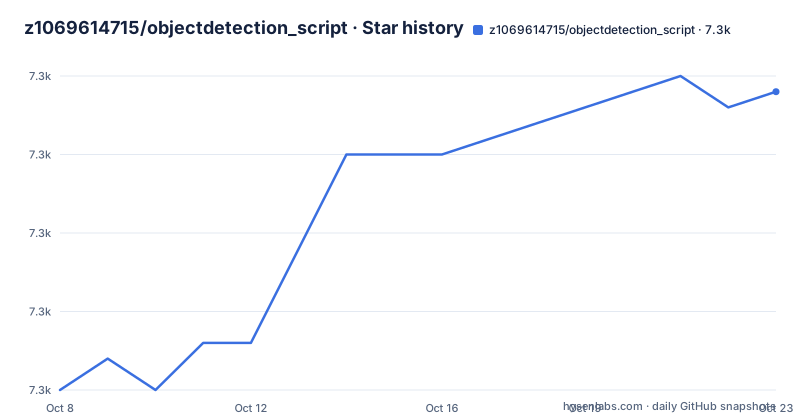
- z1069614715/objectdetection_script7,339 ★ · +19
| Repository | 2026-10-08 | 2026-10-23 |
|---|---|---|
| z1069614715/objectdetection_script | 7.3k | 7.3k |
19 Stars in the last 15 days, measured from the daily GitHub snapshot. Compare with other projects
Editorial analysis
The repository description and the repository disagree
The GitHub description says, in translation, that this project mainly provides code and improvement ideas related to object detection, with details in the readme. The language field says Python. Both are technically true and both are misleading about what a visitor will find.
The public tree contains no Python at all. It is nineteen entries, and every one of them is either a markdown document or a directory whose name describes a topic: `Ultralytics-YOLO-project.md`, `bilibili-guide.md`, `cvpr2025-deim-project.md`, `mutilmodel-project.md`, `yolovo-mutilmodel-project.md`, `readme.md`, a single image called `Customization.png`, and directories named `cv-attention/`, `damo-yolo/`, `data-offline-aug/`, `mmdet-course/`, `module-info/`, `mustread-paper/`, `objectdetection-tricks/`, `visdrone2019-benchmark/`, `yolo-gradcam/`, `yolo-improve/` and `yolo/`.
So the honest description of this repository is a documentation and announcement site. The readme is a price list. Eleven numbered projects are offered, each with a price in yuan, each linking to a detail page inside `yolo-improve/`, and each delivered after purchase through a QQ-style messaging group where the announcement section carries the download links.
Two structural facts follow from that, and they are the ones that matter for anyone deciding what to do with this repository. First, there is no LICENSE file and the license field is null, so nothing here carries an explicit reuse grant. Second, the metrics that attract people, 7313 stars and 573 forks, are accumulated by the catalogue page, not by code that anyone can read.
Eleven listings, what they cover, and how they are priced
The catalogue is organised around detector families rather than around techniques. It is worth reading as a coverage map of what a Chinese object detection research community considered worth paying for in 2026.
The YOLO line is the densest. There are separate listings for YOLOv8 and YOLOv10 improvements at 69.9 yuan, YOLO11 and YOLO12 improvements at 69.9 yuan, a combined Ultralytics YOLO project at 99 yuan, and a pricing tier for YOLOVO with image-text multimodal detection at 368 yuan, discounted to 338 yuan for existing customers. A fifth listing offers a pruning and distillation project for the same family at 89.9 yuan, with the distillation variant at the same price, covering detection, instance segmentation, pose estimation and rotated object detection, and explicitly not supporting the BCKD distillation method for the last three.
Alongside that sits YOLOv5 and YOLOv7 pruning plus knowledge distillation at 129.9 yuan, framed as model lightweighting for deployment.
The transformer line has its own tiers. RT-DETR improvements based on the Ultralytics implementation are 89.9 yuan and cover several backbones, RT-DETR-R18 through RT-DETR-L, plus hybrid variants. RT-DETR pruning is 89.9 yuan and RT-DETR distillation is 69.9 yuan, and the readme is candid that distillation here has few users and is priced accordingly. The largest single listing, at 348 yuan, is built on DEIM from CVPR 2025 and D-FINE from ICLR 2025, offering unimodal, image-image, image-text and combined three-modality training.
There is also a multimodal image-image project for YOLO and RT-DETR at 328 yuan, discounted to 278 yuan for buyers of the other projects, and an end-to-end paper writing guidance package at 238 yuan, discounted to 188 yuan. Those discounts are worth noting as a signal: the pricing model assumes repeat purchase, and the catalogue is designed around a customer who buys in layers rather than one who evaluates once.
What the free directories actually contain
Strip away the paid listings and there is a genuinely useful free resource here, and it is the part most visitors never look at.
`mustread-paper/` is a reading list. `module-info/` documents the attention and module variations that the paid listings assemble, which is the closest thing here to a reference manual for the design space. `mmdet-course/` is course material for MMDetection. `objectdetection-tricks/` collects techniques rather than architectures.
Three directories are worth singling out because each corresponds to a specific, unglamorous need. `data-offline-aug/` is about offline data augmentation, the kind of thing that matters when you cannot afford more annotation but need more variety. `yolo-gradcam/` is Grad-CAM visualisation for YOLO, which is the tool you reach for when a detection fires somewhere unexpected and you need to know which part of the backbone was responsible. `cv-attention/` covers attention mechanisms in computer vision, and `damo-yolo/` points at the DAMO-YOLO line of detection work.
`visdrone2019-benchmark/` is the most quietly valuable entry. VisDrone is a drone imagery dataset, and having benchmark configuration committed alongside research code is what makes results reproducible. A directory named after a specific benchmark version is a small signal about how the author thinks about verification.
None of this is code you can audit in the way you would audit a library. It is notes, configurations and course material, kept by one person, with no versioning discipline visible in the tree. But for someone starting in this area it is a map of what to read, which is more than most repository readmes offer.
The engineering problems the listings disclose about themselves
Read the caveats rather than the feature lists. Several listings include explicit warnings about what does not work, and they are more informative than the marketing around them.
The pruning and distillation project for YOLOv8 through YOLO12 states that it was developed against specific Ultralytics versions, naming 8.1.9, 8.2.50, 8.3.1 and 8.3.78, that neighbouring versions will probably work, and that this cannot be verified one by one so the buyer has to consider it themselves. It also says the examples are built on the modified code from the other paid listings, so the pruning examples are not included for buyers of the pruning project alone. That is a dependency between paid tiers, disclosed clearly, but it means the entry price is not the real entry price.
The RT-DETR pruning listing is more interesting because it admits a research result rather than a technical limit. It states that RT-DETR is difficult to make work with sparse training, so the project does not include sparse-training pruning methods, and advises caution if that is specifically what you need. What it does include is six pruning approaches that do not require sparse training. A seller who tells you which technique their product cannot do is more credible than one who claims everything.
The same listing also notes that knowledge distillation as a whole is difficult to modify and used by few people. That is a market observation rather than a technical one, and it explains the pricing.
One more honesty note appears across listings: because of the price point, one-to-one private support is not included, and questions are handled in the group chat when the seller has time. For a research workflow where you may be blocked for days on one config error, that is the most consequential line in the entire readme.
Delivery through chat groups, and what that means for reproducibility
Code delivery is described the same way everywhere in the catalogue: after purchase you join a group, the code and videos are in the group announcements, and updated download links are posted there as new improvements are released. One listing notes that two groups are full and a third is now accepting members, and describes the group atmosphere as active.
This is a common arrangement in this market and it works well enough for the people it is aimed at. It is also worth being precise about the trade-offs, because they are not hypothetical.
There is no repository history. If a file is broken, there is no commit to revert to and no diff to see what changed between the version you downloaded in March and the version in the announcement in September. There is no issue tracker, so bugs are reported in a chat stream and answered if and when the seller is present. There is no checksum on the archive, so verifying that what you received is what was sent requires trusting the transport. And the download is a link into a third-party cloud drive rather than a package you can pin.
For research work, the compounding effect is the problem. A result you cannot reproduce six months later because you cannot reconstruct the exact code state is a result that does not survive review or a thesis defence. Any serious evaluation of these listings should ask whether the delivered material is organised as a versioned repository, or whether it is a folder of files with names like `yolov8s_improve.yaml` that nobody has a record of.
Signals to read before you spend anything
A few things about this repository are worth weighing on their own, independent of whether you buy.
The star count is high for a repository with no code. 7313 stars suggests a large Chinese-speaking student and researcher audience reached through Bilibili, and the readme's first substantive link is a Bilibili video guide at `bilibili-guide.md`. That is the actual distribution channel, and it explains the numbers. It also means the popularity signal carries no information about code quality, because there is no code to assess.
The maintenance window is real. The last push to the default branch `master` was 2026-09-16, and 21 open issues on a catalogue repository is a modest number, which suggests the readme is updated more often than the issues are answered.
The listings themselves are more current than a typical research repository. They reference YOLO26, DEIM from CVPR 2025, D-FINE from ICLR 2025, DINOv3 backbones, Sequenced-era tooling, and a specific 2026 paper on accelerating YOLO training by not seeing every training image every epoch. Someone tracking that frontier is doing real reading. Whether that reading translates into correct implementations is a separate question that only the delivered code can answer.
If you are a student, the most efficient use of this repository is the free reading list and the module documentation. If you are a practitioner with an existing pipeline, you probably already have better access to the upstream Ultralytics and RT-DETR code than a chat-group delivery will give you. If you are evaluating this for a lab or a company, the absence of a license, the absence of version history and the support model are all reasons to require the material in a form you can version and cite.
Editorial conclusion
Judge this repository on what it is rather than what its star count suggests. There is no LICENSE file and no license metadata, so nothing in it carries an explicit grant of reuse rights, which means the documentation here is readable but not obviously safe to copy into your own work. The code the listings describe is not in the tree at all; it is delivered privately after payment, and the delivery mechanism itself is the risk, since a chat group and a third-party cloud link give you no version history, no way to verify what you received, and nothing to return to if the seller stops responding. If your interest is the underlying subject rather than this particular seller, the directories that are genuinely free are the more useful starting point: `mustread-paper/`, `module-info/`, `mmdet-course/`, `objectdetection-tricks/`, `cv-attention/`, `damo-yolo/`, `data-offline-aug/`, `yolo-gradcam/` and `visdrone2019-benchmark/`. If you are evaluating the paid listings, the questions worth asking before paying are whether a specific module is original or a reimplementation of a published paper, whether the reported metrics include a baseline trained under the same conditions, and whether the Ultralytics version pins still apply. A 7.3k-star repository maintained by one person through a messaging app is a distribution decision, not an engineering one.
Frequently asked questions
What is in the objectdetection_script repository?
Documentation and announcements rather than source code. The public tree is nineteen entries: markdown project pages including `Ultralytics-YOLO-project.md`, `cvpr2025-deim-project.md` and `bilibili-guide.md`, one image, and directories such as `yolo-improve/`, `module-info/`, `mustread-paper/`, `mmdet-course/`, `objectdetection-tricks/`, `cv-attention/`, `damo-yolo/`, `data-offline-aug/`, `yolo-gradcam/` and `visdrone2019-benchmark/`. The code described in the readme is delivered privately after purchase.
Does this repository have a license?
No. There is no LICENSE file in the tree and the repository license field is null, so nothing here carries an explicit grant of reuse rights. If you plan to reuse any of the documentation, configurations or course material, ask the author directly and get the answer in writing before you copy it into your own work.
How do you get the code for the paid projects?
By contacting the author through the messaging details in the readme and paying the listed price, after which you join a group chat where code, videos and updated download links are posted in the group announcements. There is no repository access and no package you can pin, so what you receive is a set of files without version history.
What should I check before paying for one of these projects?
Ask whether the modules are original or reimplementations of published papers, whether reported metrics include a baseline trained under identical conditions, and whether the pinned Ultralytics versions still apply to your setup. The readme itself names the versions some projects were built against, notes that neighbouring versions are untested, and warns that some pruning and distillation examples depend on code from other paid listings.
What free material is actually useful here?
The directories that are not tied to a purchase: `mustread-paper/` for a reading list, `module-info/` for documentation of attention and module variations, `mmdet-course/` for MMDetection course material, `objectdetection-tricks/`, `cv-attention/`, `damo-yolo/`, `data-offline-aug/` for offline augmentation, `yolo-gradcam/` for Grad-CAM visualisation of YOLO detections, and `visdrone2019-benchmark/` for drone imagery benchmark configuration.
Official sources
Add this badge to your README
If you maintain this project, the badge below links readers to this analysis and shows its maintenance status from the daily GitHub snapshot. Paste the markdown into your README; add ?metric=license or ?metric=stars to the image URL for a different field.

[](https://hysenlabs.com/projects/z1069614715-objectdetection-script)Star history chart for your README
[](https://hysenlabs.com/projects/z1069614715-objectdetection-script)Was this useful?