Open QuarterMaster: A Modular Inventory System That Puts Hooks Before Polish
Open Quartermaster is an open source inventory management system, designed to be simple to use yet powerful and extendable. The last inventory management system you will ever need!
At a glance
- What is it?
- Open QuarterMaster is a Java-based, GPL-3.0 inventory management system built around a Core API, a Base Station frontend, and plugins. It targets self-hosters who want control over their data and the ability to extend beyond stock tracking.
- Who is it for?
- Adopt Open QuarterMaster if you are a self-hoster who wants a modular, extensible inventory system and is willing to accept active development churn. Avoid it if you need a stable, production-grade system with a mature plugin ecosystem.
- Can I use it commercially?
- Yes, with conditions. GPL-3.0 is a copyleft licence: if you distribute software that includes it, you must release that software's source code under the same licence. Running it internally without distributing it does not trigger that obligation.
- Is it still maintained?
- Yes. The repository last received commits 2 days ago.
- What is it written in?
- Mainly Java, according to GitHub's language statistics.
Answers come from the project's GitHub data, last synced on October 22, 2026, and from our analysis. They are not legal advice.
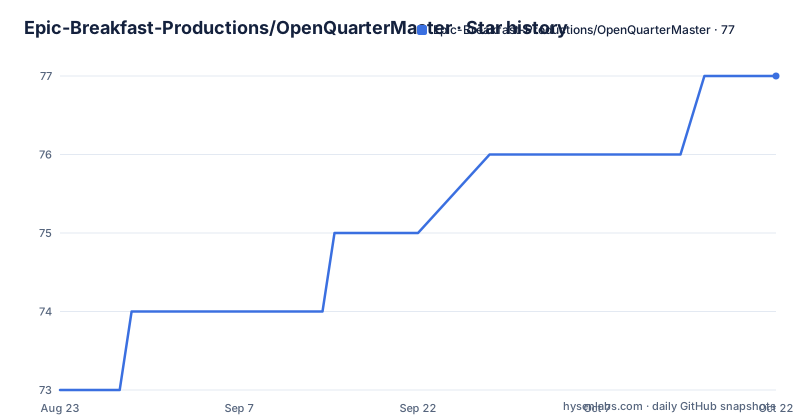
Star history
- Epic-Breakfast-Productions/OpenQuarterMaster77 ★ · +4
| Repository | 2026-08-23 | 2026-10-22 |
|---|---|---|
| Epic-Breakfast-Productions/OpenQuarterMaster | 73 | 77 |
4 Stars in the last 60 days, measured from the daily GitHub snapshot. Compare with other projects
Editorial analysis
What Open QuarterMaster Actually Solves
Open QuarterMaster (OQM) is an inventory management system for people who are tired of tools that either do too little or lock data in a proprietary cloud. The README frames it as 'the last inventory management system you will ever need,' which is a bold promise. What it really solves is the gap between a simple spreadsheet and a heavyweight ERP. It tracks what is stored where, and facts about what is stored, through a generic Core API. The intended audience is individuals or small organizations that want to run their own system on hardware they control, from a Raspberry Pi to a cloud VM. The project is explicit about privacy: the software does not phone home, with one exception for the Station Captain component that checks the Git repository for updates. That is a concrete stance, and it is rare in commercial inventory tools.
The Modular Architecture: Core API, Base Station, Plugins
The design is straightforward. The Core API is the central hub. It handles generic inventory tasks: what is stored where, and facts about stored items. The Base Station is the frontend for the Core API, giving users direct access to inventory. Plugins extend functionality for specific use cases. The README lists examples like smart refrigerator integrations, physical storage medium interaction, point of sale systems, and workflow management. The plugin idea is the heart of the project's flexibility. The phrase 'all the hooks' in the tagline is not just marketing. The system is designed so you can create your own plugins. This is a different approach from monolithic inventory systems where you are stuck with the feature set the vendor provides. The cost is that the core is intentionally generic, so out of the box it may not do anything beyond basic tracking.
Deployment: Containers and the Single Host Path
The README emphasizes that OQM is at home on the cloud or on a Raspberry Pi. That flexibility comes from containerization. Each software component is segmented, which means you run multiple containers rather than one monolithic service. The quick start is the Single Host Deployment guide, located in the deployment/Single Host directory. The documentation site is at docs.openquartermaster.com, and there is a public demo at openquartermaster.com/public/demo. The deployment directory shows there are multiple ways to deploy, but the README does not give explicit commands. You would need to follow the Single Host guide for the exact steps. The container-based approach is sensible for isolation, but it also means more moving parts. If you are not comfortable with Docker or similar tooling, the learning curve is steeper than a single binary.
Getting It Running: What the Material Shows
The README does not include a quick install command. It points to the Single Host Deployment guide, which is a file in the repository. The releases are named like core-base+station-1.21.0 and manager-station+captain-2.12.3, which suggests a versioning scheme that combines components. The plugin releases are separate, such as plugin-ext+item+search-2.1.1. This indicates that you install the core and then add plugins as needed. The documentation site is the authoritative source for setup. Without running it, I cannot confirm the exact commands, but the structure implies a Docker Compose setup for the core and station, with plugins added as separate containers or services. The active development status is clear from the release dates in August 2026. If you adopt this, expect to check the docs regularly for changes.
Privacy and the Station Captain Exception
The privacy section is a highlight. The README states that none of the included software phones home, with the brief exception of Station Captain, which looks to the Git repository for installations and updates. That is a specific and honest admission. It also mentions optional instance registration, which is voluntary. This is a meaningful differentiator for users who care about data sovereignty. However, the exception is worth noting: if you run Station Captain, it will contact GitHub. If your threat model requires zero external connections, you need to account for that. The README does not explain how to disable that check or whether it is configurable. That is a gap in the documentation that a potential adopter should investigate.
Limitations and Where It Might Be the Wrong Tool
The project is in active development, which is both a strength and a risk. The README says 'we are very much in active development, so check back often.' That means APIs can change, plugins can break, and documentation may lag. For a production environment where inventory accuracy is critical, this is a serious concern. The plugin ecosystem is not mature; the README lists only two plugins in the CI status: External Item Search and Storagotchi. There is no point of sale plugin or workflow plugin yet, despite those being named as examples. So if you need those features today, OQM is not ready. Also, the system is designed for generic inventory tasks. If you need complex lot tracking, batch expiration, or multi-warehouse routing, you may find the core too simple. The modularity means you have to build those features yourself or wait for plugins.
Alternatives: What Else Is Out There
The obvious alternative is a self-hosted inventory system like Odoo or ERPNext. Odoo is a full ERP with inventory modules, but it is monolithic and heavier to run. ERPNext is also a full ERP with a different data model, and it has a larger community. The difference in approach is that OQM separates the core inventory logic from the frontend and plugins, whereas ERPNext is a single application with built-in modules. Another alternative is a simpler tool like Inventree, which is also open source and focused on inventory and parts management. Inventree has a more traditional plugin system and a longer history. The key difference is that OQM's plugin architecture is more granular, allowing you to replace or extend individual components, but at the cost of a smaller ecosystem. If you need a proven system, these alternatives have more mature codebases.
Maintenance, Upgrades, and License Implications
The license is GPL-3.0, which means if you modify the software and distribute it, you must share your changes under the same license. For internal use, this is not a problem. If you build a proprietary plugin, the GPL may or may not require you to release it, depending on how you link to the core. This is not legal advice, but it is a consideration. The release cadence is active, with multiple releases in August 2026. Upgrading is likely to involve pulling new container images and possibly migrating data. The README does not describe an upgrade path, so you should assume manual steps. The project accepts contributions, and there is a Discord and Discussions for support. The maintenance cost is on you: you need to watch for updates, test them, and handle any breaking changes. The modular design helps isolate failures, but it also means you have to manage multiple components.
Editorial conclusion
Adopt Open QuarterMaster if you are a self-hoster who wants a modular, extensible inventory system and is willing to accept active development churn. Avoid it if you need a stable, production-grade system with a mature plugin ecosystem. Before adopting, verify the current state of the Core API and Base Station releases, test the Single Host Deployment path, and confirm that the plugins you need exist or that you can write your own.
Frequently asked questions
What does Open QuarterMaster do?
It is an open source inventory management system. The Core API handles the generic tasks, meaning what is stored where and the facts about what is stored, the Base Station gives you a navigable frontend for that inventory, and plugins add specific capabilities such as Smart Refrigerator integrations, Point of Sale Systems or workflow management.
Does Open QuarterMaster send my inventory data anywhere?
None of the software phones home at all, with one brief exception: Station Captain, which looks to the Git repository for installations and updates. On a simple setup on your own hardware your data stays with you, and the only other case is the voluntary, optional instance registration.
What does it take to run Open QuarterMaster?
Containers segmenting each software component, which is what lets the system run in the cloud or on something as small as a Raspberry Pi. The quick start for your own computer is the Single Host Deployment guide, and the deployment directory covers the other ways to host it.
Which plugins ship with Open QuarterMaster?
Two are present in the tree under software/plugins, External Item Search and Storagatchi. The README describes plugins as the place for specific cases such as Smart Refrigerator integrations, systems for interacting with physical storage mediums, Point of Sale Systems and workflow management, and invites you to write your own.
How is Open QuarterMaster versioned and licensed?
Services that deploy together share a version written with a plus sign, as in core-base+station-1.21.3 and manager-station+captain-2.13.1, while core-api-6.5.0 versions on its own. Those three releases were published on 28 September 2026, the last push is 29 September 2026, and the licence is GPL-3.0.
Official sources
Add this badge to your README
If you maintain this project, the badge below links readers to this analysis and shows its maintenance status from the daily GitHub snapshot. Paste the markdown into your README; add ?metric=license or ?metric=stars to the image URL for a different field.

[](https://hysenlabs.com/projects/epic-breakfast-productions-openquartermaster)Star history chart for your README
[](https://hysenlabs.com/projects/epic-breakfast-productions-openquartermaster)