im-not-ai: A Claude skill that strips Korean AI tells without touching the content
A Claude skill that humanizes AI-written Korean text: detects and rewrites translationese, mechanical parallelism and 71 other AI tells.
At a glance
- What is it?
- im-not-ai is a Korean-language humanizer packaged as a Claude Code skill. It detects 85 translationese and AI-typical sub-patterns, routes text through one of three pipelines based on a pre-score, and enforces a change-rate gate to prevent over-editing.
- Who is it for?
- Adopt im-not-ai if you write or edit Korean with Claude Code, Copilot CLI, Codex CLI, or Gemini CLI and need to remove AI-typical phrasing without altering facts or numbers. Skip it if you work primarily in English or other languages.
- Can I use it commercially?
- Yes. MIT is a permissive licence: you can use, modify and sell software built on it, as long as you keep its copyright and licence notices.
- Is it still maintained?
- Yes. The repository received new commits within the last day.
- What is it written in?
- Mainly Python, according to GitHub's language statistics.
Answers come from the project's GitHub data, last synced on November 15, 2026, and from our analysis. They are not legal advice.
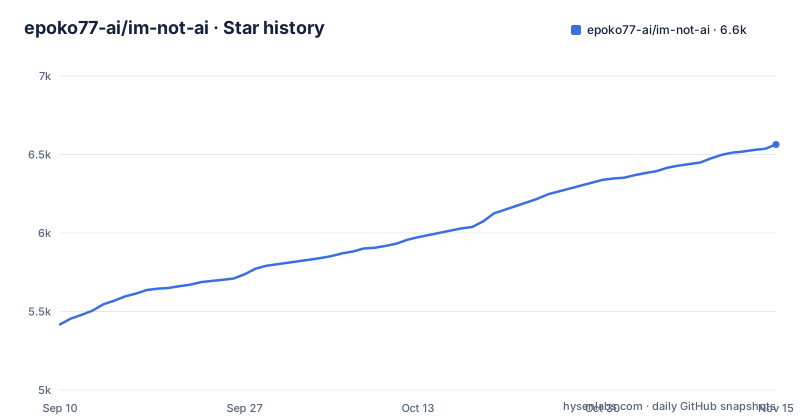
Star history
- epoko77-ai/im-not-ai6,564 ★ · +1,146
| Repository | 2026-09-10 | 2026-11-15 |
|---|---|---|
| epoko77-ai/im-not-ai | 5.4k | 6.6k |
1,146 Stars in the last 66 days, measured from the daily GitHub snapshot. Compare with other projects
Editorial analysis
What problem it solves and who it is for
Korean text produced by ChatGPT, Claude, or Gemini carries recognizable tells: translationese like "~를 통해" and "~에 있어서", mechanical parallelism with "첫째/둘째/셋째", AI idioms such as "결론적으로" and "시사하는 바가 크다", overuse of passive voice, and excessive bullet points or emoji. im-not-ai is a Claude skill that detects these patterns and rewrites the style while leaving the content untouched. It targets Korean specifically because, as the README argues, English-oriented humanizers like QuillBot or Undetectable AI handle Korean poorly, and most Korean AI tells come from English translationese. The intended users are writers and engineers who draft in Korean with an agentic CLI and want the output to read like a human wrote it, not like a machine translated it.
The taxonomy: 10 categories and 70 sub-patterns
The detection system is organized into 10 major categories labeled A through J. Category A covers translationese, including double passive forms like "~되어진다" and the obsessive use of "그/그녀" (sub-pattern A-16). B is excessive English quotation and terminology. C includes structural AI patterns like mechanical enumeration and excessive bullets. D lists AI idioms such as "결론적으로" and "혁신적인". E covers rhythm uniformity, including low sentence-length standard deviation and listener honorific inconsistency. F is modifier redundancy, G is hedging overuse, H is conjunction spam at sentence starts, I is excessive formal nouns like "것이다" and "점", and J is visual decoration overuse such as bold and dashes. In total there are 85 sub-patterns, including one held for verification. Each pattern carries a severity: S1 means definitive AI tell and must be removed, S2 allows one or two occurrences, and S3 only matters in combination with other patterns. The full list and prescriptions live in the references files ai-tell-taxonomy.md and rewriting-playbook.md.
The route_hint architecture: three pipelines, not one
The core design decision is a pre-processing script, prepare_monolith_input.py, that quantitatively scores the input text using KatFish and post-editese metrics, then deterministically outputs a route_hint of light, standard, or heavy. Light uses a single LLM call and skips diagnosis and finalize; if there is almost nothing to fix it exits early with "이미 좋습니다" (already good). Standard uses two calls: one diagnostic call to identify dominant patterns, then one targeted rewriting call. Heavy uses three or more calls, including a finalizer that compares the output against the original for meaning preservation. The user can override the route with flags: --strict or "정밀 모드" forces heavy, "가볍게" forces light. The README claims a measured result where a 10,000-character text processed with chunking into 7 calls consumed 610K tokens, while a single call consumed 134K, a 4.5x reduction with equal quality. That is why chunking is heavy-only and not recommended below 15,000 characters.
The four rules and the change-rate gate
im-not-ai operates under four stated principles: meaning invariance, evidence-based editing, genre preservation, and no over-editing. The meaning invariance rule says facts, claims, numbers, proper nouns, and direct quotes are preserved 100%. The evidence-based rule means only detected spans are modified; untouched sections stay as they are. Genre preservation prevents turning a column into literature or a report into an essay. The over-editing rule is enforced by verify_gates.py, which runs on every route and checks the change rate; verify_change_rate.py is kept only for backward compatibility. If the change rate exceeds 30%, the script warns; if it exceeds 50%, it forces a stop. This is a concrete guardrail against the common failure of aggressive humanizers that rewrite everything and lose the author's voice. The quality grades A through D are tied to this gate: grade C triggers a second pass if over-editing signals appear, and grade D demands human review.
Installation and usage across CLIs
The repository supports Claude Code, GitHub Copilot CLI, OpenAI Codex CLI, and Gemini CLI. The recommended path for Copilot is the plugin marketplace: add the repo with copilot plugin marketplace add epoko77-ai/im-not-ai, then install with copilot plugin install humanize-korean@im-not-ai. Claude Code uses slash commands: /plugin marketplace add, then /plugin install. There is also a clone-and-script method for Claude Code and Codex: git clone, then run ./install.sh, which auto-detects installed claude or codex and creates global symlinks. The install script supports --claude-only and --codex-only flags. Updates come from ./update.sh or /plugin update. The README warns that Copilot provides only a single-call path, while Codex also provides the full light, standard and heavy routes. The Gemini extension uses a separate rulebook of 47 patterns, without the 85-pattern taxonomy or route_hint. The project also includes a separate command, korean-ai-tell-taxonomist, for managing the taxonomy and approving new patterns.
Where it is the wrong tool
The most obvious gap is language: this is Korean-only. The pattern taxonomy is built from Korean translationese and honorifics, so it has no value for English or other languages. The second limitation is the dependence on the calling CLI. If you use Copilot, you get only the single-call route, which means no diagnosis and no finalize step. For a heavily AI-slopped text that route may not catch everything, and the README does not claim it does. The third issue is cost transparency. The README gives token numbers for one measured case, but there is no guarantee of quality equivalence across models, and the user must pick the model. It is a skill that runs inside a specific agentic CLI. If you do not use those CLIs, im-not-ai is not directly usable.
A real alternative: generic rewriting prompts
The alternative is not another Korean humanizer; it is writing your own rewriting prompt for a general LLM. Many users already do this: they paste text into ChatGPT or Claude and say "make this sound more human." That approach has no taxonomy, no severity levels, and no change-rate gate. It relies on the model's implicit knowledge of what AI text looks like, which is inconsistent and often results in either minimal changes or full rewrites that alter meaning. im-not-ai's difference is the explicit, documented pattern list and the deterministic pre-scoring. The trade-off is that im-not-ai constrains the pipeline to fixed routes, while a custom prompt can be adapted on the fly. For a one-off text, a prompt is cheaper and requires no installation. For repeated Korean writing, the taxonomy and the over-editing guardrail give im-not-ai an edge that a prompt cannot match.
Maintenance, licensing, and upgrade cost
The repository is under the MIT license, which permits commercial use, modification, and redistribution with attribution. The project is actively maintained, with releases in July and August 2026 addressing plugin skill location and path resolution. The update script and the plugin update command make upgrades straightforward. However, the maintenance cost is not zero. The taxonomy is an external SSOT that must be kept in sync with the skill's references. The README mentions a hold pattern awaiting verification, which implies ongoing curation. The retired agents from v2.1 and the development-only agents in agents/ mean the repository contains more than the runtime skill, and a user who clones it must distinguish between what runs and what is historical. For a team, the real cost is learning the taxonomy and trusting the severity levels, which requires reading the reference files before relying on the output.
Editorial conclusion
Adopt im-not-ai if you write or edit Korean with Claude Code, Copilot CLI, Codex CLI, or Gemini CLI and need to remove AI-typical phrasing without altering facts or numbers. Skip it if you work primarily in English or other languages. Verify first that your CLI supports the plugin marketplace path, or that install.sh detects your installed tools. Confirm the change-rate gate behavior and the exact severity thresholds in the taxonomy files before trusting it on sensitive content.
Frequently asked questions
What does im-not-ai do with Korean text?
It rewrites Korean text produced by AI so that the style, rhythm and phrasing read naturally, while stating that the content is not touched at all. Detected spans are classified by severity across 10 major categories and 85 sub-patterns, and only detected spans are edited.
Which runtimes does im-not-ai support?
Claude Code, GitHub Copilot CLI, OpenAI Codex CLI and Gemini CLI. Gemini CLI 0.14.0 or later is required for the remote Gemini install.
How many AI tells does im-not-ai detect?
The readme states 10 major categories and 85 sub-patterns, including one still awaiting verification, while the repository description advertises 71 other tells. The two counts in the repository do not agree, and the readme gives the fuller breakdown by category, lettered A through J.
How does im-not-ai decide how much rewriting a document needs?
A shim scores the input quantitatively against a dictionary of indicators and derives a route hint deterministically. Light means one call, standard means a diagnostic call followed by a targeted rewrite, and heavy means diagnosis, rewrite and finalize, with the route also forced for documents over 15,000 characters. A user can override the hint, and a scoring failure degrades to standard rather than stopping.
How does im-not-ai stop itself from rewriting too much?
The change rate is measured, with a warning above 30 percent and a forced abort above 50 percent. The final verdict comes from verify_gates.py, which runs on every route, while verify_change_rate.py is kept only for backward compatibility with existing integrations. Output is then graded A through D by severity counts, with grade D routed to human review.
Official sources
Add this badge to your README
If you maintain this project, the badge below links readers to this analysis and shows its maintenance status from the daily GitHub snapshot. Paste the markdown into your README; add ?metric=license or ?metric=stars to the image URL for a different field.

[](https://hysenlabs.com/projects/epoko77-ai-im-not-ai)Star history chart for your README
[](https://hysenlabs.com/projects/epoko77-ai-im-not-ai)Was this useful?