Crypto Market Data: A Free JSON Dataset for Bitcoin On-Chain and Derivatives Research
📈 Free crypto market data (worth $500+/mo) for ML & research. Star ⭐ to keep it free!
At a glance
- What is it?
- This project offers free, daily Bitcoin and stablecoin market data in JSON format, aimed at ML training and trading signal analysis. The dataset is useful but limited to daily granularity and lacks a formal license.
- Who is it for?
- Adopt this project if you need a free, ready-to-use JSON source of daily Bitcoin on-chain and derivatives metrics for ML research or backtesting, and you can accept the absence of a formal license. Avoid it if you require intraday data, broader coin coverage, or a legally clear open-source license.
- Can I use it commercially?
- Check first. The repository uses a licence we do not classify automatically, so read its LICENSE file before any commercial use.
- Is it still maintained?
- Yes. The repository received new commits within the last day.
- What is it written in?
- GitHub does not report a main language for this repository.
Answers come from the project's GitHub data, last synced on October 22, 2026, and from our analysis. They are not legal advice.
Star history
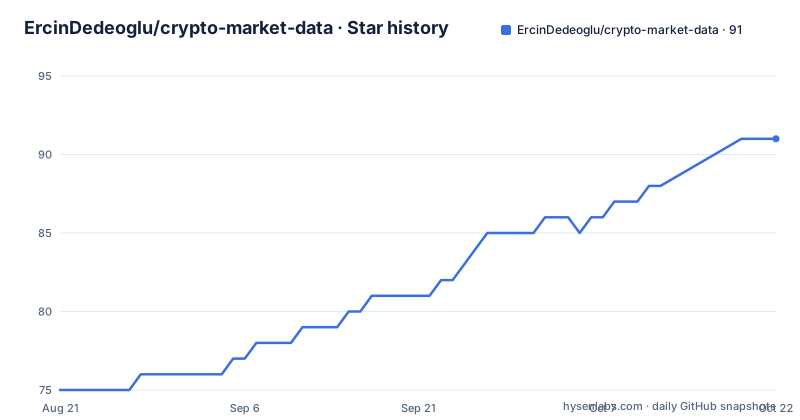
- ErcinDedeoglu/crypto-market-data91 ★ · +16
| Repository | 2026-08-21 | 2026-10-22 |
|---|---|---|
| ErcinDedeoglu/crypto-market-data | 75 | 91 |
16 Stars in the last 62 days, measured from the daily GitHub snapshot. Compare with other projects
Editorial analysis
What This Dataset Actually Provides
The repository is a collection of JSON files under data/daily/, each containing a single time series for a specific Bitcoin or stablecoin metric. The README lists 28 datasets, covering exchange netflows, whale ratios, miner metrics, funding rates, open interest, liquidations, MVRV ratio, and premium indices like the Coinbase Premium Index. The target user is someone building ML models or trading signals who needs historical data without paying for a commercial feed. The README emphasizes that comparable data would cost $500 to $2000+ per month from providers, but it does not name those providers or show a price comparison. The data is designed for research, not for production trading systems, given the daily granularity and the lack of real-time updates.
The JSON Schema and Its Metadata
Each file follows a consistent schema. There is a top-level metadata block with fields like name, description, data_type, update_frequency, category, trading_signal, and granularity. Then there is a data array of objects, each with a timestamp in milliseconds, a value, and a last_modified timestamp. The metadata includes first_data_date and last_data_date, also in Unix milliseconds. This structure is practical for programmatic ingestion: you can parse the JSON, check the granularity, and load the time series directly. The trading_signal field is a notable addition, giving a plain-language interpretation guide for each metric. For example, a whale ratio might explain that a high value suggests large holders are moving coins to exchanges, which could signal selling pressure. This is useful for researchers who are not domain experts, though the guidance is generic and not validated.
Getting the Data: No Installation Required
There is no code to install, no API key, and no build step. You clone the repository or download individual JSON files directly from GitHub. The README gives no command examples, but standard git usage applies: git clone https://github.com/ErcinDedeoglu/crypto-market-data.git. After cloning, you can load any file with any JSON parser. For Python, a typical approach would be: import json; with open('data/daily/btc_funding_rates.json') as f: data = json.load(f). The update frequency is stated in each file's metadata, but the README says data is daily, so you should expect one data point per day. There is no documented API for accessing the data programmatically beyond raw file access, which is a limitation if you want automated updates.
Data Freshness and Update Mechanism
The README states the project is automated, but it does not explain the update pipeline. The metadata includes last_added_date and last_modified_date, both as Unix timestamps, which lets you check how recent the data is. The example in the README shows a last_modified_date of 1733184000, which corresponds to December 2024. This suggests the data may not be updated continuously. For ML research, stale data can be a problem if you are training on recent patterns. The repository has no release tags, so there is no versioning to track changes. You must rely on the file-level timestamps. If the automation stops, you will not know until you check the last_modified_date. This is a real operational risk for anyone planning to use this as a live data source.
Limitations: Daily Granularity and Bitcoin Focus
The most obvious limitation is the granularity. All files are under data/daily/, and the granularity field in the metadata says daily. That means no intraday patterns, no hourly funding rate changes, and no minute-level liquidation data. For many trading strategies, daily data is too coarse. The README mentions hourly and minute granularities in the field description, but no such files are listed. The dataset is also Bitcoin-centric, with a few stablecoin metrics. There is no Ethereum, no altcoins, and no DeFi data. If your research requires cross-asset signals, this project will not cover it. The README says the data is 'high-quality', but there is no documentation on the source or methodology, so you cannot verify accuracy or bias. This is a significant caveat for any scientific use.
License and Maintenance Concerns
The repository's license is marked as NOASSERTION, meaning there is no recognized open-source license. The README includes a link to a LICENSE file, but the license type is not specified. This is a legal grey area: you can read the data, but you have no explicit rights to redistribute, modify, or use it commercially. For a data project, this is a serious issue. The README asks for stars and watches to keep the project free, which suggests the maintainer relies on community support, but it does not guarantee long-term maintenance. There are no recent releases listed, and the last push date is unknown. You should treat this as an unmaintained or sporadically updated project. If you plan to use the data in a product, you need to contact the maintainer for permission or find a licensed alternative.
Alternatives and the Real Difference
Commercial providers like Glassnode or CryptoQuant offer similar on-chain metrics, but they charge monthly fees and provide APIs with real-time or hourly data. The key difference is that those services have documented methodologies, historical data going back further, and legal terms of use. For a free alternative, you could use public APIs from exchanges like Binance or Coinbase for funding rates and open interest, but those are raw and not aggregated into on-chain metrics like MVRV or whale ratios. Another open-source option is the CoinGecko API for market data, but it does not provide on-chain metrics. The difference is that this project gives you pre-computed, curated metrics in a consistent format, saving you the work of aggregating raw data. But you sacrifice freshness, breadth, and legal clarity.
Who Should Use This and What to Verify
This dataset is best suited for researchers who need a quick, free source of daily Bitcoin metrics for exploratory analysis or model prototyping. It is not suitable for production systems or for anyone who needs reliable, up-to-date data. Before adopting it, verify the data against a known source for a few dates, check the last_modified_date in each file, and confirm that the repository is still being updated. Also, decide how you will handle the lack of a license. If you are publishing results, you must document the data source and its limitations. The project's simplicity is its strength, but that simplicity comes with trade-offs in data freshness and legal usability.
Editorial conclusion
Adopt this project if you need a free, ready-to-use JSON source of daily Bitcoin on-chain and derivatives metrics for ML research or backtesting, and you can accept the absence of a formal license. Avoid it if you require intraday data, broader coin coverage, or a legally clear open-source license. Before using it, verify the data's accuracy by comparing it with a commercial source, check the last_modified_date to confirm freshness, and confirm that the repo is actively maintained. The project's value lies in its convenience, not its completeness.
Frequently asked questions
What does the crypto-market-data repository contain?
Twenty-nine JSON files under data/daily, grouped as supply and demand, miners, derivatives and sentiment, valuation, liquidity and context, and institutional versus retail. Every file is a btc_ or stablecoin_ series; no other chain appears in the list.
How often is the crypto-market-data updated?
The published layout is a daily directory with one data point per day. Each file also carries granularity and update_frequency fields whose documented values include hourly, minute and real-time, but no dataset at those resolutions is listed.
Where do I get the USD version of a crypto-market-data metric?
Four metrics ship twice, with the dollar series in its own file: btc_exchange_reserve_usd.json, btc_exchange_stablecoins_ratio_usd.json, btc_long_liquidations_usd.json and btc_short_liquidations_usd.json. Pairing them with the non-USD files means matching on timestamp yourself.
Is there code in the crypto-market-data repository?
No collection code is present. The top level holds .github/, LICENSE, README.md and data/, and the page describes automated collection without shipping a script, workflow or configuration that does it.
Can I pin a version of the crypto-market-data files?
There are no GitHub releases and no version field inside the data, so a consumer has to record a commit hash. The field table also documents last_added_date and last_modified_date as milliseconds while the example shows ten-digit values, so confirm the units against a real file.
Official sources
Add this badge to your README
If you maintain this project, the badge below links readers to this analysis and shows its maintenance status from the daily GitHub snapshot. Paste the markdown into your README; add ?metric=license or ?metric=stars to the image URL for a different field.

[](https://hysenlabs.com/projects/ercindedeoglu-crypto-market-data)Star history chart for your README
[](https://hysenlabs.com/projects/ercindedeoglu-crypto-market-data)