seq2seq for Keras: A Look at a Pre-Attention Era Toolkit
GitHub describes it as Sequence to Sequence Learning with Keras. The repository metadata lists Python as its primary language. The metadata lists the GPL-2.0 license. This article stays within the project description and details documented in the GitHub repository README.
At a glance
- What is it?
- This review examines farizrahman4u/seq2seq, a Keras add-on for building sequence-to-sequence models, and assesses its architecture, usability, and limitations for engineers considering it today.
- Who is it for?
- Adopt seq2seq if you need a lightweight, Keras-native way to prototype classic encoder-decoder architectures for small-scale experiments or educational use, and you are comfortable with the GPL-2.0 license and legacy dependencies. Do not use it for production systems or new large-scale projects, where modern frameworks like TensorFlow's built-in attention layers or Hugging Face Transformers offer maintained code and better performance.
- Can I use it commercially?
- Yes, with conditions. GPL-2.0 is a copyleft licence: if you distribute software that includes it, you must release that software's source code under the same licence. Running it internally without distributing it does not trigger that obligation.
- Is it still maintained?
- Probably not. The repository last received commits 50 months ago, on August 20, 2022.
- What is it written in?
- Mainly Python, according to GitHub's language statistics.
Answers come from the project's GitHub data, last synced on October 21, 2026, and from our analysis. They are not legal advice.
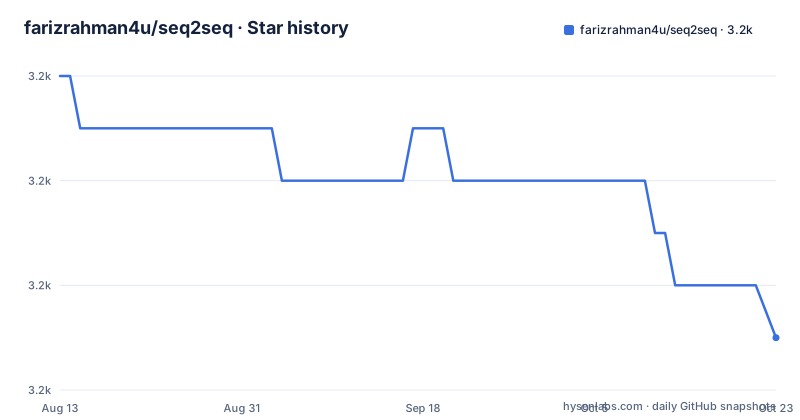
Star history
- farizrahman4u/seq2seq3,166 ★ · -4
| Repository | 2026-08-13 | 2026-10-21 |
|---|---|---|
| farizrahman4u/seq2seq | 3.2k | 3.2k |
-4 Stars in the last 69 days, measured from the daily GitHub snapshot. Compare with other projects
Editorial analysis
The Problem It Solves and Who It Serves
seq2seq addresses a specific gap in the early Keras ecosystem: the lack of modular, reusable components for sequence-to-sequence learning. In 2016, when this library was written, Keras had LSTM layers but no built-in encoder-decoder scaffolding. Engineers building machine translation, chatbots, or text summarization had to assemble the entire architecture by hand. seq2seq provides that scaffolding as a Keras add-on, with layers and models that can be compiled directly or embedded in larger networks. The target user is a Python developer already using Keras who wants to experiment with seq2seq architectures without writing every recurrent connection from scratch. The README's examples are short and copy-paste friendly, which suggests the author intended it for rapid prototyping rather than production deployment.
How the Architecture Is Organized
The library's core idea is a two-part structure: an encoder and a decoder. The encoder reads an input sequence and compresses it into a context vector, which the decoder uses to generate an output sequence. The README explains that input and output lengths can differ, because there is no explicit one-to-one mapping. The framework also includes optional components: a left-stack of stacked LSTMs on the encoder side, a right-stack on the decoder side, resizers to match shapes between encoder and decoder, and dropout layers for regularization. The key design choice is that everything is built on Keras layers, so the models integrate with Keras's compilation and training workflow. The source code is described as heavily documented, which helps engineers who want to modify or extend the models.
Three Built-In Model Variants
The repository offers three ready-made models, each with a different level of complexity. SimpleSeq2Seq is the minimal version: it takes input_dim, hidden_dim, output_length, and output_dim, and you can set a depth parameter to make it deeper. The depth can be a tuple, like (4, 5), to give the encoder and decoder different layer counts. The second model, Seq2Seq, implements the original Sutskever et al. approach where the encoder's hidden state is transferred to the decoder, and the decoder's output at each timestep feeds into the next. This model requires a full input shape, including batch size, because it uses static hidden states similar to a stateful RNN. The README notes that this requirement was relaxed in later versions after switching to the Recurrent Shop backend. The third model, AttentionSeq2Seq, adds a soft alignment mechanism between input and output, based on Bahdanau et al. It uses a bidirectional LSTM encoder by default, and you can disable that with bidirectional=False. This variant does not require a batch dimension in the input shape, because it avoids static hidden states.
Getting It Running and a First Example
Installation is a single pip command: sudo pip install git+https://github.com/farizrahman4u/seq2seq.git. The README lists two requirements: Keras and Recurrent Shop, a companion library also by the same author. After installation, you build a model by importing from seq2seq.models and instantiating a class. For example, a minimal model is created with SimpleSeq2Seq(input_dim=5, hidden_dim=10, output_length=8, output_dim=8), then compiled with model.compile(loss='mse', optimizer='rmsprop'). The examples in the README use mean squared error as the loss, which is unusual for sequence generation tasks where categorical cross-entropy is more common, but it keeps the examples simple. The compile step is standard Keras, so training and evaluation follow the usual model.fit and model.predict patterns, though the README does not show those calls.
Where the Documentation Falls Short
The README is enthusiastic but thin on operational details. It shows how to instantiate models, but it never shows a complete training loop with actual data. There is a reference to an external working example for training with movie subtitles, but that is a third-party repository. The README also does not explain how to handle padding, masking, or variable-length sequences, which are critical in real seq2seq tasks. The loss function in the examples, mse, is a red flag for language modeling, because it treats outputs as continuous values rather than categorical distributions. An engineer following the examples literally would likely get poor results on text data. The documentation also assumes familiarity with the cited papers, which is fine for researchers but a barrier for practitioners. The lack of an API reference or detailed argument list means you have to read the source code to understand options like broadcast_state and inner_broadcast_state, which are mentioned but not explained.
Limitations and When It Is the Wrong Tool
The most obvious limitation is age. The library targets Keras from around 2016, and the deep learning ecosystem has moved on. Modern Keras versions may not be compatible with Recurrent Shop, which is itself a niche dependency. The README's note that a full input shape was once required but later dropped suggests the code has undergone changes, but there is no release history or version pinning in the material. The GPL-2.0 license is another constraint: if you plan to use this in a proprietary product, the license may impose obligations, so you need to evaluate that carefully. For production use, this library is the wrong tool because it lacks features like beam search, attention variants beyond the basic one, and support for TPU or GPU performance optimization. It is also not suitable for very large datasets, because the implementation is built on Keras's eager-style graph and may not scale efficiently. The README's final words invite users to create issues for questions, but there is no mention of active maintenance, and the last push date is unknown, so you should assume it is unmaintained.
A Real Alternative: Modern Keras and TensorFlow
A modern alternative is to use TensorFlow's Keras API directly, which now includes built-in attention layers and the ability to define custom encoder-decoder models with relative ease. The difference in approach is that seq2seq provides pre-packaged models, whereas modern Keras gives you lower-level building blocks like tf.keras.layers.Attention and tf.keras.layers.AdditiveAttention, which you assemble yourself. That means more code to write, but you get full control and access to current optimizations, distributed training, and a maintained ecosystem. Another alternative is Hugging Face Transformers, which offers pre-trained seq2seq models like T5 and BART that are ready for fine-tuning. That library is focused on transformer architectures, not the recurrent models that seq2seq implements, so it is a different paradigm. If your goal is to replicate the original Sutskever or Bahdanau models for research, seq2seq might be a quick starting point, but for any new project, the modern frameworks are more practical.
Maintenance, Upgrade Cost, and License Implications
The repository shows no recent releases and no archived status, but the lack of a last push date and the general age of the code mean you should treat it as stale. Upgrading to newer Keras versions will likely require changes to the seq2seq code, because it depends on Recurrent Shop, which may not have kept pace. The cost of maintaining this library in a project is high: you would need to patch compatibility issues yourself or fork it. The GPL-2.0 license is a significant factor. It is a copyleft license, which means derivative works may need to be released under the same license. That is fine for open-source projects, but it can be a problem for closed-source commercial software. The README does not discuss licensing, so you must read the license text yourself. No legal advice here, just a warning to check before adopting. The repository's documentation is sparse on contribution guidelines, but it does invite bug reports and new examples, so the project was open to community input, even if that community has likely moved on.
Editorial conclusion
Adopt seq2seq if you need a lightweight, Keras-native way to prototype classic encoder-decoder architectures for small-scale experiments or educational use, and you are comfortable with the GPL-2.0 license and legacy dependencies. Do not use it for production systems or new large-scale projects, where modern frameworks like TensorFlow's built-in attention layers or Hugging Face Transformers offer maintained code and better performance. Before adopting, verify that the Recurrent Shop backend still installs and works with your Keras version, and check the repository's issue tracker for unresolved compatibility problems.
Frequently asked questions
What is a seq2seq model?
A model built from two primary layers, an encoder and a decoder. The encoder turns the input sequence into an internal representation called a context vector, and the decoder uses that to generate the output sequence. Input and output lengths do not need to match.
What is this seq2seq library?
A sequence to sequence learning add-on for Keras, written in Python and licensed under GPL 2.0. It provides reusable layers as well as ready-made models that can be compiled directly or added as layers of a larger model.
Is seq2seq an encoder decoder architecture?
Yes. Every model in this library has an encoder and a decoder, with the encoder producing a context vector the decoder consumes. Optional pieces include left and right LSTM stacks, resizers for shape compatibility, and dropout layers.
Is seq2seq an RNN?
The models here are built on recurrent layers, with stacked LSTMs on the encoder and decoder sides and a bidirectional LSTM encoder in the attention variant. They also support a stateful argument for a persistent hidden state, in the manner of a stateful recurrent network.
Official sources
Add this badge to your README
If you maintain this project, the badge below links readers to this analysis and shows its maintenance status from the daily GitHub snapshot. Paste the markdown into your README; add ?metric=license or ?metric=stars to the image URL for a different field.

[](https://hysenlabs.com/projects/farizrahman4u-seq2seq)Star history chart for your README
[](https://hysenlabs.com/projects/farizrahman4u-seq2seq)Was this useful?