Formbricks: an AGPL survey platform whose self-hosted stack now includes SpiceDB, Valkey and an MCP endpoint
Open Source Qualtrics Alternative
At a glance
- What is it?
- Formbricks is an open source alternative to Qualtrics for in-app, website, link and email surveys, offered as a cloud service or self-hosted with Docker. The core is AGPLv3, but local development runs a seven-service stack, the MCP endpoint needs careful configuration, and outside code contributions are accepted only as an exception.
- Who is it for?
- Formbricks suits product teams that want targeted in-app and website surveys on infrastructure they control, and who are comfortable operating PostgreSQL, Valkey, SpiceDB and Docker alongside the app. It is a poor fit for anyone who wants a simple form builder with a single container, or who plans to contribute code upstream.
- Can I use it commercially?
- Check first. The repository uses a licence we do not classify automatically, so read its LICENSE file before any commercial use.
- Is it still maintained?
- Yes. The repository received new commits within the last day.
- What is it written in?
- Mainly TypeScript, according to GitHub's language statistics.
Answers come from the project's GitHub data, last synced on November 23, 2026, and from our analysis. They are not legal advice.
Star history
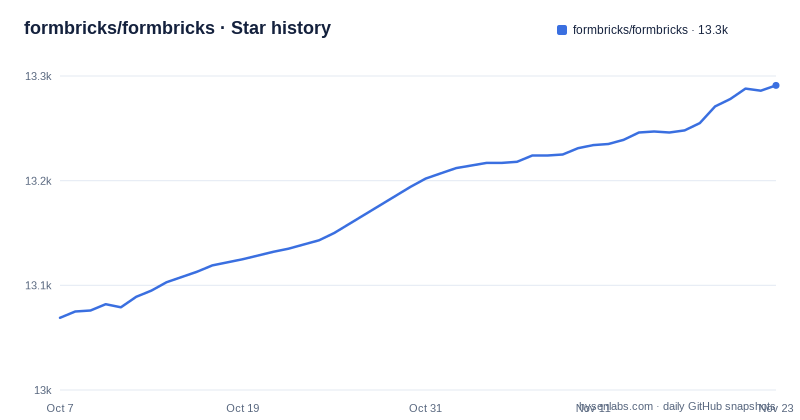
- formbricks/formbricks13,291 ★ · +222
| Repository | 2026-10-07 | 2026-11-23 |
|---|---|---|
| formbricks/formbricks | 13.1k | 13.3k |
222 Stars in the last 47 days, measured from the daily GitHub snapshot. Compare with other projects
Editorial analysis
Surveys are targeted at user groups without touching application code
Formbricks collects feedback through four channels: in-app surveys, website surveys, shareable link surveys and email surveys. Questions are built in a no-code editor with several question types and best-practice templates, and teammates from your organization can collaborate on the same survey. The distinctive part is targeting: you can launch a survey to a specific user group without changing your application code, which is what separates it from a plain form builder. Responses can flow on to Slack, Notion, Zapier, n8n and other integrations, or into Formbricks' own analysis features. The project positions itself as a privacy-first experience management platform and an open source alternative to Qualtrics, built with TypeScript, Next.js, React, TailwindCSS, Prisma and Zod, with Vitest for tests.
pnpm go starts a seven-service Docker stack before the app
Local development needs Node.js in the range set in package.json or the version pinned in .nvmrc, pnpm, and Docker. Setup is two commands:
pnpm installpnpm gopnpm go runs pnpm db:up first, which runs pnpm dev:setup and then docker compose -f docker-compose.dev.yml up -d. That step creates .env from .env.example when needed, generates the required local secrets and starts PostgreSQL, SpiceDB, MailHog, Valkey, RustFS, Hub and Cube. The app then answers on http://localhost:3000. The consequence is a heavy laptop footprint: you are running seven backing services before the first page loads, and pnpm db:down is the matching command to stop them. The repository is a Turborepo monorepo, with apps/ and packages/ driven by turbo.json and pnpm-workspace.yaml.
Permissions run through SpiceDB, which adds its own maintenance scripts
The authzed/ directory and a set of authzed scripts in package.json show that authorization is handled by SpiceDB rather than only by database tables. The root package.json carries authzed:backfill, authzed:outbox, authzed:perf, authzed:health and authzed:schema, each run through dotenv against .env with tsx and the apps/web tsconfig. For a self-hoster this is one more stateful service to keep healthy, with its own health check, schema and backfill commands that you have to know about and run. Teams that expected a single web app with one PostgreSQL database should account for SpiceDB in their backup and upgrade plans.
Three secrets and a build-time base path must be settled first
The mandatory block in .env.example sets WEBAPP_URL and BETTER_AUTH_URL, which should match. Three secrets are empty until you fill them: ENCRYPTION_KEY, BETTER_AUTH_SECRET, which signs session cookies and every invite, verification and email-change token, and CRON_SECRET for running cron jobs. Each comment suggests generating the value with openssl rand -hex 32. The encryption comment adds that you should set both keys for now and that this will change in the future, so expect the key layout to move in a later release. BASE_PATH, for serving Formbricks under a sub-path of a domain, can only be set at build time; moving an existing install to a sub-path means building again. Background jobs run on BullMQ workers, which require REDIS_URL. One detail worth noticing: the README's technology list names Auth.js, while the environment template configures Better Auth variables.
The MCP endpoint lets anyone register clients for allowed callbacks
Formbricks exposes an MCP endpoint secured with OAuth. claude.ai and ChatGPT are built-in redirect targets, and MCP_DCR_ALLOWED_REDIRECT_URIS adds extra exact https redirect URIs that MCP clients may register anonymously. The template is blunt about the risk: anyone can register a client with those URIs, so only add callbacks owned by the client's vendor. Treat that variable as a security setting, not a convenience list. A separate MCP_OAUTH_JWKS_URL lets the server verify tokens through an internal address such as http://formbricks:3000/api/auth/jwks when the runtime cannot reach its own public URL, while public issuer and redirect URLs stay unchanged.
The AGPL core is separate from an Enterprise Edition in the same repository
The Formbricks core is licensed AGPLv3 and includes what you need to design and run link, website and in-app surveys, free for personal and commercial use. You may distribute modified versions if you document your changes, including the date, and publish the modified version under AGPLv3 as well. The README then describes an Enterprise Edition kept in the same repository alongside the AGPL core, and GitHub's license detector does not report a single license for the project. The practical consequence: before building on Formbricks or offering a modified version, check which directories and features belong to the Enterprise Edition, because the README separates them from the AGPL core. Self-hosting itself needs no subscription; the deployment guide at formbricks.com/docs/self-hosting/deployment covers Docker.
Outside code contributions are accepted only as an exception
Formbricks is open source, but the contribution policy is narrow. The README asks people to star the repository, open issues and upvote existing ones with a thumbs-up so the team can prioritize the roadmap, and states that for the time being code contributions can only be facilitated as an exception. If you need a feature, expect to request it or maintain it in your own fork rather than land a pull request. Security reports go to [email protected]; there is no bug bounty or payment, though reporters can be credited in release notes on request. Release activity is frequent: 6.1.3 shipped on 2026-11-02, and 6.1.2 and 6.0.5 were cut on the same day, 2026-10-27, which shows two release lines receiving fixes in parallel. The last push was on 2026-11-02.
Editorial conclusion
Formbricks suits product teams that want targeted in-app and website surveys on infrastructure they control, and who are comfortable operating PostgreSQL, Valkey, SpiceDB and Docker alongside the app. It is a poor fit for anyone who wants a simple form builder with a single container, or who plans to contribute code upstream. Before self-hosting, read the self-hosting docs, set ENCRYPTION_KEY, BETTER_AUTH_SECRET and CRON_SECRET, decide on BASE_PATH before you build, and check which features fall under the Enterprise Edition rather than the AGPL core.
Frequently asked questions
what is formbricks
Formbricks is an open source survey and experience management platform positioned as a Qualtrics alternative. It runs in-app, website, link and email surveys, either in the Formbricks cloud or self-hosted with Docker.
is formbricks free
The AGPLv3 core is free for personal and commercial use and can be self-hosted with Docker without a subscription. The hosted cloud version has a free plan, and an Enterprise Edition exists alongside the core.
is formbricks open source
Yes. The Formbricks core application is licensed under AGPLv3, and modified versions must be published under AGPLv3 too. The README separately describes an Enterprise Edition in the same repository.
how to use formbricks
Sign up for the cloud version at app.formbricks.com or self-host with Docker following the self-hosting docs. For local development, run pnpm install and then pnpm go, and open http://localhost:3000.
Official sources
Where this project is recommended
Add this badge to your README
If you maintain this project, the badge below links readers to this analysis and shows its maintenance status from the daily GitHub snapshot. Paste the markdown into your README; add ?metric=license or ?metric=stars to the image URL for a different field.

[](https://hysenlabs.com/projects/formbricks-formbricks)Star history chart for your README
[](https://hysenlabs.com/projects/formbricks-formbricks)Was this useful?